 Clirik






Rechercher
raymond grinding mill relies on centrifugal rolling and dynamic airflow classification technology to crush non-metallic ores to 80 to 400 mesh fines. If your raymond mill pulverizer is still using the factory default settings of ten years ago, it is burning thousands of dollars in electricity bills every month. In 2026, factory managers must face a hard target: strict energy consumption standards force us to achieve extremely accurate airflow calibration and classifier dynamic tuning. Next, I will use the first-line engineering standards to teach you how to optimize the grinding circuit, squeeze tons of power consumption, and double the life of the core wear parts directly.
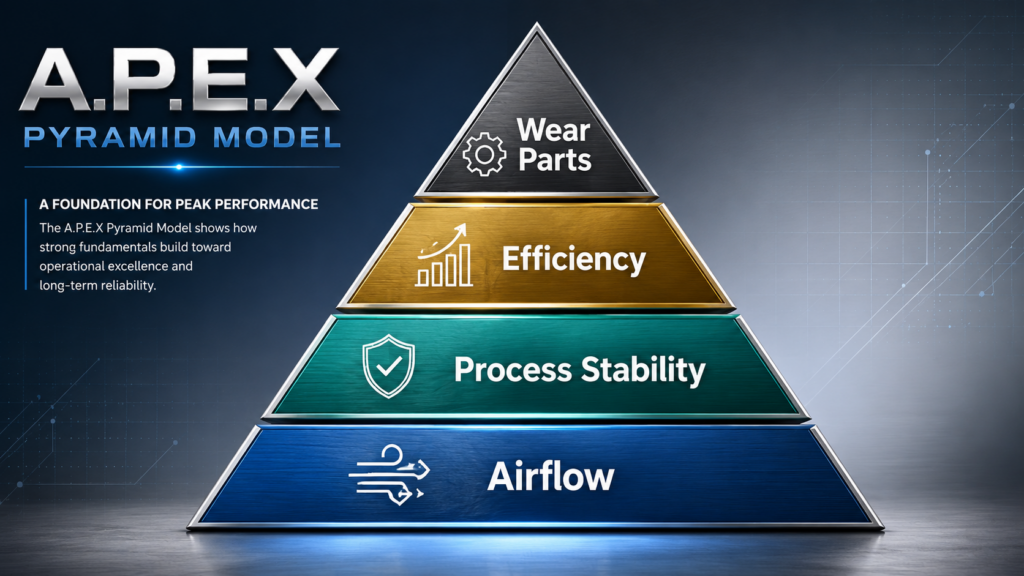
The A.P.E.X. model directly replaces empirical blind guesses with quantifiable production data. Resident engineers rely on this four-step framework to pinpoint the root causes of low output and high energy consumption. We break down grinding efficiency into four hard core dimensions: airflow dynamics (Airflow), particle classification (Particle), energy consumption control (Energy) and wear parts management (eXpendable).
The fan speed directly determines the final output. Insufficient air volume will cause the material to be crushed in the grinding chamber and cause high temperature dead circulation. Excessive air volume will force large particles of coarse powder through the classifier and pollute the finished product warehouse. The frequency converter (VFD) parameters of the main fan must be directly locked according to the specific gravity of the target ore.
The classifier speed controls the exact fineness mesh. High speed will force large particles back to the grinding zone. The operator must keep the classifier speed strictly synchronized with the fan air volume to maintain a stable system negative pressure. Once the two mismatch, 100% will lead to the discharge pipe completely blocked.
Tons of electricity consumption (kWh/Ton) determines your net profit. To let the equipment idling below the optimal feed rate is to waste basic electrical energy. The main motor load is bitten between 85% and 90% of the rated current, which is the only standard line for extracting the maximum economic benefits of the equipment.
The wear rate of the grinding ring and the grinding roller depends on the hardness of the ore and the centrifugal tension. The spring pressure must conform to the OEM specifications. Blindly increasing the pressure will not improve the fineness at all, but will directly lead to the cracking of the roller assembly and accelerate the metal fatigue.
The logic of modern raymond mill operation is very different from the equipment of ten years ago. The generation difference of hardware configuration directly determines the profitability of the plant.
Vibration sensors have long eliminated the traditional artificial listening position. Rely on the ears of workers to judge the internal load of the mill, the feed volume is always high and low. It is now necessary to install a vibration probe on the main bearing seat, and connect the real-time data directly to the PLC control cabinet. The automatic feeder follows up the data to realize millisecond adjustment, completely eliminating idling and suffocating shutdown of the machine.
The anti-wear performance of high-chromium cast iron grinding rollers thoroughly crushed traditional high-manganese steel. Processing barite this kind of high abrasive ore, ordinary grinding roller a few weeks will be scrapped. Direct replacement of high-chromium alloy accessories with a hardness of 65HRC, the average trouble-free running time (MTBF) of the equipment can be abruptly elongated by 45%.
Field engineers often take a detour in the mechanical fault diagnosis of the grinding circuit. Don’t make any more “headache” and immediately check the following 3 most basic setting mistakes.
A 5% air leak at the bottom of the cyclone collector will directly cause the finished product collection rate to plummet by 15%. When the output is 1 low, the operator habitually blames the fan, and the real culprit is that the outside air destroys the internal vacuum of the cyclone. Take advantage of downtime maintenance, immediately do a thorough smoke test (Smoke Test) on all flange joints and discharge valves, and seal every tiny air leakage point with industrial grade silica gel.
Increasing the spring pressure is not equal to the finer powder. Many operators try their best to tighten the grinding roller assembly in order to seize the output, which will only cause local fatigue of the grinding ring and severe vertical vibration. The tension is strictly set at the OEM specified value; If soft minerals such as gypsum or talc are processed, it will be further reduced by 2% on the basis of this value.
Feed materials with a moisture content of more than 6% into the machine, and the powder will immediately paste into a thick layer of mud paste on the grinding ring. Then, the grinding roller will slip on the material layer, completely losing the grinding ability. If your factory is located in a high humidity area, either dry the raw materials thoroughly before feeding, or install a hot air introduction system directly on the main fan circuit.
| Symptôme | Root Cause | 2026 Engineering Fix |
| Sudden 15% drop in finished product collection rate / Low output | Cyclone Vacuum Disruption: A tiny air leakage (as low as 5%) at the bottom of the cyclone collector destroys the internal vacuum (often misdiagnosed as a fan failure). | Zero-Leakage Protocol: Execute a comprehensive Smoke Test on all flange joints and discharge valves during downtime. Seal every micro-leak using industrial-grade silica gel. |
| Severe vertical vibration / Local fatigue of the grinding ring | Excessive Spring Pressure: Blindly over-tightening the grinding roller assembly in a misguided attempt to increase powder fineness or output. | OEM Calibration: Strictly set spring tension to the exact OEM specified value. Note: If processing soft minerals (e.g., gypsum or talc), reduce the tension by an additional 2% from the baseline. |
| Grinding rollers slip / Thick mud paste buildup on the grinding ring / Loss of grinding ability | Moisture Limit Violation: Feeding raw materials with a moisture content exceeding 6%, causing powder to paste onto the ring. | Moisture Control System: Thoroughly pre-dry raw materials before feeding, OR retrofit a hot air introduction system directly onto the main fan circuit (highly recommended for high-humidity areas). |
The data will expose the gap between a common mill and a top-fitting mill. A limestone processing plant with a daily output of 600 tons (TPD) recently carried out a comprehensive technical reform on their raymond grinding mill circuit, aiming at the energy consumption index of the collapse.
Original mess: Before the technical transformation, the plant’s electricity consumption was as high as 18 kWh/t, which was completely unsustainable. The fineness of the finished product fluctuates violently between 200 and 250 mesh.
Engineering intervention: We sealed all negative pressure air leakage points of the entire pipeline network and forced the inverter data of the classifier to bind with the fan output. Subsequently, the manual jaw breaking feeding system is removed and the automatic belt scale with vibration sensor is replaced.
Final data: The fineness of the finished product is immediately stable at 320 mesh. The power consumption per ton is permanently reduced to 14.2 kWh/t. With this parameter calibration alone, the plant has saved more than $40000 a year in electricity bills alone.
The particle size of raw materials must be strictly controlled within 30mm. Feeding oversized stones creates an extremely violent mechanical impact, directly smashing the blade and drastically cutting the kinetic energy that the grinding roller was originally used for grinding.
Every 8-hour production shift must be made with lithium-based high-temperature grease. Lack of oil bearing heat very fast, within a few hours will lock and completely destroy the suspension shaft.
raymond mill instantly produces 80 to 400 mesh powder by centrifugal extrusion and shear force. The ball mill relies on heavy steel balls to make a free fall to smash materials. It occupies an extremely large area, but it can meet the demand for super-large production capacity and can beat the powder to a very fine state below 500 mesh.
There are only 3 reasons for severe vibration: the feed is more and less, the grinding ring is worn with serious pits, and the anchor bolts are loose. Stop the machine immediately and focus on checking whether there is asymmetric wear on the suspension pin of the grinding roller.
Absolutely not. The Mohs hardness of the feed must be stuck below 7. Take it to grind quartz, granite or river sand, and within a few days all your grinding rollers and grinding rings will be scrapped.
The greater the airflow, the stronger the lift, which will force heavier and coarser particles to lift up, causing the fineness of the finished product to plummet. When the air volume is lowered, the time for the material to stay in the grinding zone will be lengthened, and the final number of powder will naturally be higher.
The high temperature will instantly evaporate the water inside the ore into water vapor, and the water vapor expansion will directly support the original negative pressure state of the explosion system. Water-cooled main bearings must be installed to prevent fatal mechanical deviation of the central drive shaft caused by thermal expansion and contraction.