 Clirik






Rechercher
What you really need is an air classification mill (ACM mill) that can not only keep the fineness of the powder below 10 microns, but also not waste the material due to heat, and also meet the latest energy efficiency standard in 2026. At present, the models that can dominate the market in 2026 are basically Hosokawa Alpine ZPS series, Netzsch CSM series and Prater CLM series. Why them? Because these head machines have long since eliminated the old belt drive, replaced with the most efficient direct drive motor, and also stuffed into the real-time particle size sensor. Many factory directors and engineers are still taking old drawings to buy grinding cavities that will be eliminated at any time and throwing millions into them in vain. Today, we will take apart the hard core. Which air grading mill is worthy of your production line? By the way, we will 1 pick up the purchasing traps of those special cheat people in the equipment contract, and finally directly put on the hard data of the field technological transformation.
If you still only stare at the horsepower of the motor when buying a mill, the end result will be a direct off the charts for electricity charges, and the thickness of the powder will be still a while. In order to help buyers avoid the pit, we got a set of P.A.T. evaluation iron triangle model. You directly take these 3 hard indicators to card: power conversion (Power), wind network fluid mechanics (Airflow) and heat control (Thermal).
In the business of grinding, the last thing to look at is the consumption of tons (SEC than energy consumption). The current high-end air grading mill has long stopped playing with the pulley set, and all come standard with a motor directly connected to the rotor spindle. You know, as long as the belt is turned, skidding and friction are added, 5% to 8% of the power will be lost in vain at the start. The advantage of direct drive is that it cuts off this part of internal friction across the board. If you buy a machine with a well-tuned ton consumption curve, you can reduce the cost of electricity per kilogram of powder.
The accuracy of particle size distribution (PSD) depends on the stability of the airflow vortex in the grinding chamber. At present, the head manufacturers all use CFD (computational fluid dynamics) to carve their powder selection wheels in order to prevent the coarse particles that want to “muddle through. If the aerodynamics of the powder selection wheel is not done well, turbulence (random air flow) will be generated in the grinding chamber, resulting in unqualified coarse particles leaking directly from the discharge port. Therefore, before signing the contract, manufacturers must be forced to take out their CFD airflow model diagram.
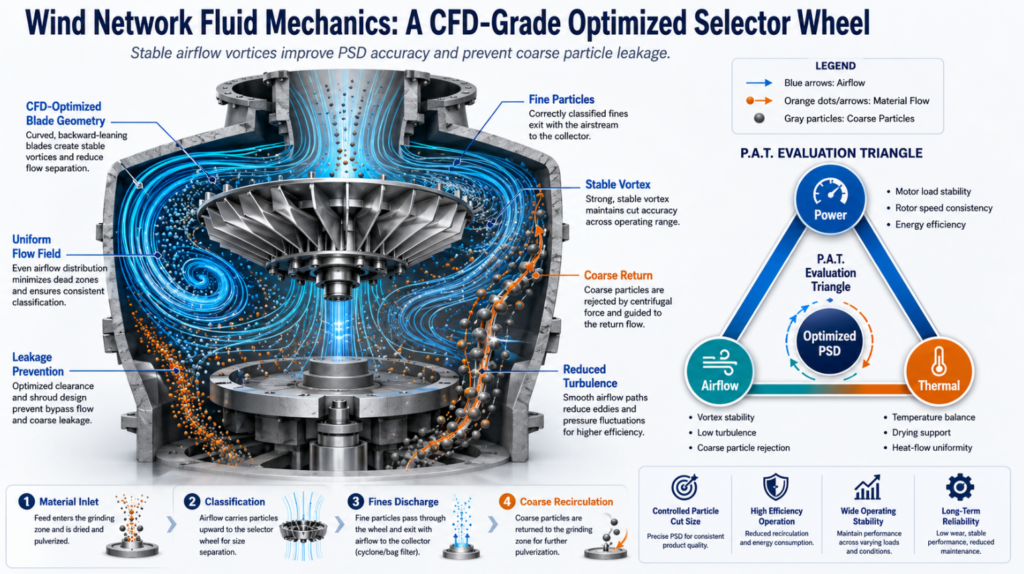
To deal with heat-sensitive materials such as powder coatings, resins or high-value pharmaceutical API, high temperature is a waste manufacturing machine. The high-speed collision of particles in the grinding chamber will generate extremely high adiabatic heat. How does a really good machine work? Direct air intake system with large air volume and water-cooled jacket casing. If you don’t take cooling seriously when buying equipment, your materials will melt directly in the machine and finally paste the whole pneumatic conveying pipeline to death. The picture is simply a disaster.
According to the real production, downtime maintenance time and energy efficiency ratio, we have found out the current mainstream market. The following are several echelons divided according to their core combat effectiveness.
Hosokawa (Hosokawa) is still the granddaddy of sub-micron smash. Its ZPS series plays a multi-round hierarchical structure, which can make the “Top-cut” of materials stuck to death. If it is a zero tolerance cross contamination of pharmaceutical or high-end battery materials, close your eyes into this. Its casing is fully hinged, and workers can wash the inside and outside of the grinding chamber 1 times in less than 20 minutes.
Nexi (Netzsch) CSM is definitely an expert in dealing with high wear materials. When processing silicon powder, talcum powder or hard ore, their family will use ceramic or polyurethane coating accessories in the machine, and the wear rate will be cut in half. The most unique is that the 2026 model also has automatic clearance compensation. Even if the plate and lining plate inside are worn out, the system can automatically adjust the clearance to keep the grinding efficiency at its peak.
If you’re making bulk food ingredients, powdered sugar, or basic chemicals, and you need the kind of machine that can eat huge capacity in one breath, Prater is absolutely reliable. CLM series focuses on ultra-high gas-to-material ratio, which not only gives out powder quickly, but also cools the material incidentally. Those who want to upgrade the old flour line or sugar powder line, choose CLM return (ROI) the fastest, because it is not only the upfront procurement cost is more close to the people, but also the machine is too solid.
CMS focuses on the extremely sticky, hygroscopic and incurable materials. Inside their home there is a set of exclusive patent baffle design, specialized anti-stick wall. We visited several factories that make complex resin compounds, and the factory directors unanimously reported that the number of unplanned downtime per month is much less for CMS machines than for cheap overseas fake machines.
| Manufacturer | Modèle | Primary Application | Drive Type | PSD Precision | Base Price Bracket |
|---|---|---|---|---|---|
| CMS (Classification & Milling Systems) | CMS Air Sweep Grinding System | Sticky, hygroscopic, heat-sensitive materials; resin compounds, polymers, specialty chemicals | Direct-drive high-speed classifier with air sweep system | Ultra-fine particle control with narrow PSD distribution | Premium industrial range |
| Hosokawa Alpine | AFG Air Classifying Mill | Minerals, chemicals, pharmaceuticals, food powders, pigments | Impact grinding with integrated dynamic classifier | High precision classification for fine powders | High-end industrial range |
| NETZSCH | CFS Fine Impact Mill | Chemicals, plastics, coatings, mineral fillers | Pin mill / impact rotor with air classification | Adjustable fine particle sizing with tight control | Premium industrial range |
| Sturtevant | Micronizer Jet Mill | Pharmaceuticals, ceramics, specialty chemicals | Jet impact grinding with classifier system | Extremely fine PSD with no grinding media contamination | High industrial range |
| Kemutec | PPS Air Classifier Mill | Food ingredients, chemicals, powders requiring controlled particle size | Integrated grinding rotor and classifier drive | Consistent particle distribution and fine powder production | Mid-to-high industrial range |
Many purchasing teams just listen to the sales 1 and sign the brochures. We checked dozens of waste powder production lines on the spot and summed up 3 big pits that must not be stepped on when buying air grading mills.
At present, a salesman who dares to blow his own equipment has done “CFD airflow optimization”, but this is mostly brainless and back talk. Really powerful manufacturers will be very happy to throw you 1 a detailed fluid mechanics calculation report, which clearly draws the pressure drop data and the extremely regular cyclone geometry around the powder wheel. The supplier who can’t get the technical fluid file, let him go directly.
Old sales love to take “belt cheap, good exchange” to brainwash. Pure bullshit. In order to adjust the belt tension, you have to stop the machine 5 every 3 difference. The most terrible thing is that the aging belt will keep dropping the black rubber powder that is invisible to the naked eye. If you are making high-purity food or medicinal powder, these 1 pot materials will be completely scrapped. Remember, to kill the direct drive motor, completely cut off the hidden danger of mechanical loss and belt pollution.
Many factories still rely on workers to pick up 1 cups of powder every few minutes and run to the laboratory to measure the fineness, relying solely on experience. The standard game in 2026 is to install a laser diffraction sensor directly on the exhaust pipe. This thing stares at the granularity 24 hours a day, and when something is wrong, it directly sends a signal to the PLC to automatically fine-tune the rotation speed of the powder selection wheel. In order to save this money without closed-loop feedback, your factory can only stay in the time-consuming and laborious “slash-and-burn” era forever.
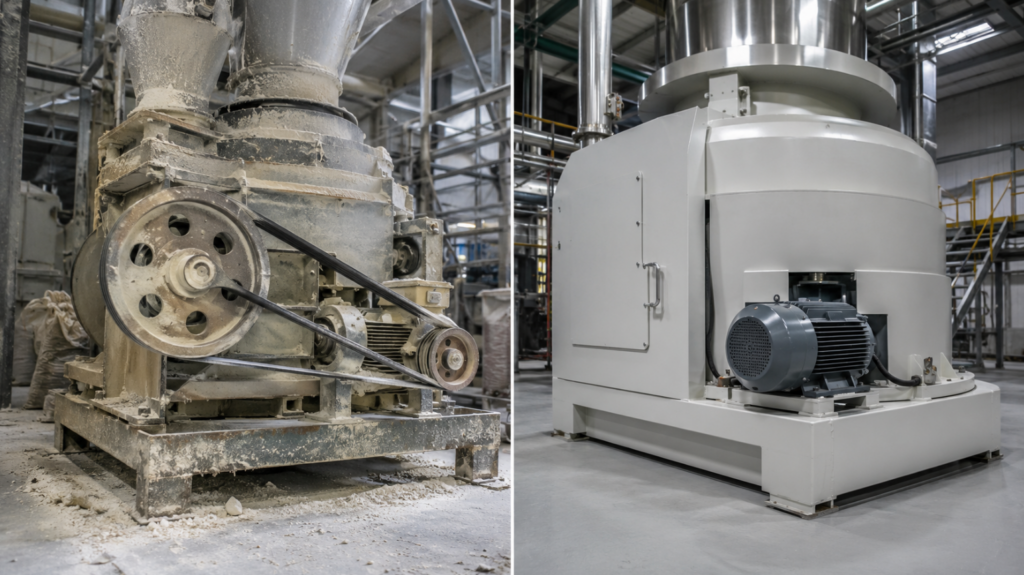
Taking old machines to make do is actually taking money from electricity and scrap rates. We followed a large powder coating factory in North America. They replaced a miscellaneous brand impact mill bought in 2010 with a high-specification direct-drive air grading mill in 2026.
The following data are the real workshop records for 6 months after the technical transformation. The factory’s death order is that the D90 must be stable at 35 microns. In the past, a 75kW large motor was hung on the broken machine and cried at full load every day. As a result, the powder was often scrapped by quality inspection due to high temperature sintering. After the new machine went up, only a 55kW motor was used to perfectly jam the target granularity. 1 accounts, than energy consumption straight down 28%. In the past, because the rotor was blocked, it had to be shut down for 14 hours every month, but now it is directly reduced to 0. Relying on the saved electricity bills and the reduced scrap rate, the boss made all the money to buy the equipment in just 18 months.
| Metric | Before Upgrade: 2010 Impact Mill | After Upgrade: 2026 Direct-Drive Air Classifying Mill | Improvement |
|---|---|---|---|
| Motor Power Usage | 75 kW | 55 kW | 26.7% lower installed power |
| Overall Energy Consumption | Baseline: 100% | 72% of previous level | 28% reduction |
| D90 Stability at 35 μm | Unstable; frequent deviations | Consistently maintained at 35 μm | Significantly improved |
| D90 Stability Percentage | Not recorded | Not recorded; reported stable throughout production | Reliable target control |
| Heat Generation | High; caused powder sintering | Low and controlled | Reduced thermal damage |
| Monthly Maintenance Downtime | 14 hours | 0 hours | 100% reduction |
| Product Scrap Rate | High due to overheating and off-spec powder | Substantially reduced | Lower material waste |
| Equipment Payback Period | — | 18 months | Rapid return on investment |
What is the difference between air classification mill (ACM) and jet mill (Jet Mill)?
There is a mechanical rotor in the air classification mill, which carries a plate to smash the material, and at the same time controls the final thickness by the internal powder selection wheel. However, there are no active mechanical grinding parts in the air flow mill. The materials are blown up purely by ultra-high pressure compressed air, allowing them to “hit hard” and crush them. ACM mill has large output and low power consumption. However, jet mill is usually only used when dealing with ultra-fine powders that are extremely afraid of heat or have high fineness requirements.
How much can the finest air classification mill grind?
As long as the material is brittle enough, a top-level air grading mill can basically dry the fineness to D97 = 10 microns. If it is the kind of special custom multi-wheel grading mill, the limit can approach 5 microns. If your process requirements must be below 5 microns, then don’t choose ACM and go directly to fluidized bed airflow mill.
How to adjust the powder thickness of air grading mill?
The operator mainly holds two variables in his hand: the rotation speed (RPM) of the powder selection wheel and the air volume of the system. If the rotation speed of the powder selection wheel is increased, the large particles will be mercilessly returned to the grinding cavity at the bottom to be remade, and the powder will be finer. If the air volume is turned on, the strong air flow will forcibly pull the large particles out of the powder selection wheel, and the powder will become coarse.
Why is my air grading mill so hot?
3 is one reason why the machine is damaged by high temperature: the feeding is too hard, the wind is not enough, or the grinding cavity rotor is bald. Once the gas-to-material ratio (the ratio of air volume to material) drops too low, the pneumatic system simply cannot take away the huge adiabatic heat generated by grinding. At this time, the operator must immediately reduce the feed rate, or pull up the speed of the induced draft fan to force the temperature down.
Can air-staged mills be used to grind highly abrasive materials?
Ordinary carbon steel machines will die as soon as they encounter high wear materials such as quartz stone or alumina. When purchasing, anti-wear kits must be rigidly required-such as tungsten carbide, special ceramics or high-density polyurethane lining and column. Dare to take ordinary models to grind hard bones, within a few weeks the core components will be completely scraped.