 Clirik




Buscar
There are two particle size levels for drilling-grade barite powder: the coarse particle residue must be low, and the proportion of ultrafine powder also has an upper limit. Tightening the cutting particle size of air grading can reduce the coarse particles entering the finished product, but it may allow more material to be reground, increase the internal load of the mill, and make some particles too fine. When designing a dry grinding line, the verification is how much qualified powder can be produced stably per hour when the particle size indicators of the same batch of raw ore meet the standards at the same time. API Spec 13A Version 19 Supplement 2 Barite Powder Air Grading Test
Taking Table 2 of Supplement 2 to API Spec 13A, 19th Edition as an example, the minimum densities of the two drilling-grade barite grades, 4.1 and 4.2, are 4.10 g/mL and 4.20 g/mL, respectively. The same particle size limits are used for both grades: the maximum sieve residue mass fraction greater than 75 μm is 3.0%, and the maximum particle mass fraction with an equivalent sphere diameter of less than 6 μm is 30%. The table also specifies the limits for water-soluble alkaline earth metals. The project shall be accepted in accordance with the standard version and test methods specified in the contract. API Spec 13A Version 19 Supplement 2, Table 2
Writing only one mesh number means that testing the mill is missing a judgment. Even if the sieving residues of two batches of powder greater than 75 μm are the same, the proportions of powders less than 6 μm may differ. The acceptance form should list the limits at both ends and the corresponding test methods respectively. If the coarse particle screening residue meets the standard after grading and fine adjustment, but the proportion of ultrafine powder exceeds the line, this set of working conditions cannot be included in the qualified product production capacity.
First measure the density, BaSO₄ grade, main gangue, moisture content and particle size distribution of the proposed ground ore sample. Maximum block size and moisture content are used to verify the feed conditions of candidate mills and determine whether pre-crushing or drying is required. If the density is low, first check the content and occurrence status of low-density gangue, and then determine whether mineral processing or replacement of grinding ore sources is necessary. Simply grinding the entire batch of ore cannot remove the gangue. EPA Barite Processing Survey
If the source of the ore changes, the test grinding results will also change. Bayar and Yekeler conducted laboratory dry grinding tests on four barite ore samples. In the same set of ball milling tests, after 8 minutes of milling, the proportion of the two high-grade ore samples passing through the 38 μm sieve was about 54%, and the proportion of the two low-grade ore samples containing more quartz was about 44%. This set of figures applies to the ore samples and conditions used in the experiment. If the production plan involves switching mineral sources, the trial grinding should cover the representative batches of ore actually used, and record the grinding conditions and finished product performance of each batch separately. Dry grinding tests of four barite ore samples, Table 3
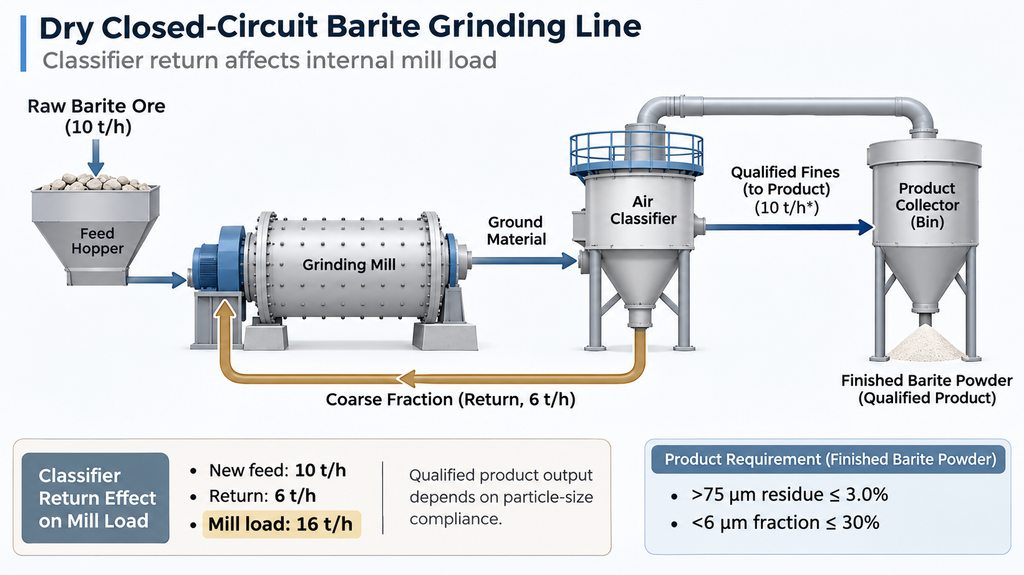
In the dry closed-loop process, the mill grinds the ore finely, and the airflow carries the ground material to the classifier. The separated fine powder enters the collection system, and the coarse powder returns to the mill. The grading results are affected by both rotor speed and air volume. Grading tests on barite powder also showed that different combinations of rotational speed and air intake can change the particle size distribution and grading effect of the finished product. These two parameters should be recorded in groups during test grinding, and samples should be taken simultaneously to check the finished product and the return material. If the returned material already contains a large amount of fine powder, it should be checked whether the grading has brought the particles that could have been discharged back to the mill. Closed-loop process example, Barite powder air classification test, Section 4
Assuming working conditions. A closed circuit adds 10 tons of dry-based new material per hour, and the classifier returns 6 tons of material per hour. Under steady-state conditions, ignoring losses and without other solid outlets, the mill actually processes 16 tons/hour, while the finished product outlet remains at 10 tons/hour. If the return material is increased to 9 tons/hour after fine adjustment, maintaining the same amount of new material requires the mill to process 19 tons/hour. If the mill can only handle 16 tons/hour stably under this operating condition, then the amount of new material can only be reduced to 7 tons/hour while the return material is still 9 tons/hour. Only after the finished product passes acceptance will these 7 tons be included in the hourly qualified product production. After the actual feeding adjustment, the return material should be retested, as both will change with the working conditions.
Continuous closed-circuit test grinding was performed using representative ore samples. After the feeding, return and power are stable, the dry basis new material quantity, return material quantity and finished product quantity are recorded at the same time, and then the finished product is tested according to the contract method. When the coarse end exceeds the limit, check the mill outlet and the fine powder classification: If the mill outlet is coarse and the return volume is high, the grinding capacity of the mill under the current feeding volume should be verified. If the fine powder outlet still carries a lot of coarse particles, the grading process should be checked first. If the coarse end has met the standard but the ultrafine end has exceeded the limit, the proportion of fine powder in the return material should be checked, and it should be tested whether the two limits can be maintained after reducing the fine powder regrinding. Barite powder air classification test, Section 4
When comparing plans, capacity and power consumption are calculated only using the stable operating conditions of all accepted projects. Divide the power consumption of the agreed equipment range within the same statistical period by the tonnage of dry-based qualified products during that period. When comparing the entire line, the mill, classifier, and fan are included in the same boundary, and it is noted whether crushing, drying, and dust collection are included. Finally, representative mine samples, finished product acceptance methods, dry basis qualified tonnage and corresponding return volume are written into the design basis. In this way, the tonnage of finished products can be verified by test results, and the mills and classifiers also have their own actual loads that can be used for selection.