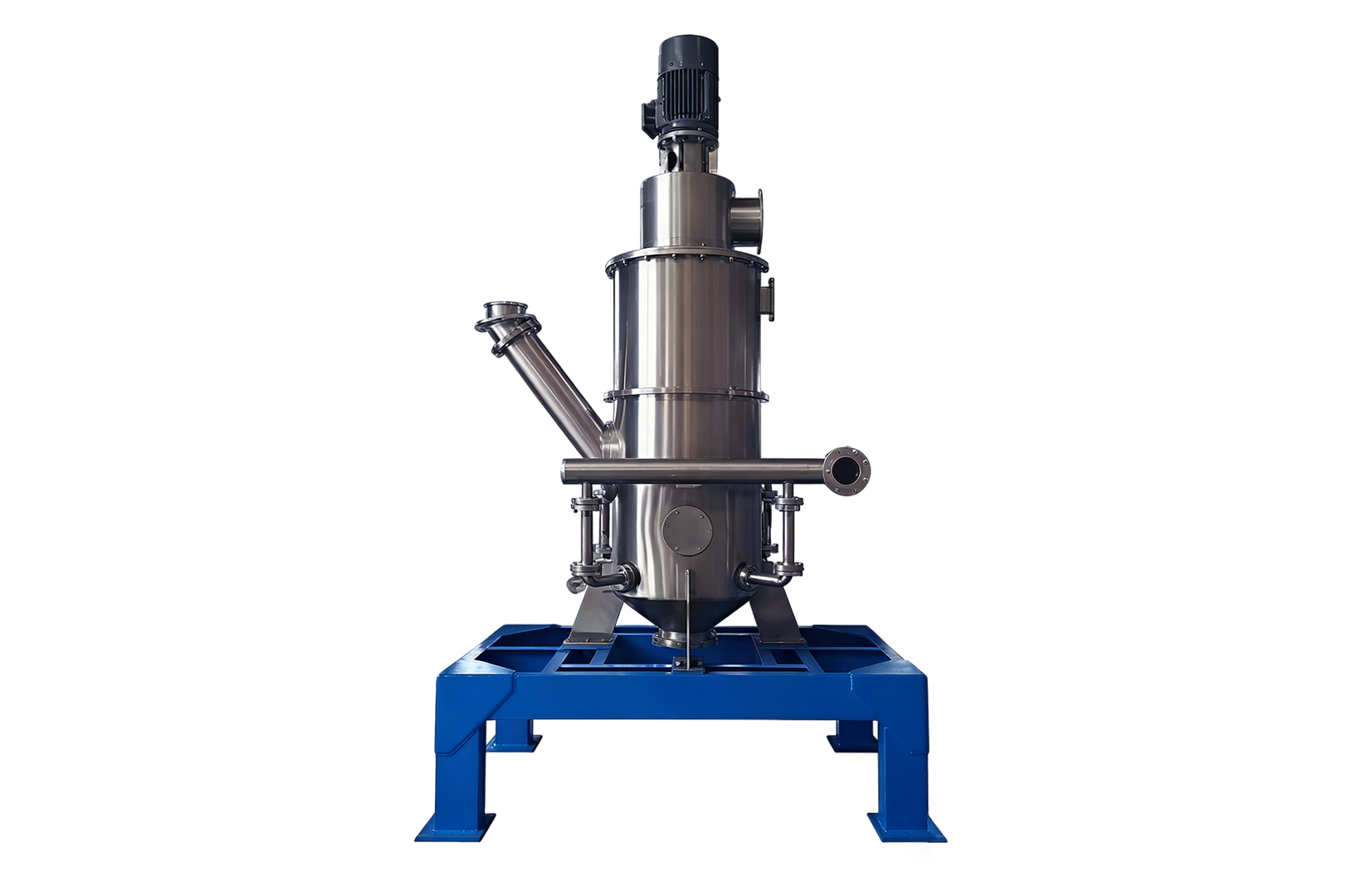
 Clirik






Rechercher
To push calcium carbonate grinding efficiency to its limits, the ton power consumption of standard heavy calcium must be stuck below 25 kWh/t, while the tolerance of D97 particle size distribution must be strictly controlled within 2 microns. After inspecting large and small production lines, I found that relying on hard work on equipment power could not achieve this indicator at all. The real way out lies in the synchronous adjustment of classifier speed, gas flow state and grinding aid ratio. Honestly, your workshop is probably burning 20% of its electricity bill for nothing right now because of internal particle agglomeration and ineffective circulation. The following engineering framework is designed to cut off these losses, stabilize production, and directly reduce the cost per ton.
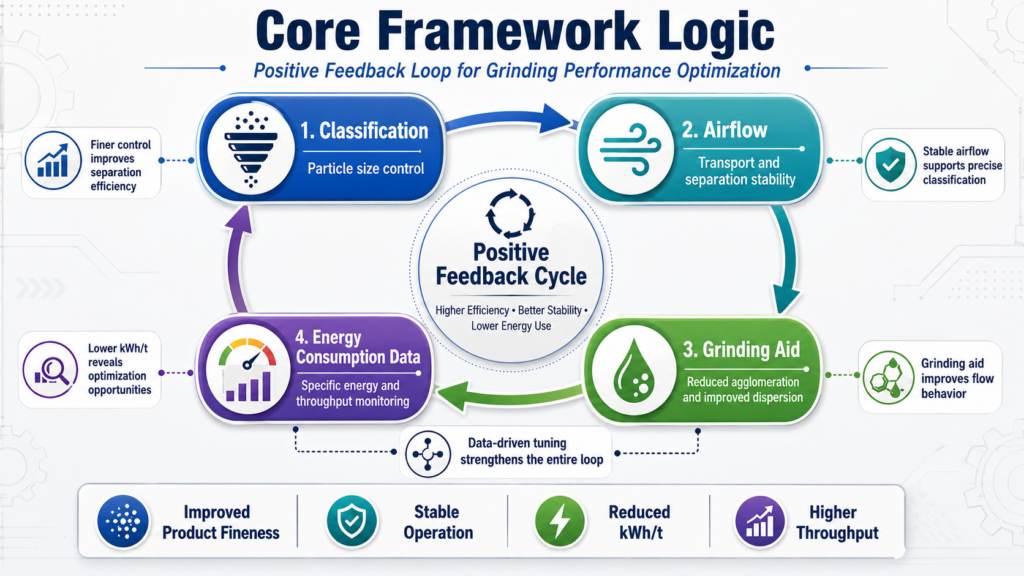
During equipment compliance audits, many factory directors are accustomed to viewing the main unit as an isolated iron lump rather than a dynamic system. CORE The core of the matrix is to replace it with tight synchronization of mechanics and chemistry “powering on by feel”. By putting these four pillars on the ground, your factory can directly upgrade from passive maintenance to active optimization.
Tuning a dynamic classifier is the operation with the highest return on investment. The efficient classifier must maintain a steep cutting point and must never allow the ultrafine powder to return to the grinding zone. The fine powder that keeps wandering around in it is like a soft mat, which will completely absorb the mechanical impact force. This is how production capacity is dragged down.
The sweep speed determines the residence time of the material in the cavity. The speed of the pilot must be aligned to the true specific gravity and moisture of the raw ore. The wind is too strong and the coarse particles are pumped away before they are even ground; the wind is too weak and directly leads to severe over-grinding.
Chemical grinding aids prevent electrostatic agglomeration at the microscopic level. Many people only look at the amount of medicine they feed when adding medicine, which is definitely a misunderstanding. Liquid grinding aids like polycarboxylic acids must be pumped in proportion to the actual specific surface area generated.
Pull the main motor current and real-time throughput into a graph for comparison, and the inefficient points hidden in the dark will be clearly visible. Remember this hard law: before the D50 particle size completely gets out of control, the ton power consumption will definitely experience an abnormal surge first.
Optimizing the entire production line, to put it bluntly, means managing the material flow before and after the central processing unit. If the pneumatic conveying or silo exhaust system gets stuck in the neck, the performance of the main circuit will still be stretched.
The system back pressure determines the speed at which the finished product leaves the grinding zone. If the pressure difference between the two ends of the bag dust collector is too high, it will directly hold down the suction force of the main air guide. I highly recommend installing differential pressure sensors at all duct elbows to see where exactly the material is deposited. By lowering the trigger threshold of pulse jet cleaning , the airflow sweep in the mill will be much more stable, and the hourly production capacity can be increased by 5-8% on the spot.
The timing and location of dosing are important. It is a common problem to drop the grinding aid directly on the raw mineral belt. The agent often flashes and evaporates before entering the mill. The correct approach is to use a compressed air nozzle to drive the atomized grinding aid directly into the interior of the mill housing to ensure that the newly broken calcium carbonate particles are evenly wrapped. This targeted jetting energy presses down the accumulation of surface energy and prevents the fine powders with D97 < 5μm from being resoldered together.
The optimization logic of different mechanical structures is completely different. If the ball mill path is applied to the vertical roller mill, not only will the whiteness be damaged, but serious mechanical failure will also prevent it from running.
The steel balls contained in the ball mill directly determine the internal crushing dynamics. The operator’s most common mistake is to use a ball that is too large, patronize the primary impact, and forget that grinding and stripping are the key points. Try replacing 30% of the 40mm steel balls inside with 17mm and 20mm steel segments, and the overall contact surface area will show geometric growth. This physical adjustment can accelerate the production of fine powder with D50 < 2μm without additional power.
When the vertical mill reports a vibration and stops, nine times out of ten it is unstable in the material bed. To maintain a flat material bed of 30mm to 40mm, the hydraulic tensile pressure and feeding amount must be strictly controlled. A laser sensor is installed in the mill to mark the depth of the material bed, allowing the PLC to automatically control the rotary feeder. As long as the material bed is flat enough, metal-on-metal contact will not occur, and the life of the grinding roller casing can be said to last 3,000 hours longer.
Hardware sellers, always fixated on heavy steel parameters, often blind operators to the process traps that eat into profits day after day. I have seen the following two issues too often during on-site inspections.
Classifier Wear Ring Trap: The stationary retaining ring around the rotor cage of a dynamic classifier can destroy the particle size distribution of the product if it wears even slightly. As long as the gap is expanded from 2mm to 5mm, coarse particles will leak directly over the side, and the upper limit of D97 will not be retained. If you want to continue making high-end powder, you must use tungsten carbide for hard-surface surfacing in this gap, which is not a good idea to save money.
Water content blind: Once the moisture content of the limestone raw material exceeds 0.5%, the rheology of the powder inside the mill will change significantly. Water vapor is simply a binder in the grinding chamber. It not only coats the grinding medium, but also blocks the blades of the classifier. It is clever to install an online microwave moisture meter on the feed belt and dynamically adjust the hot air generator before the wet material gets stuck in the system.
The theoretical results measured by talking only about theoretical formulas are also theoretical results. The real blueprint for cost reduction depends entirely on actual technical changes in the workshop. Our engineering team recently took over the renovation of a plant with an annual output of 100,000 tons and producing D97=10μm heavy calcium.
At the time, customers were overwhelmed by the system’s high-frequency vibrations and power consumption, which soared to a maximum of 28.5 kWh/t. We follow CORE The matrix has made two targeted changes. In the first step, the media gradation of the ball mill was readjusted to reduce the maximum ball diameter from 50mm to 30mm. In the second step, the spray point of the liquid grinding aid is moved directly from the feed chute to the hollow journal using an atomizing spray gun.
| Metrics | Before Optimization | After Optimization | Net Improvement |
| Specific Energy | 28.5 kWh/t | 24.2 kWh/t | -4.3 kWh/t (15% reduction) |
| D97 Stability | ± 1.5μm | ± 0.4μm | 1.1μm variance reduction |
| System Uptime | 82% | 96% | +14% increase |
| Media Wear Rate | 15g/t | 11g/t | -4g/t (26.7% reduction) |
Subsequent operational data demonstrated that by aligning the positions of the impact physics and chemical agents, the entire heavy calcium grinding line was forced into an efficient steady state. Customers made all their money back on the tech changes in 43 days just from the electricity savings.
The production standard GCC, depending on the raw ore work index, should be stuck between 18 and 25 kWh/t. If ultrafine grinding, 40 to 60 kWh/t is usually required. If this bottom line is exceeded, it means that there is serious agglomeration inside the mill or the classifier efficiency has collapsed.
Feeding large stones directly into the fine grinding circuit is simply a waste of money. The upper feed limit of the ball mill is controlled below 10mm, and the feed limit of the Raymond mill is controlled below 5mm, so that the equipment can use all its strength to grind and peel instead of doing the rough work of primary crushing.
The cutting point fluctuates up and down, either the sweep airflow fluctuates, or the classifier gap is worn. Go check the seal between the rotating cage and the static housing, as long as the gap exceeds 3mm, the coarse powder will definitely run out.
Dry heavy calcium works best with polycarboxylate ether – or triethanolamine – based liquid agents. The amount added must follow the specific surface area of the final product, fine-tuned between 300 and 800 ppm.
Modifications can be made, but this is equivalent to completely revamping the grading and dust collection system. The wet method relies on hydrocyclones and centrifuges, while the dry method must be equipped with dynamic air classifiers and high-pressure pulse bag dust collectors. It is usually much more cost-effective to create a new dry normal next to it than to hard-change the wet grind.
Every 2000 hours of operation, the silo must be shut down and the medium must be thoroughly screened. Pick out the deformed iron bumps and make up for the worn-out size to prevent the grinding dynamics from plummeting over the next few months.