 Clirik






Buscar
Excellent barite mill design is the core of the protection of plant profitability. By precisely matching the grinding pressure to the aerodynamics of the classification system, companies can produce API-compliant drilling-grade barite with the lowest electrical consumption per ton (kWh/t).
The fatal mistake that many operators often make is to treat high-density barium sulfate as ordinary limestone, which often leads to a significant reduction in the quality of the final product. The cornerstone of a truly professional barite mill project is to improve the force geometry of the grinding base, increase the pneumatic induced air velocity to adapt to the specific gravity (SG) of more than 4.2, and strictly control the particle size distribution (PSD) to minimize the reduction of micropowder below 6 microns. In order to achieve high-yield and stable continuous operation, each component of the grinding system must be customized and adjusted for barite, a heavy mineral.
80% of the world’s barite production flows to the field of oil and gas drilling fluids, which requires products to strictly comply with API 13A specifications. Drilling grade barite requires that 97% of the material must pass through a 200 mesh (75 micron) screen.
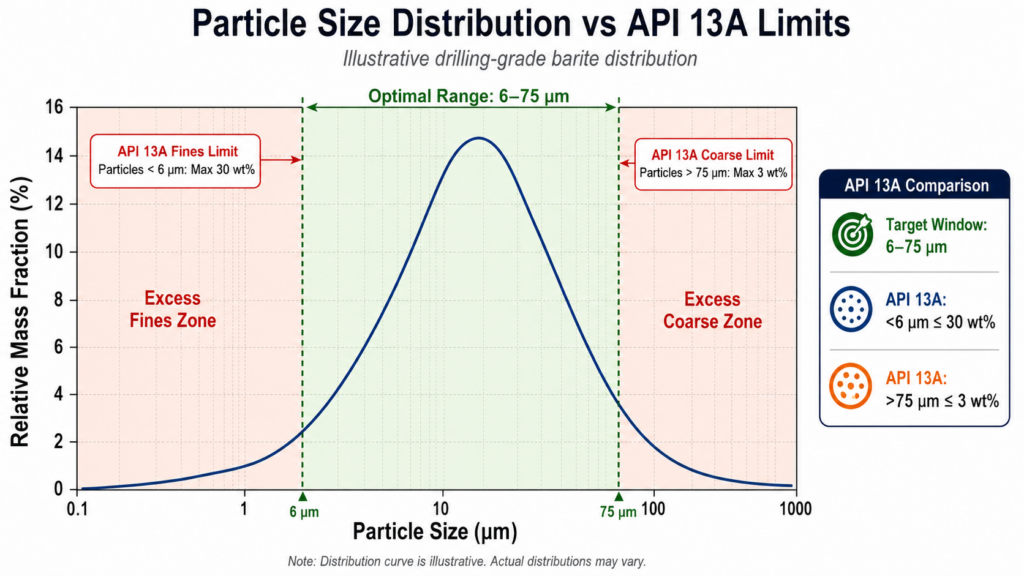
If the content of fine powder (especially fine powder below 6 microns) exceeds the standard, the plastic viscosity of the drilling mud will rise sharply. This will not only increase the load on the drilling pump, but also greatly increase the risk of blowout.
The traditional mill configuration will inevitably cause the material to be “over-crushed”. The advanced barite mill design takes “narrow particle size distribution curve” as the primary goal. Engineers usually achieve this by combining a low-speed main motor with a high-precision dynamic separator. After the raw ore enters the grinding chamber, it only needs to apply the appropriate compression force to break it along the natural cleavage surface, and then the updraft of high wind speed will immediately take away the qualified particles, thus completely eliminating the secondary crushing.
The key to maximizing yield without exceeding the API viscosity limit is the use of 1 proprietary engineering model, the Barite Grinding Yield Triangle. The model achieves system optimization by balancing 3 mutually constraining operational dimensions: high specific gravity pneumatic conveying wind speed, dynamic grading techniques, and the geometry of the wear surface.
Compared with ordinary minerals, the pneumatic conveying system of barite requires much higher wind speed and special pipe geometry design. The high specific gravity of barium sulfate can easily lead to its rapid settlement in horizontal pipes. Therefore, when selecting the equipment, the total static pressure of the main induced draft fan must be at least 15% to 20% higher than that of the limestone mill of the same capacity. If the updraft is weak and weak, qualified particles will stay in the grinding zone, which not only directly leads to over-crushing, but also makes the energy efficiency of the mill plunge.
The rotor speed inside the separator directly determines the cutting point of the particles. The turbine separator equipped with a frequency converter (VFD) allows the operator to dynamically adjust the speed based on real-time particle size sampling data. Appropriate reduction of the speed of the separator can allow the coarser but still meet the API standard particles to be discharged from the system in time. This rapid discharging mechanism is the key to preventing the production of deadly “micro-powder below 6 microns.
The Mohs hardness of pure barite is only 3.0-3.5, which is a soft mineral, but the commercially mined barite ore is often mixed with extremely abrasive silica (quartz) impurities. Under actual working conditions, grinding rollers and grinding rings made of ordinary manganese steel will wear out quickly. Therefore, all direct contact areas in the system must be specified to use high chromium cast iron alloys (Cr20 or higher), which directly doubles the service life of the grinding media.
High-density materials require a specific design of mechanical force. When a high density barite feed is encountered, the standard spring-loaded or hydraulic roller assembly will jump violently and transmit destructive vibrations to the foundation. Professional barite mill designs use hydraulic accumulators with damping. These devices can not only absorb the impact of high-density material fluctuations, but also can maintain a constant and uniform bed thickness of 15mm to 25mm between the grinding roller and the grinding ring.
| Parámetro | Conventional Mill Parameters | Modified Barite Mill Parameters |
| Fan Pressure | Standard | High / Optimized for dense feed* |
| Classifier Type | Standard / Fixed speed | Turbine classifier with Variable Frequency Drive (VFD) |
| Roller Material | Standard manganese steel | High-chromium cast iron alloys (Cr20 or above) |
| Conveying Air Velocity | Standard | Increased (for rapid evacuation of coarse particles)* |
| Roller Assembly | Standard spring-loaded or hydraulic (prone to violent bouncing) | Dampened hydraulic accumulators (absorbs shock) |
| Compressive Bed Depth | Variable / Unstable | Constant and uniform (15mm to 25mm) |
The rate of wear of fan blades is exponentially faster when dealing with airflows containing barium sulfate dust. The main induced draft fan must be a heavy duty backward tilting impeller with a tungsten carbide surface coating. In addition, at the volute where particle impact is most concentrated, the housing design shall incorporate replaceable AR400 wear resistant steel liners.
Structural integrity is the cornerstone of the success of any EPC project. The barite mill generates a huge dynamic load. The foundation design must adopt thick reinforced concrete blocks, and its volume and weight should reach 2.5 to 3 times of the total static weight of the mill equipment to effectively absorb low-frequency vibration.In the plant layout, the engineer must try to shorten the length of the pipeline, and the main vertical pipe. As long as the 90-degree horizontal right-angle elbow in the pneumatic conveying system is canceled, a large amount of siltation of barite powder and the risk of pipe blockage caused by it can be greatly reduced.
Targeted engineering modifications can often lead to an immediate surge in production capacity. Taking the technical improvement project of a drilling fluid supplier in Texas in 2024 as an example, the technical team decisively replaced the old conventional suspension roller mill with a vertical roller mill (VRM) customized for barite. This 1 of measures directly invigorated the economic benefits of the entire factory.
API 13A requires drilling grade barite to have a specific gravity of at least 4.10, while premium grades are typically aimed at 4.20. The mill engineer must configure the feed bin and pneumatic conveying system specifically for this extreme density to prevent blockage of the material.
Too much fine powder (<6 μm) is usually caused by insufficient air volume and high speed of the powder separator. If the induced draft fan does not have enough wind pressure to hold up the high density barite particles, the material will fall back to the grinding zone and suffer from secondary or even multiple crushing.
No way. The use of limestone mills for barite requires substantial structural and aerodynamic modifications. The high density of barite requires higher airflow and wind speed, as well as a reinforced foundation that can withstand greater vibration. At the same time, it also requires special wear-resistant parts to resist abrasive impurities such as quartz that are common in barite raw ore.
The core of reducing the specific energy consumption (kWh/t) is to narrow the particle size distribution of the product. By installing a variable frequency (VFD) separator and optimizing the system air volume, operators can quickly discharge particles that meet API standards, thereby eliminating energy waste caused by over-crushing.
High chromium cast iron alloy is the best wear-resistant material for barite grinding. Although pure barite is relatively soft (Mohs hardness 3.0), the quartz and silica impurities in the raw ore are extremely destructive abrasives that can quickly scrap ordinary manganese steel parts.
Micropowders of less than 6 microns lead to an exponential increase in the plastic viscosity of the drilling mud. The high plastic viscosity not only forces the mud pump to consume more fuel, but also increases the friction inside the drill string. This is why the API 13A standard has extremely strict limits on the generation of micropowders during the grinding process.
The EPC (Engineering, Procurement and Construction) contractor is responsible for the overall system integration of the barite plant. The specific work includes: design of heavy load foundation, selection of accurate mill configuration, optimization of plant layout to eliminate hidden dangers of horizontal pipeline blockage, and completion of commissioning and delivery of complete electrical control system.nstruction) contractor handles the complete integration of the barite plant. This includes designing heavy-duty foundations, selecting exact mill configurations, optimizing plant layout to eliminate horizontal pipe blockages, and commissioning the electrical control systems.