 Clirik




Buscar
Crushing limestone randomly is still a hundred and eighty thousand miles away from a truly usable finished powder. Before the mill enters the mill, moisture and impurities are competing in the dark; after grinding, the grading and dust collection system determines what kind of goods are finally put into the bag. If you only focus on “how fine this mill can grind”, you will often ignore the coordination of the entire line upstream and downstream, which affects the whole body.
To put it bluntly, the limestone grinding powder we are talking about is the physical crushing of natural stone. No matter how much you try, its core component is still calcium carbonate. This is not a matter of putting it in a kiln to boil it into quicklime, or adding water to make mature lime, and rooting it is not a matter of the same thing.
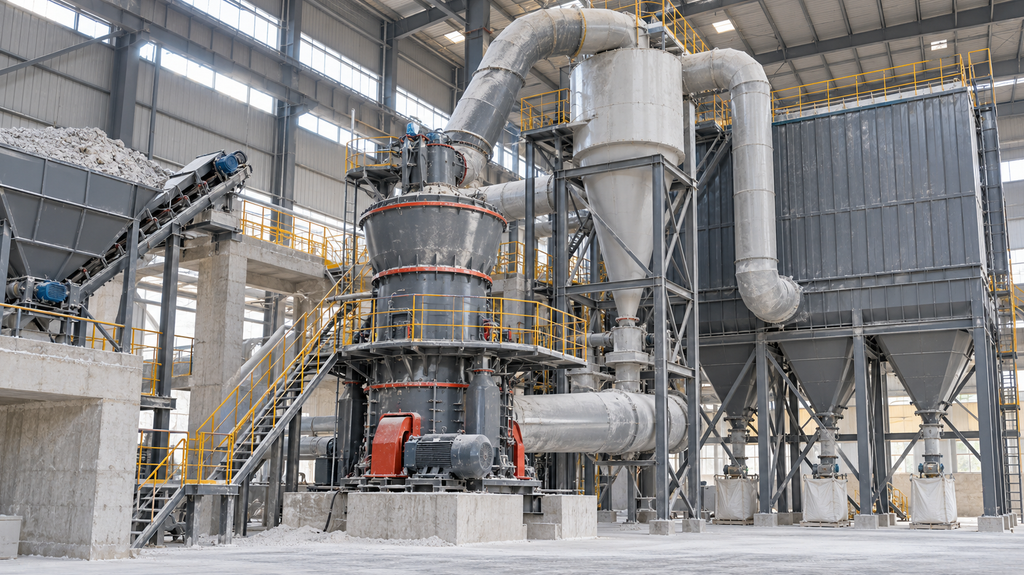
A typical dry normal line begins with collecting and removing debris, followed by the crusher and screening machine. If the material is really not good enough, some pretreatment or drying must be added. Only when the material is ready will it be fed into the mill, ground, graded, and finally the qualified fine powder is collected and packaged into the warehouse.
The crushing function is very real, which is to knock large stones into a size that the grinding machine can “eat”; and grinding is the real link in determining the fineness and particle size distribution. Some bosses only make aggregate or crushed stone, so crushing and screening are enough, but these crushed stone blocks are still far from the requirements of powder products. ( Just like holding crushed limestone and limestone powder in a metal plate on a workshop workbench, they are completely different things to the naked eye.)
Even if everyone is making “limestone”, the doorways inside vary greatly. Whether the calcium carbonate content is high or low, how much dolomite is present, whether quartz or clay is mixed in, and the hardness, abrasiveness and water content, each of these will greatly change the load and process conditions of the machine. As for the messy things like mud and scrap metal, they have to be sieved out before feeding.
If downstream customers are obsessed with the whiteness or purity of the powder, they will have to go back and find the source and pretreatment to settle the score. Whether it is water washing, re-selection, flotation or magnetic separation, it all depends on what the impurities in the raw ore look like. Remember, no matter how big the mill is, it can’t replace purification——grinding stones finely and improving purity are fundamentally two-dimensional tasks. In this area, many factories involved in Limestone Millings (limestone grinding operations) are prone to pitfalls. They always feel that the quality naturally improves after grinding, but in fact, this is not the case at all.
If the limestone is already quite dry and has been crushed in advance, then it can be fed directly into the closed-circuit system “feeding-grinding-grading-dust collection”. However, if you encounter materials with high moisture content, sticky materials are easy to stick to the machine, or the finished product is severely damaged and has low moisture content, you can’t avoid it by adding pre-drying, hot air, or simultaneous drying inside the mill.
Of course, not every line requires the foolish purchase of a dryer. A system like an air-swept roller mill, or one with its own hot air, can knead the Drying And Grinding Process (drying and grinding process) directly together to dry. However, this “combination” is very skill-testing; you need to clearly balance the heat, air volume, system pressure drop, and moisture content of the finished product.
Removing an independent drying device does not mean that the heat and air volume required for drying can be extracted out of thin air.
Moreover, drying also provides strength to the dust collection process “upper strength”. The amount of water carried in and out of the material, the amount of water to be evaporated, the amount of heat to be given, the degree of the air outlet, whether it will be exposed to cold condensation in the pipe, plus the load of the dust collector itself, this large number of parameters are combined to create a low-moisture finished product. If the machine can achieve a certain moisture index, it is definitely based on specific feeding and operating conditions. Changing the material or changing the working conditions may cause the food to stop.
Once the material enters the mill, it’s time for the grading system to act as a “door god”. Fine powder that meets the requirements is sucked away, and coarse material that is not ground properly can only be beaten back to the house and re-entered the grinding area to be hammered. This furnace return mechanism can firmly grasp the upper limit of particle thickness, but the cost is that the “circulating load” in the system becomes larger, and the pressure of the fan and dust collector also increases with the water.
Here we need to settle an account: the new material that was just fed in, the coarse material that was sent back, and the finished product that was finally collected are three completely different material streams. When calculating material balance, it is necessary not only to look at the finished product, but also to clearly calculate the powder caught by the dust collector, the material leaked by the bypass, and various losses. The circulating materials and the finished products that are finally bagged in the mill are not a statistical caliber at all.
If you want to grind finer, it means the classifier is working harder, more material is being recycled back to the furnace, or the material is staying in the mill longer. At this time, output, power consumption, machine heat generation and wear will fluctuate wildly with the working conditions, which cannot be simply calculated by setting a fixed ratio. In this link, the feeding speed, mill load, air volume or negative pressure, and classifier speed are all grasshoppers tied to each other on a rope, which can move the whole body with one stroke.
Before being bagged and stored, cyclone separators, bag dust collectors, and a bunch of conveying equipment have to lift the beams to recycle finished products, control dust, and transfer materials. Covering the sources of easy ash and concentrating the exhaust, and leaving enough space for maintenance, cleaning filter bags and moisture prevention, are all standard features of a mature production line. When the machine is turned, the temperature of the air outlet, the pressure difference of the filter bag, and the actual particle size of the finished product all require constant attention.
When it comes to the fineness of the finished product, who listens to just one sentence “how many eyes” nowadays, that is not rigorous at all. You need to take out the sieve allowance, d50 or d97 data, the maximum cut particle size, and the test method together. Particle size data measured using different methods should never be compared together. Some powders are particularly prone to clumping. At this time, the machine measures whether the particles are native or the large lumps after clumping, which makes a big difference. Moreover, whether the sample is dried before testing and whether it is well dispersed will directly affect the final test report.
Finally, where your powder goes determines where this process line ends. When making cement raw materials and building materials, the key is to ensure stable chemical composition, smooth feeding, large output, and even a little moisture and particle size distribution. When making coatings or rubber fillers, one must be extremely particular about whiteness, purity, oil absorption, and surface properties. If it is sold to agricultural sprinklers, people value the ability to neutralize acidic soil, moisture and spreading conditions. There is no need to follow the trend and make ultrafine powder routes.
For example, in desulfurization projects, it is necessary to calculate the reaction activity, air volume and absorption conditions, and it is necessary to figure out whether dry powder or limestone slurry is required for dry, semi-dry and wet systems. You can’t simply and crudely apply the parameters of a direct injection solution to another system. In short, the particle size, moisture content, and various indicators of the finished product must be determined based on the customer’s actual application. To evaluate whether a line works, we need to look not only at the output, but also at how much electricity is consumed, whether the machine is hot or not, whether it emits a lot of dust, whether it is noisy or not, whether the equipment is wear-resistant or not, and how long it will take for maintenance to stop. The “rated production capacity” marked on the nameplate of a mill can only indicate the tip of the iceberg in this big game.