 Clirik






Buscar
When selecting an air-classified mill, don’t just focus on the total bottom price listed on the quotation.
On the table lay two quotations for what appeared to be the same model of machine, one of which was significantly lower in price. At this point, many people can’t help but immediately circle that low price and quickly make a decision.
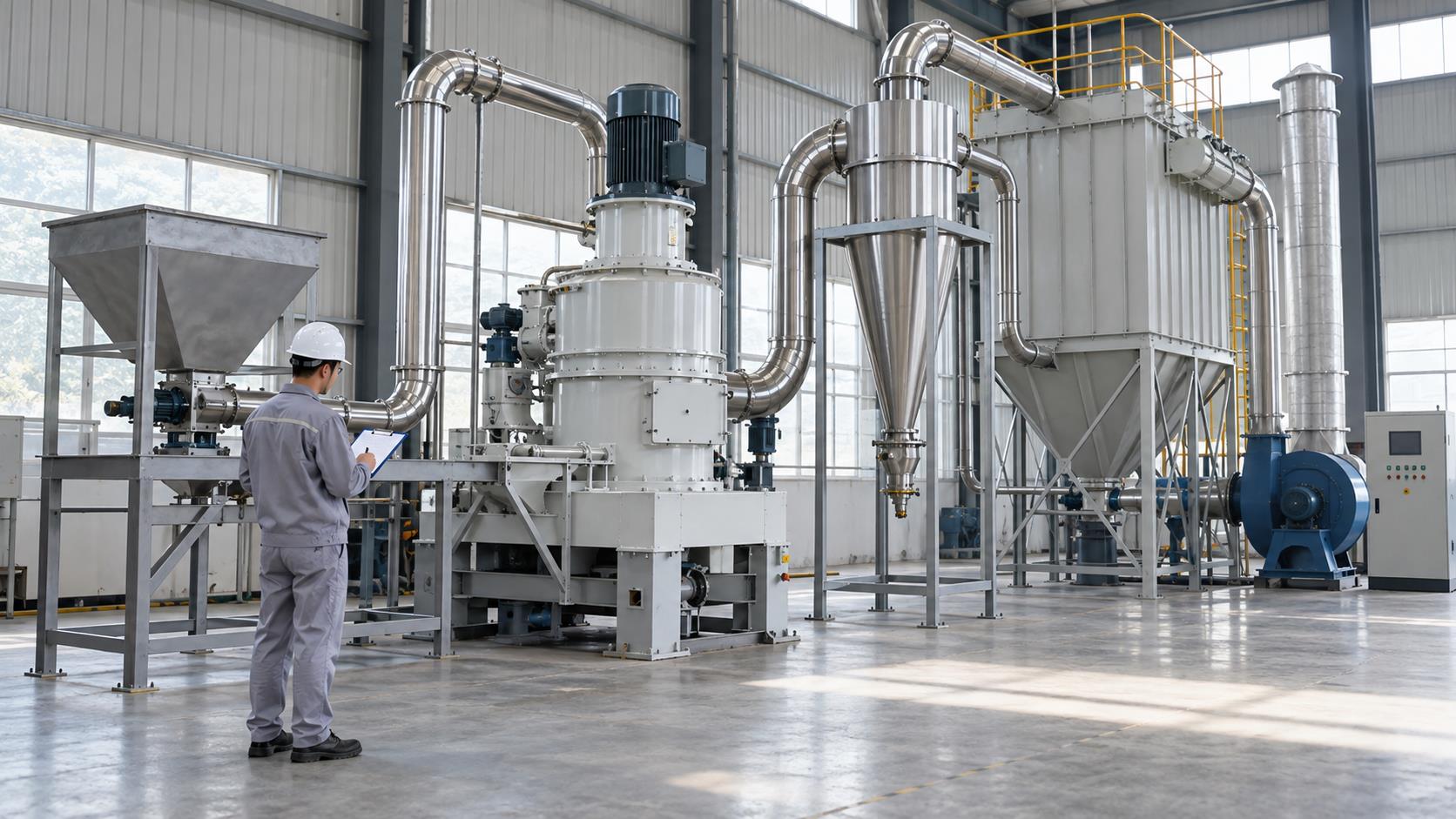
But if you take a closer look at the fine print below, you’ll spot the catch. That cheap quote actually only included 1 crushing machine; whereas the slightly more expensive quote bundled in the feeder, fan, cyclone separator (or dust collector), airlock, piping, and control cabinet. Now you finally realize that this is not a fair “price comparison” at all—you’re comparing the price of a bare machine with that of an entire production line.
This is the most common pitfall people fall into when requesting a quote. Only when both the buyer and the seller reach a consensus on “what exactly this equipment package includes” do the figures in the quotation hold any real meaning.
When buying equipment, don’t rush to flip through the product catalog. Suppliers need to understand far more than just which model you want to purchase. They need to know: What exactly are you dealing with? How big is the initial charge? Is it dry, wet, sticky, abrasive, or sensitive to temperature? Most importantly, what do you want the finished product to look like?
Simply throwing out the statement "How many microns do I need to achieve?" does not answer the final question at all. This term sounds very technical, but in reality it is quite vague. D50 and D97 represent different points on the particle size distribution curve; if a “maximum particle size limit” is also imposed, the requirements become even more stringent. Even the instruments you use to collect this data need to be aligned with the supplier in advance. Otherwise, even if the figures reported by both sides appear identical on the surface, the underlying testing standards they use could differ drastically.
Let’s take a look inside the machine: crushing and classification are performed in a continuous process. After the material is broken by the impact part and the crushing plate, the air flow will carry the powder forward. Fine particles that meet the fineness standard pass through the classifier and exit the system, while coarse particles are returned for reprocessing.
Therefore, the parameter settings of the equipment directly determine the final outcome. Classification rotor speed, crushing rotor speed, and system airflow—these are by no means trivial background data. If the requirements for powder fineness change, the machine’s optimal operating conditions will likely need to be adjusted as well.
The buyer's favorite question must be: "How many kilograms can this machine make in an hour?" The answer given by an honest supplier usually adds a bunch of premises after the number: under "this material", "this feed size", "this moisture content" and "this fineness of the finished product.
If you discuss production capacity without considering these operating conditions, it’s nothing but a blatant ploy. Beautiful data obtained from one type of powder may not hold true at all when tested with another.
The abrasiveness of the material necessitates a more cautious selection of equipment materials; stickiness also poses a significant challenge; and if the material is heat-sensitive, even greater care must be taken. Some products are very easy to clean, while others require a whole half-day of effort. Each of the above details will affect the equipment’s materials, system layout, and even the final actual production capacity. These trivial details may seem cumbersome, but only by sorting them all out can a truly practical quotation emerge.
People often focus all their attention on the main unit of the crushing chamber, but to ensure the entire system runs smoothly, you need to take care of many more things.
Think about it, processing ordinary ore powder, and processing those easy to fire, explosion or produce static materials, can be the same thing? The equipment may need to do anti-static grounding; the whole system should also consider whether to do inert gas protection, exhaust explosion, explosion suppression, explosion-proof or special dust removal filter. The specific safety measures to implement depend entirely on your material properties and production environment.
With these added safety features, the total amount on the quotation will definitely increase—after all, the costs are there. If they are all cut off, the quotation will indeed become "beautiful" a lot, but this is just a cover-up, and the real security risks and production needs will not disappear out of thin air.
Before comparing the final total prices, I suggest you use the following questions to scrutinize each quote:
Are each supplier being evaluated based on the same sample and feed conditions?
Do their promised standards for D50, D97, or the maximum particle size all align?
Is the production capacity they reported based on the same finished product fineness?
Where exactly does each supplier’s scope of supply begin, and where does it end?
In addition, there are some non-technical provisions, if not clearly seen, may cost a lot of money in the future: who is responsible for the door-to-door commissioning? The package does not include operator training? What spare parts are included with the random? Delivery date, warranty policy, payment method, trade terms and even disclaimers, each of which is worth picking. Remember, anything not listed on the quotation will never be provided to you free of charge, even if “the final project actually requires it.”
A brief quotation is no problem; what’s alarming is when the content is vague and unclear.
If the powder quality is your lifeline, then taking real money and silver materials to the manufacturer to do a test machine on the spot is definitely much more reliable than listening to the supplier's optimistic boast of "how high the expected production capacity is" in the mail.
Of course, the test machine not only depends on the quality of the finished powder, but also records the various parameters during the test: feeding conditions, system air volume, rotor and grading wheel speed, actual processing capacity, particle size distribution, equipment temperature rise and energy consumption. Only by recording these data in black and white do the results become worthy of discussion. Without the support of these detailed data, the 1 sentence of "the test machine was very successful" will not help you in selecting models or expanding production capacity in the future.
In summary, when dealing with different materials and varying process requirements, there has never been a “standard fixed price” for air-classified mills. The cheapest offer is not necessarily defective, it may even be a very wonderful solution, but before you come to this conclusion, you must make sure that it and other offers are on the same starting line.
So, look at the quotation, don't just stare at the last total price, see all the additional terms around the price. The real reference value of the figure is never how much the iron pimple with the nameplate of "air grading mill" is worth. But the buyer and seller clearly reached a consensus: in order to process the raw materials you specify into the powder you want, how much does this 1 the whole system cost.