 Shanghai Clirik Machinery Co.,Ltd

Search
A proven limestone mill upgrade in 2026 requires abandoning purely mechanical replacements in favor of integrating Variable Frequency Drives (VFDs), high-efficiency dynamic classifiers, and edge-computing wear sensors. Replacing or upgrading your legacy limestone milling machine using these three specific interventions reduces specific energy consumption from the industry average of 18 kWh/t down to under 13.5 kWh/t, while increasing D97 pass rates by up to 15%.
Plant managers delaying these upgrades are losing approximately $40,000 annually per mill in wasted energy and unscheduled downtime. The core focus of this technical breakdown is to bypass the sales brochures and show you exactly which upgrades actually deliver measurable ROI in high-capacity calcium carbonate processing.
Upgrading a production line requires a structural approach rather than buying random new parts. We use the O.E.E. (Overall Equipment Effectiveness) Limestone Upgrade Pyramid to dictate capital expenditure priorities for plant engineers.
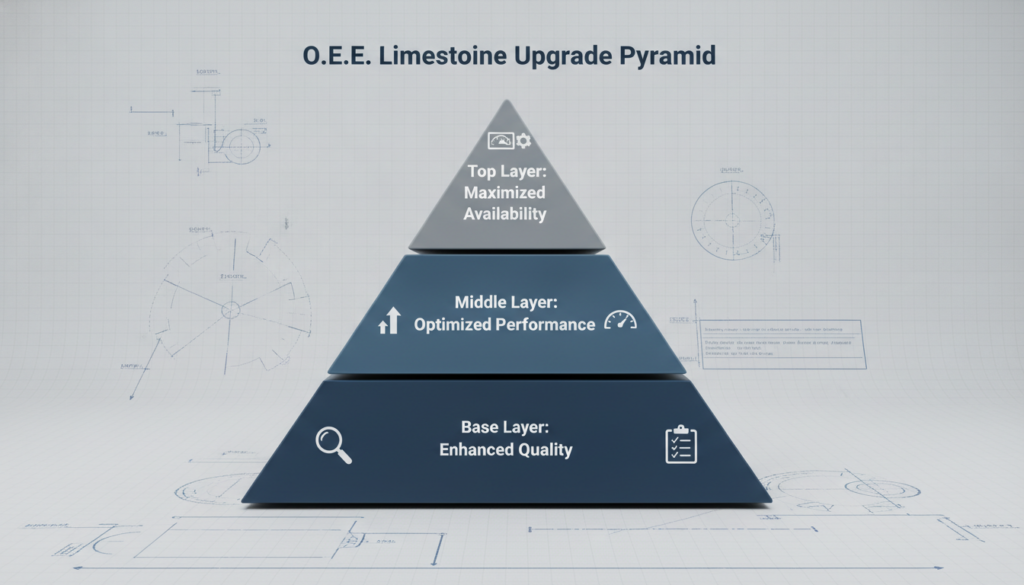
Plant engineers need interventions that don’t require entirely rebuilding the foundation of the plant. These three upgrades offer the highest proven returns for existing limestone mills.
Rotor design dictates your final Particle Size Distribution (PSD). Older limestone mills use static separators that allow oversized particles to bypass the grinding zone, creating a wide, inconsistent product curve. Installing a 2026-spec multi-rotor dynamic classifier ensures a sharp top cut (D97 at 400 mesh / 38 microns) without reducing the total throughput. The variable speed rotor actively rejects coarse particles back to the grinding table instantly, preventing over-grinding of fine particles and saving up to 12% in specific power consumption.
Traditional gearbox-driven mills suffer from a 5-8% mechanical power loss simply through gear friction. Replacing the legacy gearbox of a limestone milling machine with a direct-drive permanent magnet motor eliminates this mechanical loss entirely. These motors deliver constant high torque at low speeds, preventing mill stalls when a high-hardness batch of limestone enters the grinding chamber. Maintenance teams drop gearbox oil changes from their schedule permanently.
Static spring tensioning systems lead to uneven roller wear. 2026 technology utilizes active hydraulic cylinders paired with localized edge-computing sensors. The sensors monitor the material bed thickness on the grinding ring 100 times per second. If the limestone bed thins out, the system automatically reduces hydraulic pressure to prevent damaging metal-to-metal contact between the roller and the ring. This extends the life of high-chromium grinding media by an average of 4-6 months.
Upgrade Cost-Benefit & ROI Analysis
| Upgrade Type | Implementation Time | Est. Cost Reduction | ROI Timeframe |
| 1. Minor Component Upgrade <br>(e.g., Premium Viton Seals & High-grade Valves) | 1 – 2 Days | 5% – 10% <br>(in routine maintenance & leakage mitigation) | 1 – 3 Months |
| 2. Control System Automation <br>(e.g., Flow-Actuated Unloaders & VFD Drives) | 1 – 2 Weeks | 15% – 25% <br>(in energy consumption & labor efficiency) | 6 – 12 Months |
| 3. Complete Equipment Retrofit <br>(e.g., High-Efficiency Motor & Pump Replacement) | 3 – 6 Weeks | 30% – 40% <br>(in overall operational & downtime costs) | 1.5 – 2 Years |
Equipment manufacturers want to sell you maximum capacity. Field engineers know that maximum capacity on paper often destroys real-world stability.
Buying a high-TPH (Tons Per Hour) limestone milling machine without matching the thermal air sweep capacity will cause catastrophic clogging. Sales specs assume a raw limestone moisture content of 1%. When quarry stock reaches 4-5% moisture after heavy rain, the standard internal airflow cannot dry the material fast enough. The wet powder sticks to the classifier blades, blinding the separator and dropping production by 60%. Always specify an oversized hot air inlet and a high-volume draft fan if your raw material storage is exposed to the elements.
Purchasing a larger mill to hit throughput goals often ruins the end-product quality. A massive grinding table running at low efficiency produces a “lazy” material bed. This results in a wide PSD, meaning you get the required fine powder but also excessive ultra-fines that waste energy, and coarse grits that ruin the batch. Upgrade the classification and airflow of your current mill before spending capital on a larger grinding footprint.
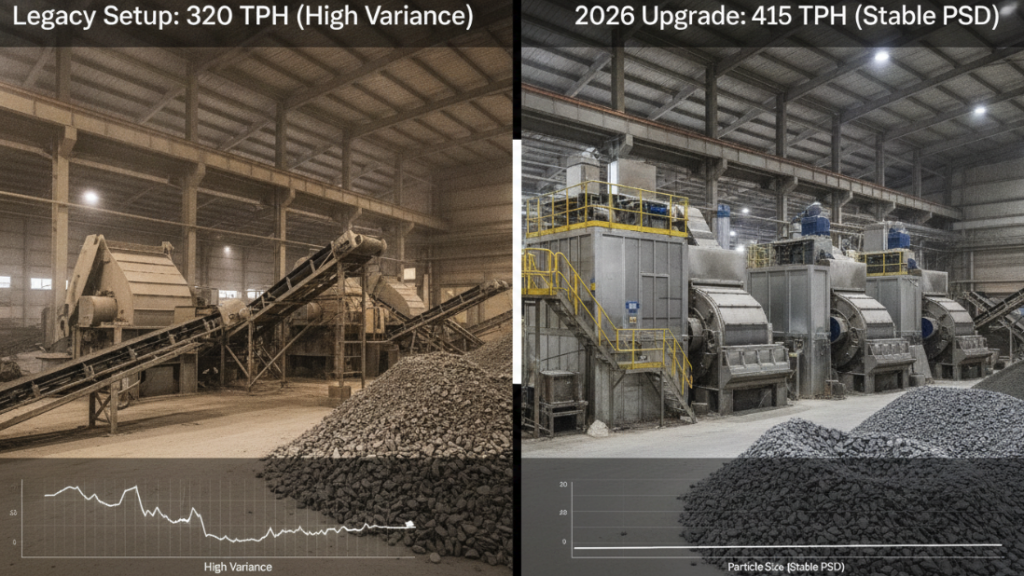
Raw data from operational plants proves the value of targeted upgrades. A major desulfurization (FGD) limestone supplier operating a 15-year-old vertical roller mill line hit a production ceiling of 320 TPH.
Instead of purchasing a new 400 TPH system, they implemented a Level 2 O.E.E. intervention. They replaced the primary draft fan with a VFD-controlled unit and installed a new dynamic classifier head.
The Results Post-Upgrade:
Q: How often should grinding rollers be replaced in a modern limestone mill?
A: With standard spring tensioning, high-chrome rollers last 4,000 to 6,000 hours. Mills upgraded with active hydraulic tensioning and edge-computing bed sensors extend this lifespan to 8,000+ hours by preventing metal-to-metal impact.
Q: Can I upgrade a Raymond mill to match Vertical Roller Mill (VRM) efficiency?
A: You cannot match VRM efficiency completely due to structural physics, but you can close the gap. Installing a dynamic separator and sealing air leaks in a legacy Raymond mill will boost efficiency by 15-20%, making it highly profitable for mid-tier fineness demands (200-325 mesh).
Q: What is the ideal feed size for a limestone milling machine?
A: Feed size dictates power draw. For maximum efficiency, pre-crush your limestone to under 30mm for VRMs and under 20mm for pendulum mills. Feeding 40mm+ rocks directly into the mill spikes the motor torque and accelerates grinding table wear.
Q: Does raw limestone moisture affect milling machine capacity?
A: Yes. Every 1% increase in raw material moisture above the 2% baseline reduces your milling capacity by roughly 5-8% unless you supplement the system with external hot air sweeps to dry the material instantly during the grinding phase.
Q: What is the most cost-effective way to improve D97 particle size distribution?
A: The most direct intervention is upgrading the classifier rotor. Adjusting grinding pressure or fan speed only offers marginal gains; true top-cut control (D97) requires a high-speed, variable-frequency dynamic cage rotor to physically reject oversized particles.
Q: Why does my limestone mill vibrate excessively during startup?
A: Vibration typically stems from an unstable material bed. Before the feed rate matches the grinding pressure, the rollers bounce. Modern upgrades use VFDs to soft-start the mill while simultaneously building the material cushion before full hydraulic pressure is applied.
Q: Is a direct-drive motor worth the investment for an existing mill?
A: If your current gearbox requires replacement, absolutely. Direct-drive permanent magnet motors eliminate gearbox maintenance, reduce noise by 15 decibels, and cut mechanical transmission power losses by up to 8%, paying for themselves within 24 months in energy savings.