 Клирик






Поиск
An efficient limestone grinding process requires integrating precise hydraulic attrition forces with dynamic air classification to achieve a targeted specific surface area (typically 3000-4500 Blaine) while keeping specific energy consumption strictly below 15 kWh/t. Plant managers routinely bleed 15-20% of their operational budget by tolerating severe over-grinding and ignoring massive internal recirculating loads inside their mills. Mastering exactly how to grind limestone at scale dictates the difference between a highly profitable cement or FGD (Flue Gas Desulfurization) operation and one plagued by chronic classifier choking and mechanical fatigue. We outline the exact mechanical adjustments, thermodynamic principles, and empirical load data that dictate high-yield calcium carbonate reduction.
Maximizing throughput while minimizing electrical draw demands replacing static machine settings with dynamic mechanical calibration. The C.A.R. (Classification, Attrition, Residence) Index Method provides the exact engineering sequence for troubleshooting and upgrading any heavy-duty limestone circuit.
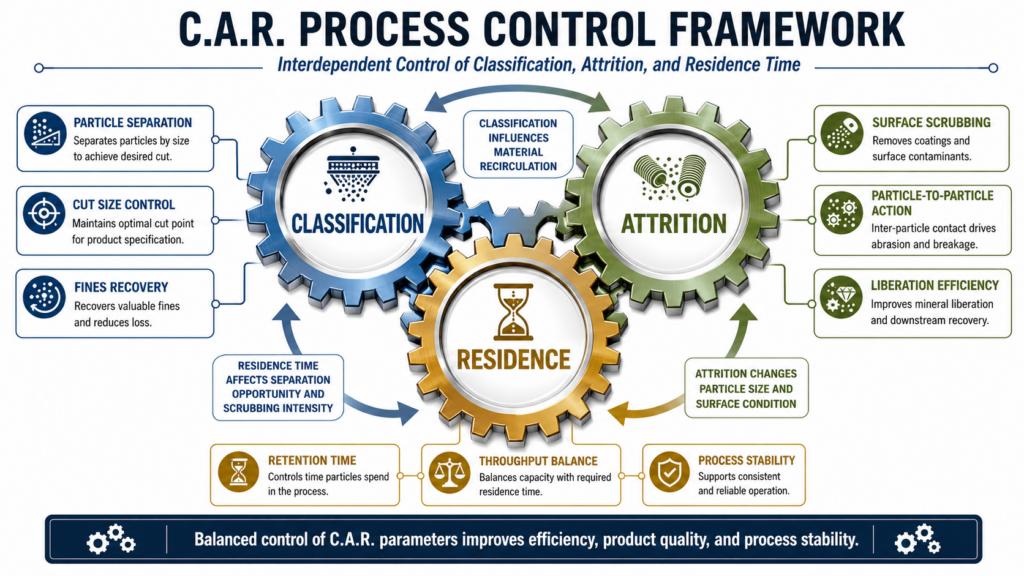
Dynamic separator speed directly dictates the particle size distribution (PSD) and the magnitude of your recirculating load. Plant engineers frequently set the variable frequency drive (VFD) of the classifier rotor to a high RPM to guarantee fine output, ignoring that this forces perfectly acceptable mid-sized particles back onto the grinding table. Lowering the rotor speed in 2% increments while testing the hourly product samples allows operators to find the exact cut-point. This specific adjustment stops the artificial inflation of the circulating load and immediately reduces the amp draw on the main mill motor.
Roller pressure must exactly match the specific Bond Work Index (BWI) of the raw calcium carbonate entering the mill. Limestone generally exhibits a BWI between 10 and 14 kWh/t depending on its crystalline structure and silica impurities. Applying generic, factory-default high pressure via the hydraulic accumulators crushes the materialbed too thinly, causing severe metal-to-metal vibration and wasting megawatts of kinetic energy. Operators must modulate the nitrogen accumulator pressure to maintain a stable, uniform material bed of 30-50mm across the grinding table.
Fast particle ejection prevents over-grinding and thermal degradation. Grinding limestone creates intense localized heat through mechanical friction. The primary draft fan must generate enough vertical air velocity through the nozzle ring to lift the pulverized limestone instantly once it fractures. Restricting this sweep air volume increases the residence time, forcing the machine to re-grind powder that already meets specification, which drastically drops the total tons-per-hour (TPH) yield.
Feeding limestone with a moisture content exceeding 3% into an unheated milling circuit guarantees catastrophic classifier blinding. Operators incorrectly attempt to clear this damp accumulation by simply increasing the draft fan speed. This action pulls wet, heavy agglomerations directly into the dynamic separator blades, causing severe mechanical imbalance and sudden vibration trips. Solving this requires injecting supplemental thermal energy (typically hot gas from a rotary kiln or an auxiliary hot air furnace) directly into the mill inlet at temperatures between 200°C and 250°C. This flash-dries the raw material entirely on the grinding table before it ever reaches the classification zone.
| Feed Moisture Level | Inlet Hot Air Temperature | Mill Output (TPH) | Specific Power (kWh/t) | Process Observations & Operational Status |
| Dry Feeding (<1% moisture) | Ambient (Unheated) | Baseline / Optimal | 10.0 – 14.0 | Stable material bed (30-50mm); efficient particle ejection; no classifier blinding. |
| Wet Feeding (3-5% moisture) | Ambient (Unheated) | Drastically Reduced | Spiking / >14.0 | Catastrophic classifier blinding; wet agglomerations drawn into separator blades; severe mechanical imbalance and sudden vibration trips; wasted megawatts of energy. |
| Wet Feeding (3-5% moisture) | 200°C – 250°C | Restored to Baseline | 10.0 – 14.0 | Material flash-dries completely on the grinding table prior to classification zone; prevents moisture-blinding; restores stable production yield. |
Producing limestone powder for Flue Gas Desulfurization mandates a coarser, strictly controlled PSD compared to raw meal preparation for cement clinker. FGD systems require maximum chemical reactivity, which peaks at a specific surface area generated by 250-mesh to 325-mesh particles. Pushing the limestone grinding equipment to produce ultra-fine 400-mesh powder for FGD applications actually decreases the desulfurization efficiency. The ultra-fine particles agglomerate in the scrubber slurry, reducing the total exposed reactive surface area of the calcium carbonate. Plant engineers must configure the mill’s separator to yield a steep PSD curve with minimal ultra-fines when supplying environmental scrubbing units.
Acoustic monitoring systems provide the exact feedback loop required to maintain optimal mill load without manual guesswork. During a 90-day optimization trial at a 400 TPH cement raw mill facility, engineers installed acoustic sensors targeting the primary grinding zone. By tying the raw material feed rate directly to the acoustic resonance of the grinding table—rather than relying solely on bucket elevator amp loads—the system maintained a perfectly consistent 40mm material bed. This elimination of erratic feed spikes reduced the specific power consumption for grinding limestone from 14.8 kWh/t down to 12.1 kWh/t, generating substantial annual energy savings.
“Our control room used to chase the mill load manually, reacting only after the vibration sensors spiked. Shifting to acoustic load monitoring allowed us to predict bed depletion seconds before it happened, completely stabilizing our hydraulic pressure.”— Marcus Vance, Senior Process Engineer, Apex Heavy Industries.
Q1: What is the most efficient limestone grinding process?
The most efficient process utilizes a Vertical Roller Mill (VRM) equipped with a dynamic high-efficiency separator and integrated hot gas for simultaneous drying and grinding. This setup offers superior energy efficiency (kWh/t) compared to traditional ball mill circuits.
Q2: How does moisture affect grinding limestone?
Moisture above 2-3% drastically reduces grinding efficiency by causing the limestone dust to agglomerate and stick to the mill internals. Operators must introduce hot air into the mill to flash-dry the material, preventing classifier blinding and vibration trips.
Q3: How to grind limestone for FGD (Flue Gas Desulfurization)?
FGD applications require limestone ground to specific sizes, usually 90% passing 250 or 325 mesh, avoiding excessive ultra-fines. Operators must lower the separator rotor speed to prevent over-grinding, which causes the particles to clump in the slurry and lose chemical reactivity.
Q4: Why is the Bond Work Index (BWI) important in a limestone grinding process?
The BWI measures the exact amount of energy required to crush a specific ore. Knowing the exact BWI of your limestone deposit allows engineers to calibrate the hydraulic roller pressure accurately, avoiding wasted electrical energy and mechanical wear.
Q5: What causes high vibration when grinding limestone in a vertical mill?
High vibration stems from an unstable material bed on the grinding table. This instability is triggered by excessive feed moisture, incorrect roller hydraulic pressure, or an erratic feed rate that starves the mill of raw material, leading to metal-to-metal contact.
Q6: Can ball mills be used for efficient limestone grinding?
Yes, but they require a closed-circuit setup with a high-efficiency air separator to prevent over-grinding. While ball mills are highly reliable, they generally consume 20% to 30% more specific power (kWh/t) than vertical roller mills for equivalent limestone production.