 Клирик






Поиск
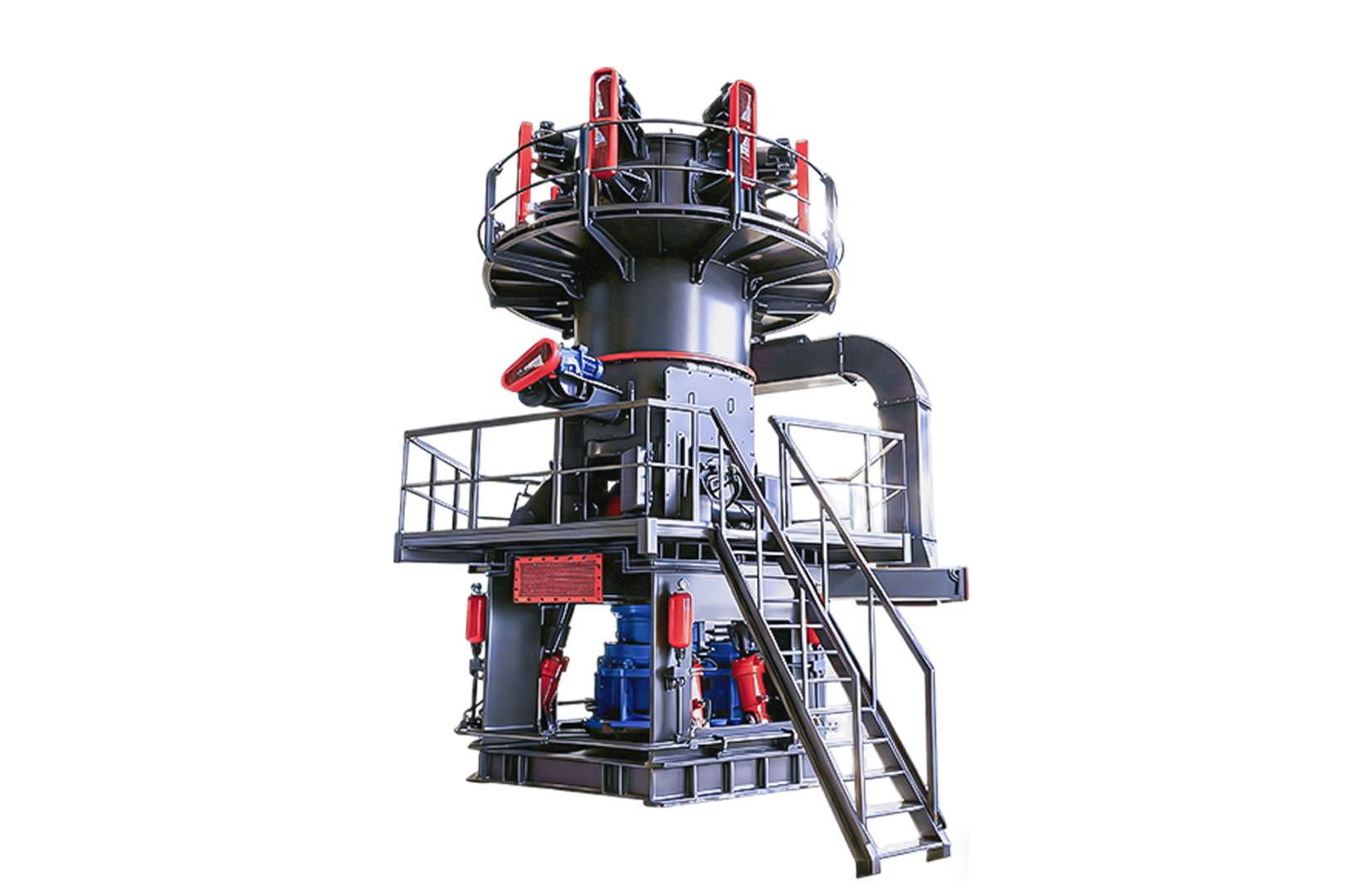
Vertical roller mill (VRM, referred to as vertical mill) relies on high pressure extrusion and strong shear force generated between hydraulic pneumatic grinding roller and electric rotating grinding disc to crush materials. Modern vertical mill system is very powerful, it will be crushing, drying, dynamic classification and pneumatic conveying directly integrated in a continuous operation of the circuit. If you want to play with the vertical mill, you must accurately control the feeding amount, hydraulic pressure and internal wind speed to stabilize the crushing bed.
Many on-site operators encounter grinding disc vibration, and their first reaction is often to blindly increase the hydraulic pressure to press the machine. As a result, the tread of the grinding roller is often abruptly destroyed. However, insiders all know that sometimes only 1% water is added to the material bed, and the vibration can be subsided instantly. In this article, we will break up the operation benchmark of the vertical mill, the mechanical design parameters and the troubleshooting logic of the old engineer’s bottom of the box, and make it clear to help you fill up the crushing efficiency of the equipment.
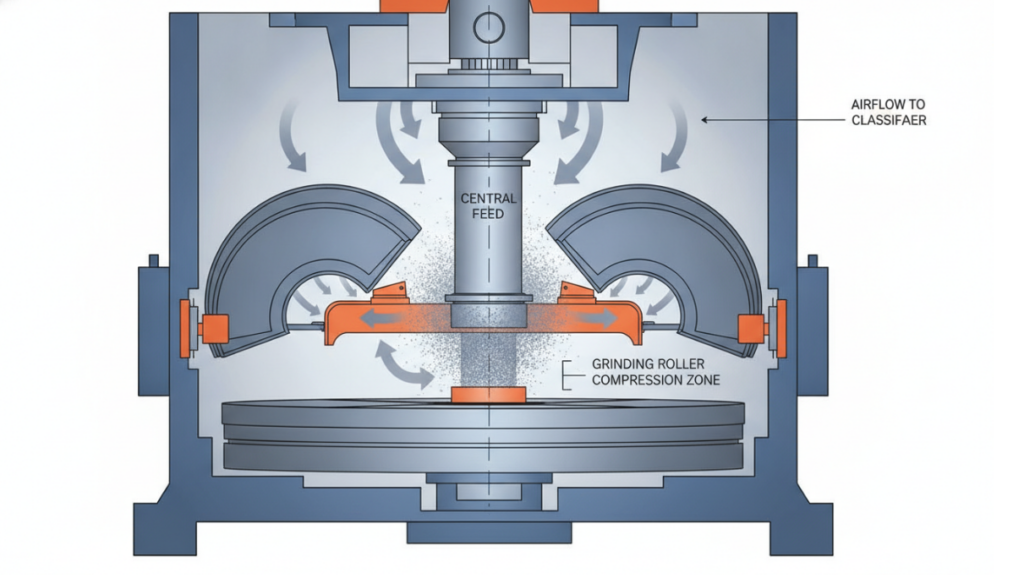
The vertical mill plays with the “principle of crushing the material bed”-it does not use iron bumps to smash stones directly, but allows particles to crush each other. The raw ore directly hits the center of the rotating grinding disc by gravity from the central feeding pipe. Then, the centrifugal force throws the material to the periphery and feeds it just under the grinding roller. In this process, the material will break along its natural cleavage surface under the huge local stress of the grinding roller, which reduces the energy consumption to a minimum.
Don’t think that the grinding roller is just “pressing down”. Due to the geometric difference between the flat (or dimpled) grinding disc and the grinding roll profile, a 1 “microslip” effect occurs in the contact zone. The strong shear force brought about by this slippage can tear hard bones such as clinker or blast furnace slag very quickly. Of course, the thickness of the material bed must be stable, generally controlled between 30 and 100mm according to the size of the mill, and the grinding roller and grinding disc must not be allowed to “grind iron”, otherwise not only the power consumption will soar, but also the equipment will not be able to carry it.
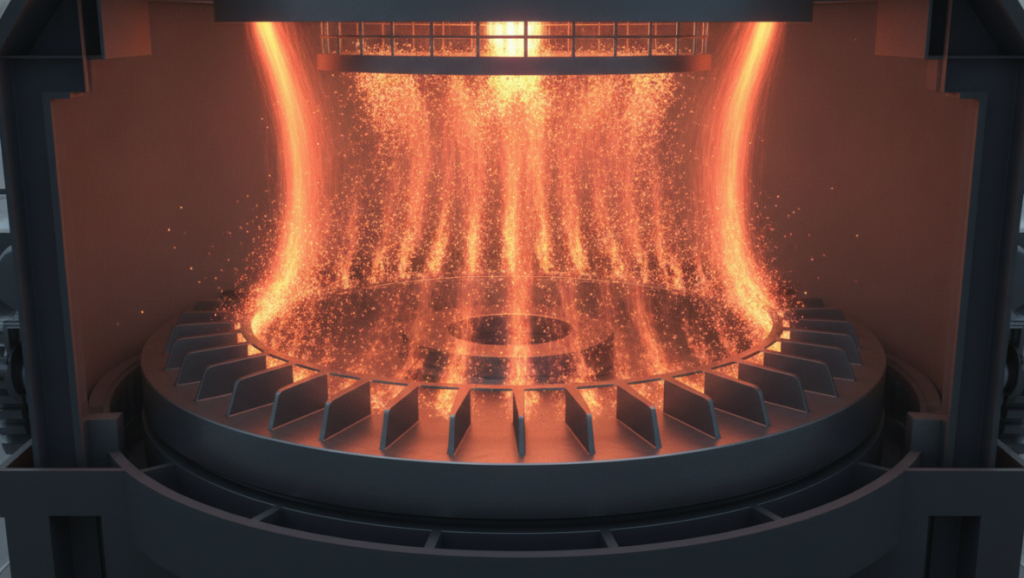
The material handling inside the vertical mill relies entirely on high-speed airflow. Hot air is sprayed from the guide vanes of the air ring at the edge of the grinding disc into the grinding. Once the freshly ground materials fall out of the edge of the mill, this strong upward air flow will take over them-while drying them instantly, while lifting them up to the dynamic powder separator. If too heavy particles cannot be blown up, they will fall back to the grinding disc and grind again. This internal circulation is extremely large and can usually account for about 80% of the total material flow.
The design of the vertical mill should not only withstand the extremely abnormal dynamic load, but also ensure the smoothness of the aerodynamic flow field. The whole mill shell is not only the pressure vessel of hot air, but also the load-bearing support of the top separator. When designing the base, engineers will deliberately isolate the huge shock generated by the reducer to prevent fatigue fracture of the concrete foundation underneath.
The dead weight of the grinding roller itself is not enough, and the real resistance to work comes from the hydraulic system. The high-pressure oil cylinder presses the grinding roller on the material bed. The core component here is the “nitrogen accumulator” directly connected to the cylinder, which is equivalent to a super pneumatic shock absorber. If the nitrogen bladder of any accumulator is broken, the hydraulic cylinder will lose its cushion and become 1 rigid iron pillar. At this time, the grinding roller will hit the grinding disc extremely violently, and it will not take a few hours to shake out internal injuries and even dry the mechanical structure to scrap.
The shape of the grinding roller directly determines the wear and maintenance cycle of the machine. The angle of the tapered roller is exactly aligned with the center of the grinding disc, which almost eliminates the lateral sliding speed, so the friction wear is very small. The drum roller (spherical roller), like a tire, has a higher degree of containment for large feeding and is more stable at the start-up stage. As for which to choose, plant managers usually have to strictly refer to the “Bond Work Index” (Bond Work Index, or grindability) of the feed to make a decision.
A good vertical mill must have a thorough understanding of 3 core parameters: residence time (Residence Time), grinding roller pressure (Roller Pressure) and cycle rate (Recirculation Rate). Only adjust one of them and ignore the other two, and sooner or later the machine will collapse.
The baffle ring is the baffle at the edge of the grinding disc, which is used to leave the material on the disc to form the material bed. If the material retaining ring is too high, the material will stay inside for a long time, resulting in excessive crushing, and the pressure difference in the mill will directly alarm. If it is too low, the material will run too fast, the grinding roller will not be full, and the machine will shake wildly. Once the chemical composition or particle size of the raw material has been permanently changed, the operator must go to the site to physically adjust the height of the retaining ring.
The greater the pressure, the higher the output is indeed, but the power consumption and grinding parts loss is also rising linearly. A smart operator will get the pressure stuck at a critical point: if you press up any more, the fine powder production will not increase. This is the limit. If you have to press hard in the face of highly abrasive materials such as Shi Ying and slag, the wear-resistant surfacing layer of the grinding disc will have to be scrapped in advance before the next shutdown for overhaul.
The speed of the dynamic separator controls the fineness of the finished product and also determines the load of the internal circulation. The higher the rotation speed, the more coarse powder is beaten back to the grinding plate, and the thicker the material bed. If the material returned by the powder selecting machine exceeds the pneumatic conveying limit of the exhaust fan, a large amount of material will collapse and hit back to the grinding disc instantly, and the whole mill will be directly “suffocated” (that is, the phenomenon of “full grinding” is often called).
In fact, the screen in the central control room often “lies” because the data collected by the sensors often conceals the real mechanical conditions. On-site technicians can’t just stare at the software alarm, they have to rely on common sense of physics to judge abnormalities.
The 1 in the central control room saw that the vibration of the grinding disc suddenly became larger, and the most common misoperation was to reduce the pressure quickly. But in fact, nine times out of ten, it’s because the feed moisture suddenly drops. Too dry materials have no cohesive force and cannot be held together under the grinding roller. 1 pressure, they slip out of fluidization. At this time, as long as 1% to 3% water is accurately injected into the grinding disc, the material bed will be honest immediately and the vibration will disappear instantly.
If it is found that the vibration amplitude of only one grinding roller suddenly becomes extremely severe, don’t doubt, it definitely corresponds to the explosion of the nitrogen bladder in the accumulator. At this time, the pressure of the hydraulic gauge may still be normal, which is extremely confusing, because the buffering effect of the gas has completely disappeared. With this kind of “hard-hitting” hydraulic cylinder, as long as the hard support for one shift, the grinding roller hub will have micro cracks, and finally can only pay for the whole assembly.
Without data, there is no basis for investigation. Deviating from the following engineering benchmarks, either the sensor is broken or the machine is worn out.
| Operational Parameter | Clinker Vertical Roller Mill | Slag Vertical Roller Mill |
| Nozzle Ring Air Velocity (m/s) | 40 – 45 | 45 – 55 |
| Mill Table Water Spray Rate (%) | 1 – 2 | 0 |
| Потребляемая мощность (кВт·ч/т) | 25 – 30 | 35 – 45 |
The vertical mill relies on extrusion and shear forces. The hydraulic system keeps the grinding roller dead on the rotating grinding disc. After the material is fed to the center, it is thrown to the edge by centrifugal force and stuck between the grinding roller and the grinding disc. Then the high-speed hot air at the bottom will blow the crushed material into the classifier at the top for classification.
The most direct physical means is to adjust the height of the disc edge retaining ring. Auxiliary means include regulating the amount of feeding, changing the speed of the classifier (adjusting the amount of material returned), or spraying water on the grinding disc to increase the cohesion of the material.
The source of all evil vibration is the “instability of the material bed”. There are many reasons, such as the material is too dry, the feed block is too large, the iron block debris is introduced into the mill, the height of the retaining ring is wrong, or the most fatal point-the nitrogen airbag of the hydraulic accumulator is broken, resulting in the shock absorber function completely failed.
The air spray ring is responsible for blowing high-speed hot air up the periphery of the mill. The wind speed and angle are precisely calculated, which can not only blow the crushed particles off the grinding disc and dry them instantly, but also “lift” them all the way to the top dynamic classifier pneumatically.
The hydraulic pressure directly determines the crushing force pressed on the material. Find the best pressure can make the yield and crushing effect double harvest. If the blind pressure, not only can not improve the fineness, but will waste electricity, resulting in rapid wear of metal parts, but also cause severe vibration.
The vertical mill uses a grinding disc and a hydraulic grinding roller to round up the 3 steps of crushing, drying and powder selection in the same machine, saving 30% to 50% less electricity than the ball mill. The ball mill is 1 a large drum, which smashes materials by rolling steel balls inside. It usually needs to be equipped with an external dryer and powder selection equipment, which has a large area and high energy consumption.