 Клирик






Поиск
The output falls off the cliff, the casing vibrates violently, or the powder suddenly becomes thicker-once these situations are encountered, don’t hesitate, your Raymonde mill must stop immediately to intervene.
Cut off the feed at the first time, but don’t rush to turn off the main fan, let it turn on, pump out the leftover material in the grinding chamber, and then quickly look at the pressure difference of the analyzer (classifier). Many on-site operators 1 met with this incident, and when they came up, they removed the grinding ring and changed the grinding roller, and went in for several hours in vain. In fact, the real root of the disease is often in the internal airflow imbalance. This article will give you a thorough understanding of the quick troubleshooting tips used by top maintenance engineers. By doing so, you can find out the fault point at once and make this lying nest equipment run again in less than an hour.
Under the pressure of downtime to check the problem of Raymonth mill, there must be a routine in my mind. After dealing with more than 300 sudden shutdown accidents, I summarized a set of “4V diagnosis method” (vibration Vibration, output Volume, wind speed Velocity, appearance Visuals). This mental model forces you to understand the most critical operating parameters before moving the wrench.
If the equipment shakes badly, the most direct reason is usually that the material mat is not evenly spread, or there is a broken hardware inside.
Look at the feed quantity first. If there is a shortage of material in the grinding chamber, the grinding roller and grinding ring will directly hit hard. At this time, you will hear the particularly harsh metal friction sound, and the machine will also follow the crazy shock. If there is no problem with the feeding, it is a mechanical failure. For example, the suspension pin shaft is seriously worn and the plum blossom frame is broken, which will completely destroy the centrifugal balance of the system. In this case, don’t say anything, stop the machine and change parts.
Once the output falls, either the pipe is blocked or the grinding parts are worn to the limit.
Focus on checking the return duct and cyclone collector. If the raw material is too wet, it will be pasted on the inner wall of the cyclone collector, jamming the “neck”, resulting in the ground powder not leaking into the discharge valve. Remember this sentence: No matter what configuration of Raymonds you are repairing, clean up the air lock valve (fan off) of the cyclone collector before you suspect that the grinding roller will not work.
If the wind pressure of the fan cannot keep up, the crushed materials will be completely suppressed in the main engine and cannot get out.
Take a look at the pressure gauge of the fan outlet. If the static pressure falls, it means that the pipeline system is leaking or the fan impeller is worn too hard. As soon as the temperature inside is high, the wind speed drops 1. These two factors together often directly trigger the thermal protection shutdown.
The powder is too coarse? Don’t think blindly, go directly to the trouble of the analyzer. If the belt of the inverter is loose or the blade of the analyzer is dropped, the large particles will slip through the powder selection area directly through the back door.
Then see if the exhaust is taking a lot of dust. The system leaks ash out, which means that the pulse bag filter is either burned or the bag inside is broken, which will directly destroy the negative pressure environment of the whole circulation system.
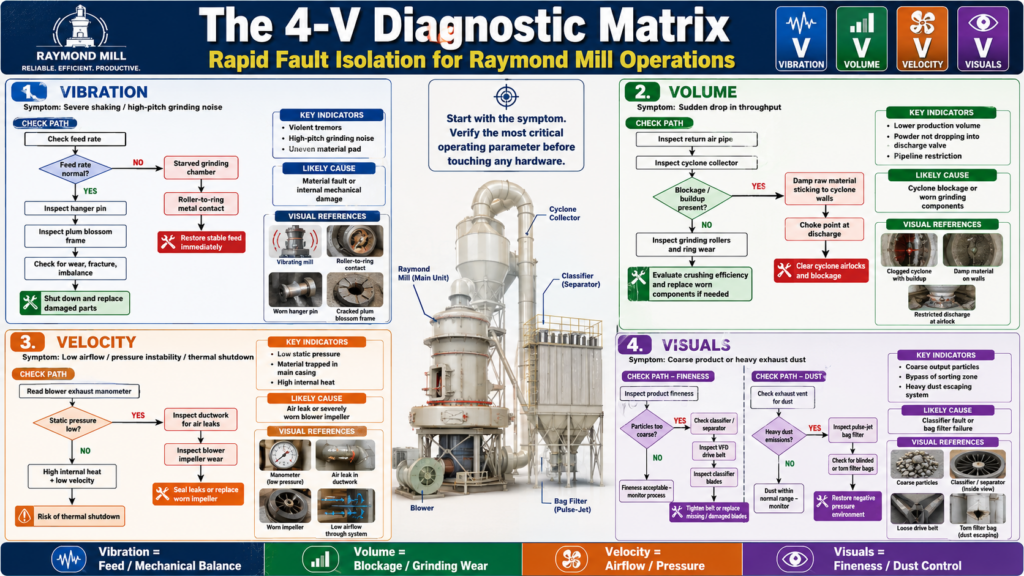
The repair of the machine has to suit the remedy to the case, and all that is saved is real money and silver production time. The following are some of the most likely problems of Raymonds under harsh working conditions, as well as very specific practical steps.
By adjusting the blade clearance of the analyzer, 80% of the particle size problem can be solved. Many technicians always like to push up the motor speed of the analyzer, trying to force the fine powder out. But there is a big hole: if the blades inside wear unevenly, the motor will overheat in minutes for you to see.
The correct way is to cut off the power and take a ruler to measure the gap between the blade and the shell of the analyzer. If the gap exceeds 5mm, don’t hesitate to change the blades directly. In addition, it must be confirmed that the parameters of the frequency converter (VFD) match the specific gravity of the material you are currently feeding.
If the grinding ring is ground with grooves of different depths, it must be re-machined or replaced immediately. The grinding roller rolls the material by centrifugal force. If hard objects such as iron blocks are accidentally mixed in, deep pits will be scraped out on the surface of the grinding ring. These pits will damage the material layer, causing local friction to soar, forcing the casing temperature to above 90 ℃.
When this happens, open the access door and check the wear surface with the naked eye. If you want to change, it is best to change the grinding ring and grinding roller set, so as to maintain the best grinding contact surface.
| Component | Normal Wear Rate / Condition | Abnormal Wear Rate / Condition | Operating Hours (Estimated)* | Suggested Replacement Thickness / Clearance |
| Classifier Blades | Uniform edge wear; stable motor temperatures | Uneven wear; causes motor overheating and coarse powder output | 2,000 – 4,000 Hours | Replace blade set when clearance gap to housing exceeds 5 мм |
| Grinding Ring | Smooth, uniform surface wear; stable casing temperatures | Accelerated wear grooves; deep gouges from tramp iron; casing temps > 90°C | 4,000 – 6,000 Hours | Re-machine or replace immediately upon deep gouging |
| Grinding Rollers | Symmetrical wear; maintains optimal grinding geometry | Localized friction spikes; deep gouging from tramp iron | 4,000 – 6,000 Hours | Replace simultaneously with the grinding ring |
A thorough cleaning of the pipeline can directly eliminate the back pressure of the system. If the fan motor current suddenly soars, it means that the heavy materials that have not been classified are deposited in the horizontal tube.
Find a rubber hammer to knock 1 on the pipe. If the sound is stuffy, it is blocked. Open the cleaning port and remove the accumulated material. When restarting, remember to adjust the wind deflector of the fan to increase the air volume by 15% to prevent problems before they occur.
If you butter the grinding roller bearing set too much, it will not only waste the oil seal on the spot, but also cause catastrophic internal pollution.
Many mechanics have a big mistake. They like to slam new butter into the bearing components every day. They always feel that the equipment is overloaded and cannot be damaged by more lubrication. This is a big mistake. If there is too much butter, the hydraulic pressure will be suppressed in it. The excess butter will harden and directly top the oil seal at the bottom. 1 the oil seal is broken, the ultra-fine stone powder will drill into the bearing cavity and mix with butter to become a very destructive “grinding paste”.
The standard practice is to add only 50 to 70 grams of high-temperature lithium-based grease per shift—under no circumstances should you be tempted to over‑lubricate. It’s best to install grease fittings with an automatic pressure-relief function, which eliminates the possibility of human error at the source.
The scene to remove obstacles, the most afraid of guessing. Last autumn, the owner of a talcum powder factory in Shandong Province jumped in a hurry. Their main Raymon mill tripped the thermal protection every three hours or more because of the overload of the main motor, and the output was even more pitiful. The on-site mechanic squad leader insisted that the spindle was deformed and killed with the bearing. He even took the drawings and was ready to order tens of thousands of new spindles in the 1. At least he had to stop work for half a month.
After our team arrived on the scene, we didn’t touch the main shaft at all. The first thing is to start the equipment and measure the wind pressure of the system. Boy, the whole circulation pipeline is full of positive pressure, and the interface is full of dust. There is no negative pressure environment at all. This shows that the interior of the host is completely suffocated by powder.
After finding the tail end along the air duct, the truth came to light: the solenoid valve diaphragm of the pulse dust collector had long been aged and broken, causing the cloth bag to be unable to clean the dust at all. Hundreds of dust removal cloth bags have been pasted into 1 “cement walls” that are blocked to death. Exhaust gas cannot be discharged. The main engine can only carry and stir stone powder under huge resistance. It is strange that the motor does not trip.
How did you finally solve it? Spent tens of dollars to change a solenoid valve diaphragm, manually hit several pulses to clean the bag. Less than half an hour before and after, the equipment restarted, the current was as stable as an old dog, and it never tripped again. This pit once again confirms a dead reason: when you encounter a car, check the gas path first, and don’t easily suspect large mechanical parts.
The feed is not uniform, or the raw material is too hard, resulting in a stable pad between the grinding roller and the grinding ring. adjust the speed of the feeder, by the way to check whether the grinding chamber fell into the metal debris.
Change the speed of the top separator (analyzer). If the speed is increased, the powder will become fine. If the speed is slowed down, the large particles will run out and the powder will become coarse.
Either the feeding is supported, or the return air pipe is blocked, causing the main motor to turn hard under the huge internal resistance. Quickly reduce the feeding quantity and check whether there is any accumulated material blockage in the pipeline.
Look at two hard indicators: first, under the condition of the best air volume, the output still dropped by 20%; Second, the wear of the grinding roller diameter exceeded 15mm. As long as you meet one, you have to change it. The specific cycle depends on how many waste parts you grind (for example, ground quartz must be much more than ground limestone waste parts).
Ash leakage means that the negative pressure in the system is gone. Hurriedly check whether the pulse bag filter is suffocated, the fan speed is not up to standard, and whether the sealing gaskets of each pipe joint are aged and scrapped.
It is very important to control the moisture of raw materials below 6%. If the moisture is too high, the ground powder will agglomerate, stick to the blades of the analyzer, and block the cyclone collector, which will soon lead to system paralysis.