 Клирик






Поиск
Maintenance of Vertical Roller Mill: Avoid Costly Halts
For every hour a vertical roller mill (VRM) experiences an unplanned shutdown, the plant loses as much as $50,000 in profits. Efficient maintenance of vertical roller mills is by no means a passive, reactive replacement of components; rather, it requires the implementation of predictive asset management—specifically, rigorous monitoring of the hydraulic tensioning system, proactive control of wear profiles in wear‑resistant parts, and the integration of acoustic emission (AE) monitoring technology. Next, you will see the core strategies being employed by leading cement plants and slag‑micro powder plants. These strategies can not only completely cut off the source of unexpected downtime, extend the life of the grinding roller sleeve by up to 30%, but also significantly reduce your annual vertical roller mill repair budget.
The sudden vertical roller mill repair will completely blow through the factory’s annual operating budget. In the event of comminuted damage to the main reducer, the direct replacement cost is often more than $250000, which does not include the devastating loss of production due to the 12-week delivery of custom spare parts. Decision makers must stop treating Lim maintenance as a tinkering mechanized task and upgrade it to a core financial risk management agreement.
| Failure Mode | Reactive Maintenance Cost & Downtime | Predictive Maintenance Cost (AE Sensors, Oil Analysis) | Net Savings |
| Main Reducer Comminuted Damage (e.g., Thrust Bearing Failure) | Cost: >250,000(directreplacementofcustomparts)Downtime:12weeksofdevastatingproductionloss(250,000(directreplacementofcustomparts)Downtime:12weeksofdevastatingproductionloss(50,000 profit loss per hour) | Integration of Acoustic Emission (AE) monitoring & continuous oil analysis | >$250,000 in direct budget saved + prevention of millions in devastating downtime profit losses |
| Premature Grinding Roller Sleeve Wear | Cost: High frequency of spare parts replacement Downtime: Unexpected shutdowns ($50,000 profit loss per hour) | Proactive control and monitoring of wear profiles | Up to 30% extended sleeve lifespan + $50,000 saved for every hour of downtime avoided |
| Hydraulic Tensioning System Malfunction | Cost: Emergency repair and parts replacement Downtime: Sudden mill halts ($50,000 profit loss per hour) | Rigorous and continuous monitoring of the hydraulic tensioning system | Completely cuts off this source of unexpected downtime; saves $50,000 per hour |
Abandoning “on-time maintenance” and moving to “condition monitoring” can directly cut these emergency expenditures of up to six figures. Factories that implement strict equipment lifecycle management have absolute control over quarterly maintenance expenditures.
To truly control vertical roller mill maintenance, asset managers need to rely on a VRM-3D framework to allocate budgets and execute maintenance actions. This combat model strips all maintenance tasks into 3 independent and deadly core layers: the driver layer (Drives), the durable layer (Durability) and the dynamic layer (Dynamics).
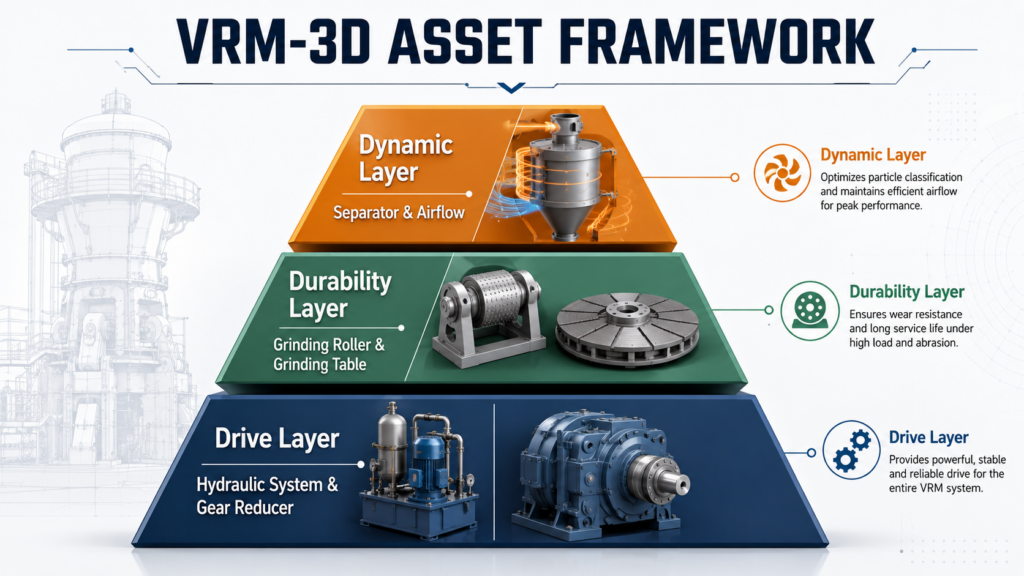
The hydraulic tensioning system and the main reducer determine the kinematic stability of the mill. Once the hydraulic pressure deviation, the extreme impact load will directly hit the reducer, will inevitably lead to premature death of the equipment.
Grinding rollers and combined grinding discs bear the most direct material wear. The accuracy of the surfacing cycle directly determines the service life of these high-value heavy assets.
The concentrator rotor and the internal aerodynamic system are stuck in the neck of the production capacity. The blade of the separator is blocked or the air seal is worn, which will force the mill to over-grind, waste several megawatts of electric energy and accelerate the consumption of the mechanical structure.
Accurate inspection of high-risk components can avoid most vicious shutdowns. The following is the engineering truth behind the core module maintenance.
The lack of nitrogen pre-charge pressure in the hydraulic accumulator is the biggest culprit to destroy the vertical mill reducer. On-site mechanics often only stare at the hydraulic oil pressure, but completely ignore the nitrogen bladder inside the accumulator. Once the nitrogen leaks, the accumulator momentarily loses the “shock absorber” function. The rigid grinding impact force will bypass the hydraulic system and directly impact the thrust bearing of the reducer with a terrible destructive force.
The irregular wear profile results in an exponential amplification of vibrations throughout the mill structure. When the grinding disc is ground into a deep “bathtub” shaped groove, the grinding roller cannot maintain parallel contact with the material bed. This misalignment directly triggers violent structural vibrations. Before the base metal has been damaged, the implementation of on-site robot surfacing welding in advance can maintain the initial geometric size and completely cut off the fatal vibration source.
The aging of the air sealing system will seriously lock the factory’s capacity limit. Worn seals will allow “false air (air leakage)” to enter the mill shell directly, which not only forces the exhaust fan (ID Fan) to run at full load and consume electricity, but also greatly reduces the amount of materials lifted to the separator by the air flow. Forced replacement of the dynamic and static seals during planned small outages can immediately eliminate this huge operating loss.
The original equipment manual will only teach you how to screw, and will never tell you how to avoid a devastating maintenance disaster. The following is the experience of first-line senior engineers who smashed real money out of the pit.
If you are hardfacing directly on a roller sleeve with micro cracks inside, it will definitely break structurally during operation. The high temperatures generated by welding can tear these hidden microcracks, causing large areas of the roll sleeve to peel off during operation. Ultrasonic testing (UT) of the base metal must be mandatory before any surfacing budget is approved.
The standard vibration sensor will only alarm after the mechanical structure has been physically damaged. When the central control room hears the bearing defect alarm of the vibration sensor, this component has no other way but to scrap the whole set. Immediately switch to acoustic emission (AE) monitoring technology, which can accurately capture the high-frequency friction sound generated by metal microscopic fatigue 6 months before the vibration sensor detects an abnormality.
A European cement plant with a daily output of 5000 tons, simply by adjusting its vertical roller mill maintenance strategy, completely eliminated the unexpected failure of the reducer in 24 months.
In the past, the plant’s raw mill was bound to have two large-scale unplanned shutdowns per year due to thrust bearing damage. After the new maintenance director took office, a continuous acoustic emission (AE) sensor was directly installed on the main reducer, and the maintenance team was required to record the nitrogen pressure data of the hydraulic accumulator every week.
In the first quarter of implementation, the AE sensor captured the abnormal high-frequency friction signal. The team followed through and locked the root cause directly to a leaking nitrogen accumulator-it was silently amplifying the impact load on the device. By replacing a $500 bag during a planned 2-hour shutdown, the plant successfully avoided 1 catastrophic $300000 vertical roller mill repair accident.
Roller sleeves typically require a hardfacing weld every 3,000 to 5,000 hours of operation, depending on the abrasiveness of the raw materials (e. g. high silica clinker has a very different loss than soft limestone). Senior asset managers never look at the running time, but directly use the wear profile scanning tool to finalize the surfacing schedule based on the accurate data of geometric loss.
The high vibration results from a 3 fatal defect: extreme instability of the material bed (abnormal feed rate or failure of the water spray system), severe misalignment of the wear profile between the grinding roller and the grinding disc, or rupture and failure of the nitrogen bladder in the hydraulic tensioning system.
The annual maintenance budget usually accounts for 2% to 4% of the initial purchase cost of the equipment. However, historical field data shows that once predictive technologies such as oil particle analysis and AE monitoring are connected to completely eliminate emergency air spare parts and worker repair overtime, this annual expenditure will be abruptly cut by 15-20%.
If it is a shallow surface crack, it can be repaired by carbon arc gouging and local special welding. However, if the structural cracks have reached as far as the casting base metal, usually only scrap and replace the entire sector disc liner. Because under heavy operating loads, any weak points of repair welding will be quickly re-torn.
Nitrogen is the “mechanical spring” in the hydraulic accumulator “. The precise inflation pressure can perfectly absorb the violent vertical impact force generated during the grinding process. Once the pressure is low, these deadly shock waves will directly penetrate the hydraulic system and bombard the mechanical transmission spindle and bearings.
Passive maintenance is to use the parts until they are completely scrapped, in exchange for a long shutdown and associated damage to peripheral equipment. Predictive maintenance uses data streams-such as high-frequency acoustic signatures and oil particle counts-to intervene and replace parts at stuck points in time before they actually break.
The false air leaking from the seal of the aging shell will directly bypass the grinding area and fill the load of the exhaust fan. This will frantically weaken the lifting and cleaning ability inside the mill, causing the material to be unable to be blown up and hit back to the mill again, thus causing extremely harsh working condition vibration.