 Клирик






Поиск
If you are in the mining, construction, or mineral processing industry, you already know that raw materials alone don’t yield the highest profits. When it comes to gypsum, the real commercial value lies in processing. Many plant owners and investors ask: Why should we invest in a calcination and grinding line instead of just selling raw gypsum ore?
In this guide, we will break down the differences between raw gypsum ore and calcined gypsum, explore why the market is shifting toward processed powder, and look at the exact equipments for calcined gypsum production line needed to make it happen.
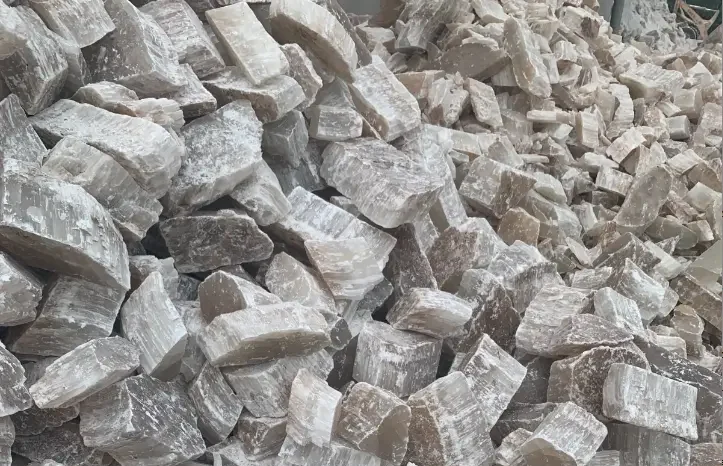
Calcined gypsum (frequently referred to in everyday industry terms as dry gypsum powder or plaster) is created when natural raw gypsum rock undergoes a controlled heating process called calcination.
To understand what makes it unique, it helps to look at its transformation from raw stone:
▸ From Raw Stone to Dehydrated Powder: Natural gypsum quarried from the earth (chemically known as dihydrate) contains two locked molecules of crystal water (CaSo4.2H2O). In its raw form, it is basically a soft, inert rock.
▸ The Heating Process: When this raw stone is crushed and heated in a kiln or calciner, the heat drives off most of that trapped crystal water.
▸ The Result: The de-watered material turns into a reactive powder (anhydrous CaSo4).
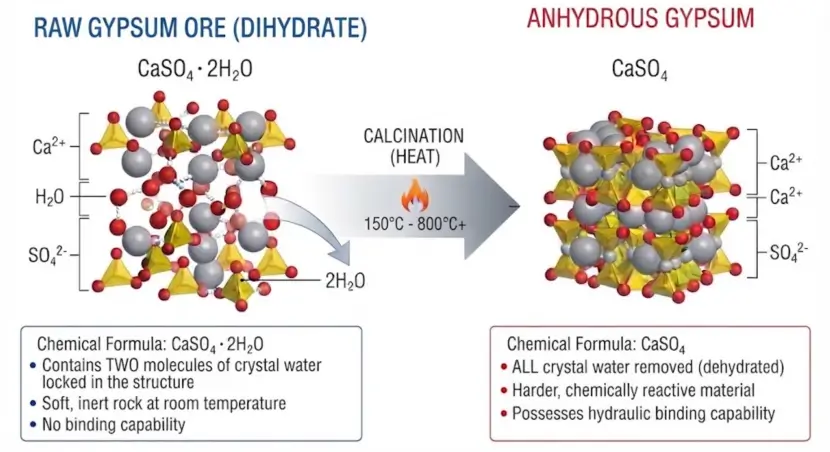
Unlike raw gypsum rock—which just sits in water without changing—calcined gypsum gains hydraulic activity. The moment you mix calcined gypsum powder back with water, it absorbs it, hardens rapidly, and locks into a dense, durable crystalline structure. This ability to set, bond, and cure is why calcined gypsum is the essential base material for everything from premium wall plasters and self-leveling floor mortars to industrial molds and cement retarders.
● Physical Comparison: Hardness, Density, and Durability
Physically, raw gypsum ore is a very soft, stable mineral with a Mohs hardness of 2 and zero inherent binding strength, making it suitable only as a bulk stone or basic filler. In contrast, calcined gypsum powder—when mixed with water and allowed to cure—forms a dense, interlocking crystalline matrix that provides the high structural integrity, density control, and durability required for modern building products.
● Chemical Reactivity: From Dead Stone to Active Binder
Chemically, raw gypsum is entirely inert at room temperature, meaning it will sit in water indefinitely as a wet paste without hardening or developing any cohesive strength. Calcined gypsum, however, possesses powerful hydraulic activity; because part of its crystal water has been driven off, it urgently seeks to rehydrate, triggering a rapid exothermic reaction that converts a liquid slurry into a solid, durable mass simply by adding water.
● Real-World Performance & Functional Differences
In real-world performance, these distinct properties decide completely separate industrial applications where the two forms cannot substitute one another. Raw gypsum ore is strictly utilized as a passive additive, such as a slow-dissolving set retarder in cement manufacturing or a low-grade mineral filler. Meanwhile, calcined gypsum serves as the active, indispensable structural backbone for high-performance applications like drywall cores, self-leveling floor mortars, and precision architectural molds.
| Property | Dihydrate Gypsum (Raw gypsum ore) | Anhydrite Type III (Soluble anhydrite) | Anhydrite Type II (Insoluble hard anhydrite) |
|---|---|---|---|
| Chemical formula | CaSO₄·2H₂O | CaSO₄ | CaSO₄ |
| Crystal water content | 20.9% (2 water molecules) | ≈0% (virtually none) | 0% |
| Crystal structure | Flat/pillar-like layers | Porous and loose | Dense and solid mass |
| Density (g/cm³) | 2.30 – 2.35 | ≈2.58 | 2.93 – 3.00 |
| Mohs hardness | 1.5 – 2.0 | — (very fine powder) | 3.0 – 3.5 |
| Calcination temperature | Natural, not calcined | 200 – 360°C | 400 – 700°C |
| Production route | Natural mining | Deep-heating hemihydrate to dry | High-temp calcining |
| Setting behavior | Does not set | Fast setting (absorbs water quickly) | Needs a chemical activator to set |
| Strength after setting | — | Low (unstable strength) | High after activation (up to 30 MPa+) |
| Solubility (in water) | Slightly soluble | Soluble | Insoluble |
| Main applications | Cement retarder gypsum board feedstock soil amendment sculpture stone | Desiccant quick-set gypsum regulator | Self-leveling floor mortar gypsum blocks floor gypsum (used activated) |
Example 1: Cement Retarder (Raw ore vs. Controlled calcined gypsum)
Raw gypsum ore is the ideal, traditional retarder for cement because its two crystal waters dissolve at a controlled, moderate rate during the early hydration stage, acting as a stable “brake” to prevent flash-setting. In contrast, anhydrous gypsum or heavily calcined forms cannot provide this balanced retardation because their aggressive thirst for water would disrupt the normal setting behavior of the cement matrix.
Example 2: Self-Leveling Mortar & Wall Putty (Why raw ore just doesn’t work)
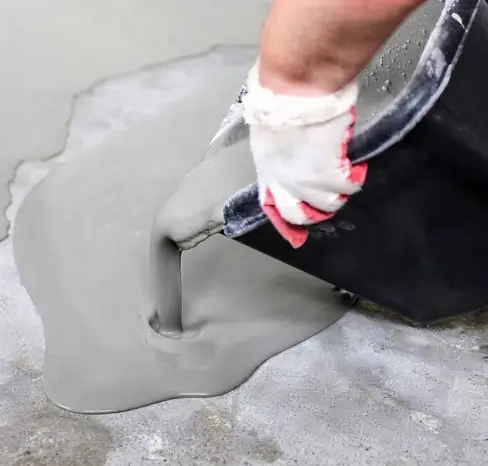
Raw gypsum ore is chemically dead in terms of self-curing and cannot work here because its crystal structure is already fully saturated and inert, acting merely as a weak, non-binding filler that turns to dust upon drying. Conversely, anhydrous gypsum produced via rotary kiln calcination possesses high rehydration reactivity, allowing it to rapidly absorb water, reform crystal networks, and deliver the exceptional compressive strength and smooth leveling required for modern flooring.
Example 3: High-End Fillers (Paints, plastics, and paper)
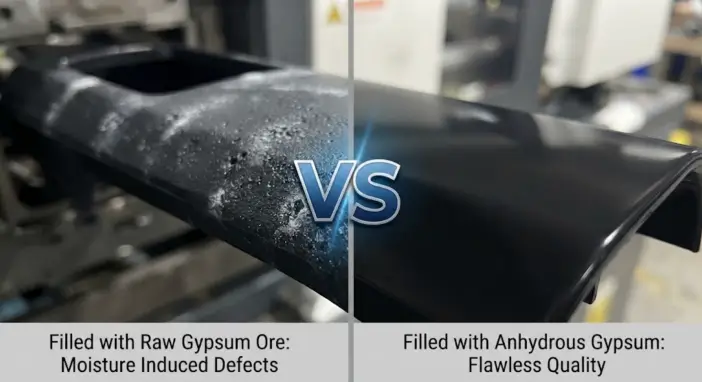
In high-performance applications like plastics and specialty paints, raw gypsum ore cannot be used directly because its bound crystal water would vaporize and cause bubbling during high-temperature polymer processing. Therefore, raw ore must first undergo deep dehydration in a rotary kiln to become moisture-free anhydrous gypsum, serving as a stable, dry, and functional filler that reinforces the material without compromising its chemical integrity.
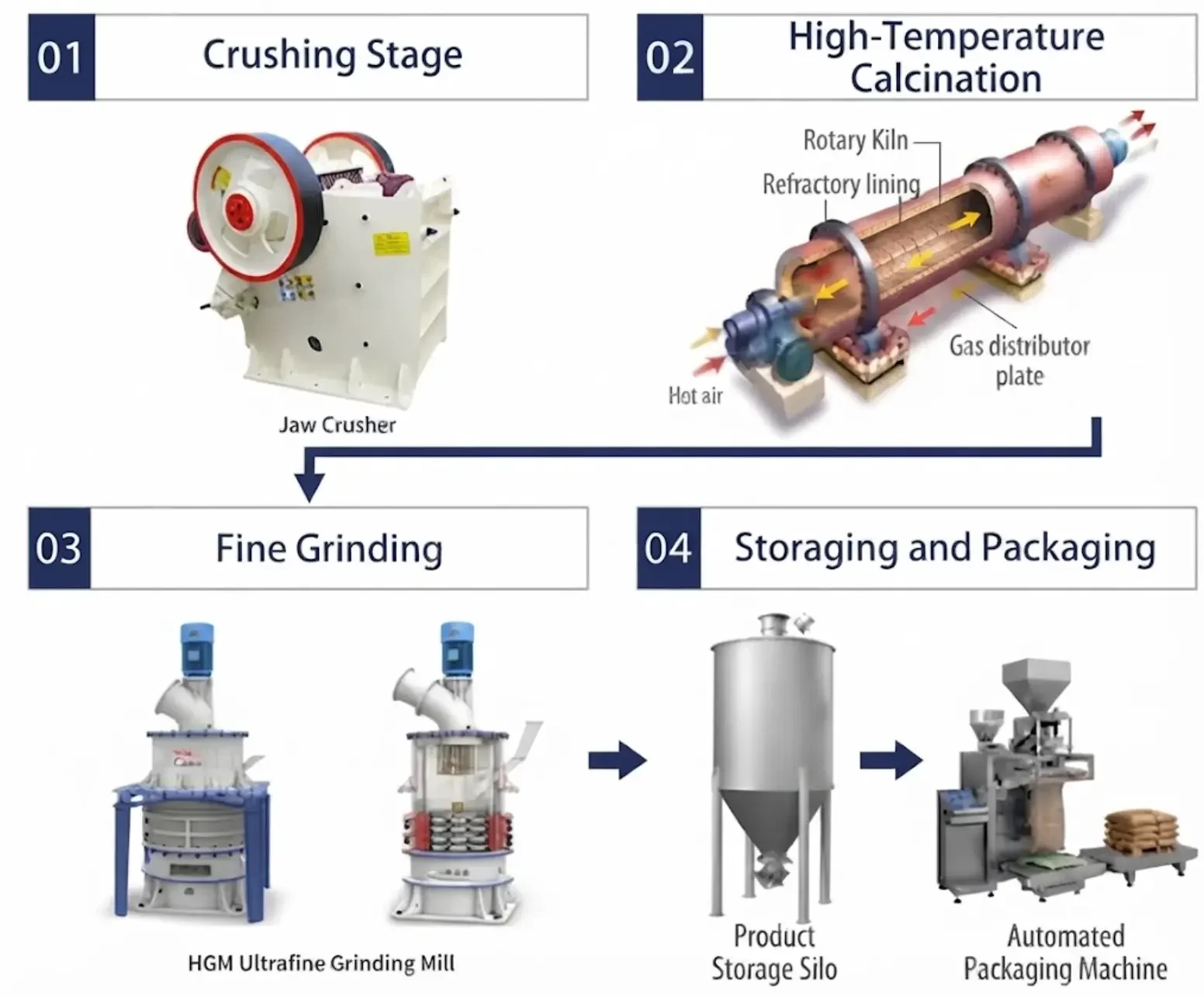
▸ Crushing Stage (Jaw and Impact Crushers for Primary & Secondary Size Reduction)
▸ High-Temperature Calcination (Rotary Kilns and Fluidized Bed Calciners)
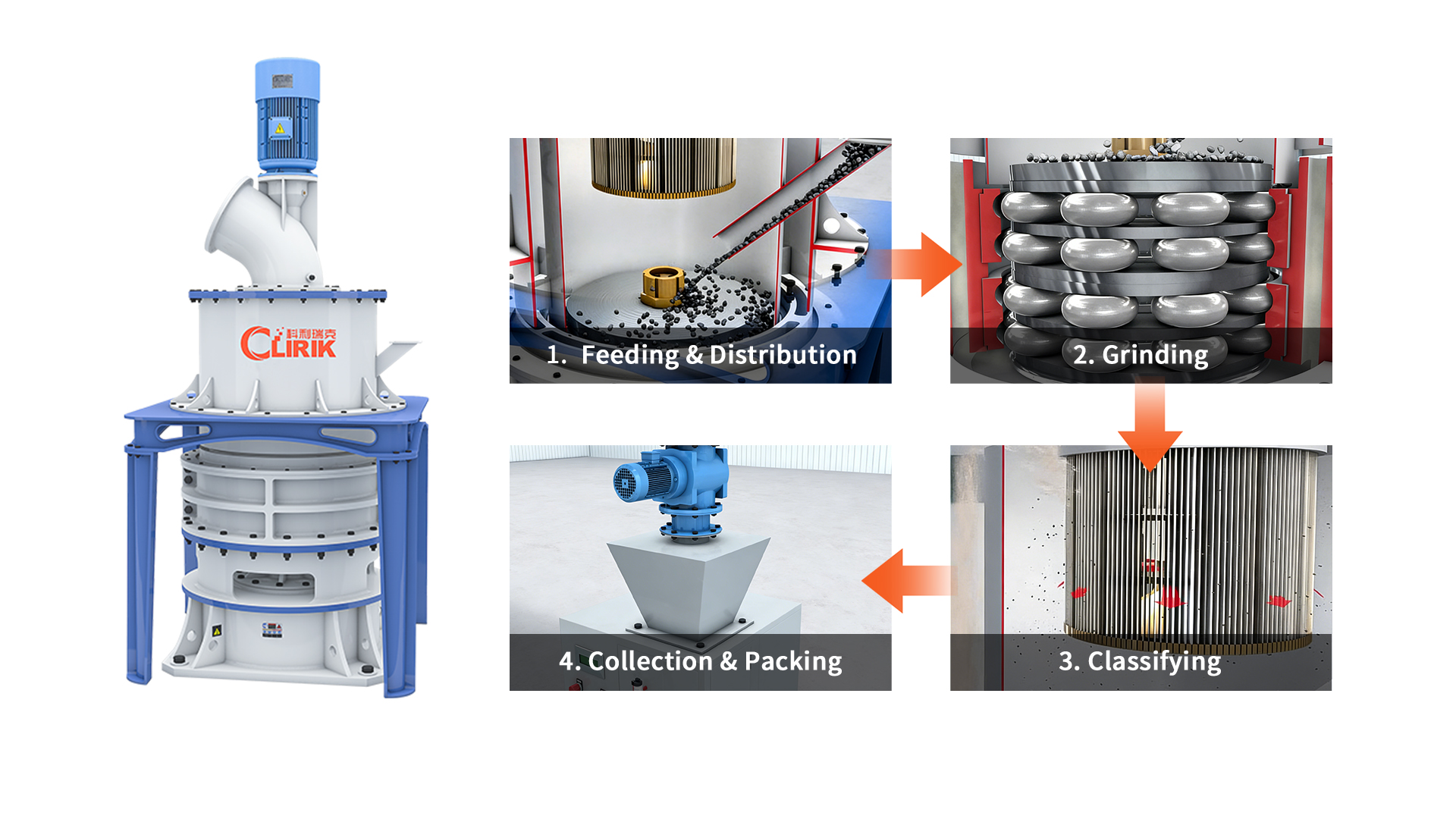
▸ Fine Grinding and Air Classification (Vertical Mills & Raymond Mills)
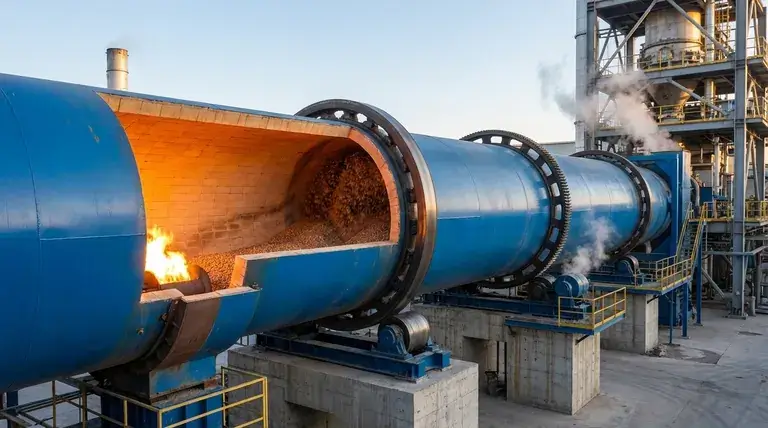
Challenge 1: Keeping the Right Temperature During Calcination -Producing Calcined Gypsum requires heating gypsum to temperatures typically exceeding 600°C, and sometimes as high as 800°C – 1000°C, to remove all chemically bound water. At such extreme temperatures, maintaining precise, stable heat across the entire rotary kiln is difficult. Even slight overheating or temperature fluctuations result in incomplete conversion (residual dihydrate) or massive spikes in energy consumption.
✔Our Solution: The Clirik rotary kiln is engineered to overcome these challenges, providing the perfect synergy of thermal control, efficiency, and stability:
• Advanced Combustion Control System: Ensures the entire calcination zone maintains a consistent, high-temperature plateau, guaranteeing thorough dehydration without energy waste.
• Clirik Rotary Kiln Advantage: Equipped with high-precision burners and a multi-point temperature monitoring system (spanning the firing hood and mid-kiln), our kiln provides real-time, closed-loop control over both flame temperature and length.
• Superior Insulation & Thermal Efficiency:Stabilizes the internal thermal regime, ensuring every ton of material reaches the precise required conversion temperature while minimizing heat loss.
• The kiln shell is constructed with premium, heavy-duty refractory materials and multi-layer insulation designed to withstand ultra-high temperatures while maximizing energy retention.
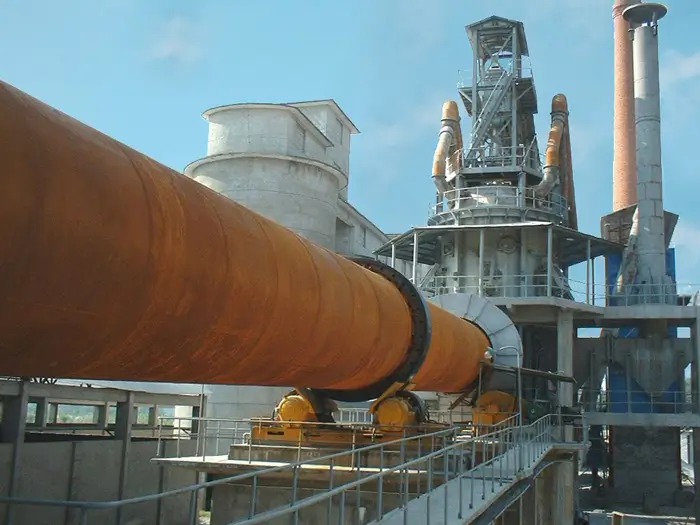
Challenge 2: Avoiding Over-Burning and Keeping Material Active -This is the most critical technical risk in high-grade anhydrite production. If material remains in the ultra-high heat zone for too long, or experiences localized hot spots, it undergoes an irreversible crystalline phase change, resulting in “dead-burned” anhydrite. Dead-burned material possesses zero hydration activity, causing severe quality issues in downstream products, such as erratic setting times in self-leveling compounds or structural failure in high-strength gypsum boards.
✔Our Solution: The Clirik rotary kiln is engineered to overcome these challenges, providing the perfect synergy of thermal control, efficiency, and stability
• Optimized Kiln Geometry & Speed Matching:Precisely controls the “residence time” of the material within the critical high-heat zone, ensuring full dehydration occurs just before the material is moved out of the intense heat, preventing over-burning.
• Through precise scientific calculation, we engineer the perfect synergy between the kiln’s inclination angle and rotational speed to match your specific production requirements.
• Gentle Tumbling & Uniform Heating Dynamics: Avoids localized overheating common in static or fluidized bed systems, ensuring every single particle is exposed to the same uniform heat treatment.
• The slow, stable rotation of the kiln creates a continuous, even curtain of material. This ensures gentle, thorough heat exchange between every particle and the hot air stream, resulting in high-activity, premium anhydrite with zero dihydrate residue.
Challenge 3: Getting Uniform Fineness With Stable Productivity-Traditional mills struggle to balance high output with precise, ultrafine particle sizes, making it difficult to adapt to diverse market needs while maintaining stable, continuous productivity.
✔Our Solution: The HGM series is engineered to overcome these limitations, providing the perfect synergy of precision, flexibility, and performance:
• Market-Driven Adaptability: Instantly switch production fineness (ranging from 300 to 3000 mesh) to meet specific customer orders and diverse industry applications without re-configuring the line.
• Precision Classification: Our advanced variable-frequency classifier guarantees a perfectly consistent, narrow particle size distribution, ensuring zero coarse contamination.
• High-Efficiency Grinding: An optimized roller mechanism maximizes grinding force, allowing you to achieve ultra-fine powders while maintaining maximum, stable throughput.
• Non-Stop Operation: The stable closed-loop system ensures a continuous, reliable production flow, protecting your productivity while guaranteeing quality.
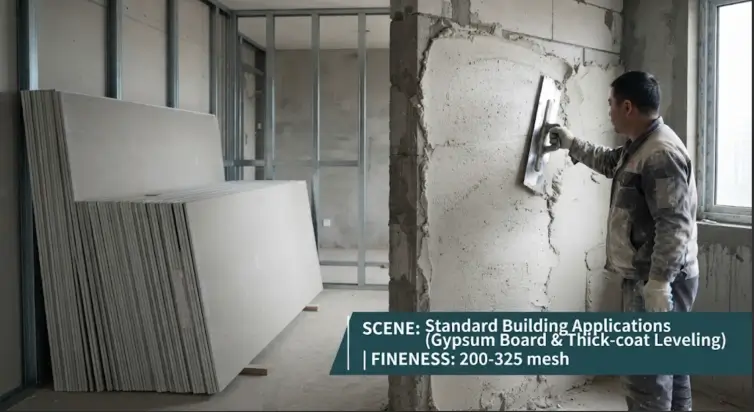
✦Standard & Medium Fineness (200 Mesh – 325 Mesh)
Characteristics: Relatively coarser particles with good permeability and fast setting properties.
Key Applications:
• Construction & Drywall: Widely used as the core material for standard plasterboards, gypsum wall panels, and traditional interior base-coat plasters.
• General Masonry: Applied in block bonding and rough construction leveling where high surface smoothness is secondary to structural volume and fast setting.
✦Fine Powder (400 Mesh – 600 Mesh)
Characteristics: Balanced texture offering improved surface coverage and moderate mechanical strength.
Key Applications:
• Interior Finishing & Skim Coats: Perfect for wall putty, smooth skim coating, and decorative architectural plastering, providing a clean, paint-ready surface.
• Ceramic Molds: Used in traditional ceramic casting molds where moderate absorption and detail reproduction are required.

✦Ultrafine Powder (800 Mesh to 3000+ Mesh)
Characteristics: Extremely high specific surface area, ultra-smooth texture, and dense crystal packing after hydration.
Key Applications:
• High-End Architectural Decors & Cornices: Used for intricate interior moldings, ceiling roses, and high-definition decorative castings.
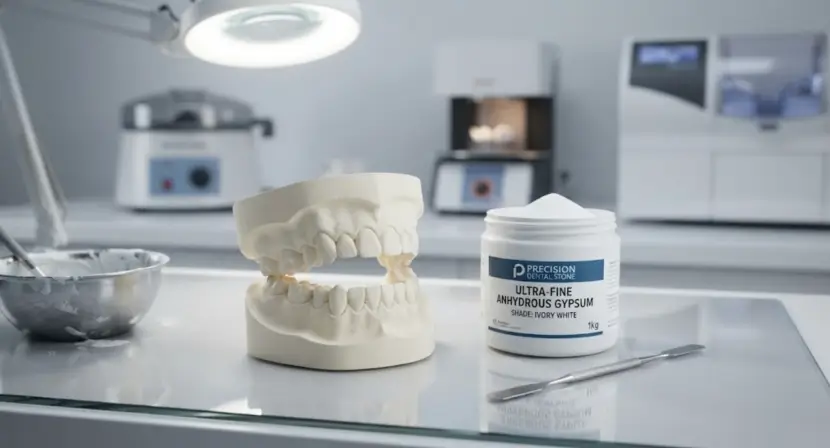
• Precision Industrial & Medical Molds: Essential for high-precision ceramic casting, precision machinery molds, and medical orthopedic bandages or dental casts where micro-details are critical.
• Specialty Chemical Fillers: Applied in specialized coatings, high-end paints, and composite materials as a functional filler.