 Clirik





Search
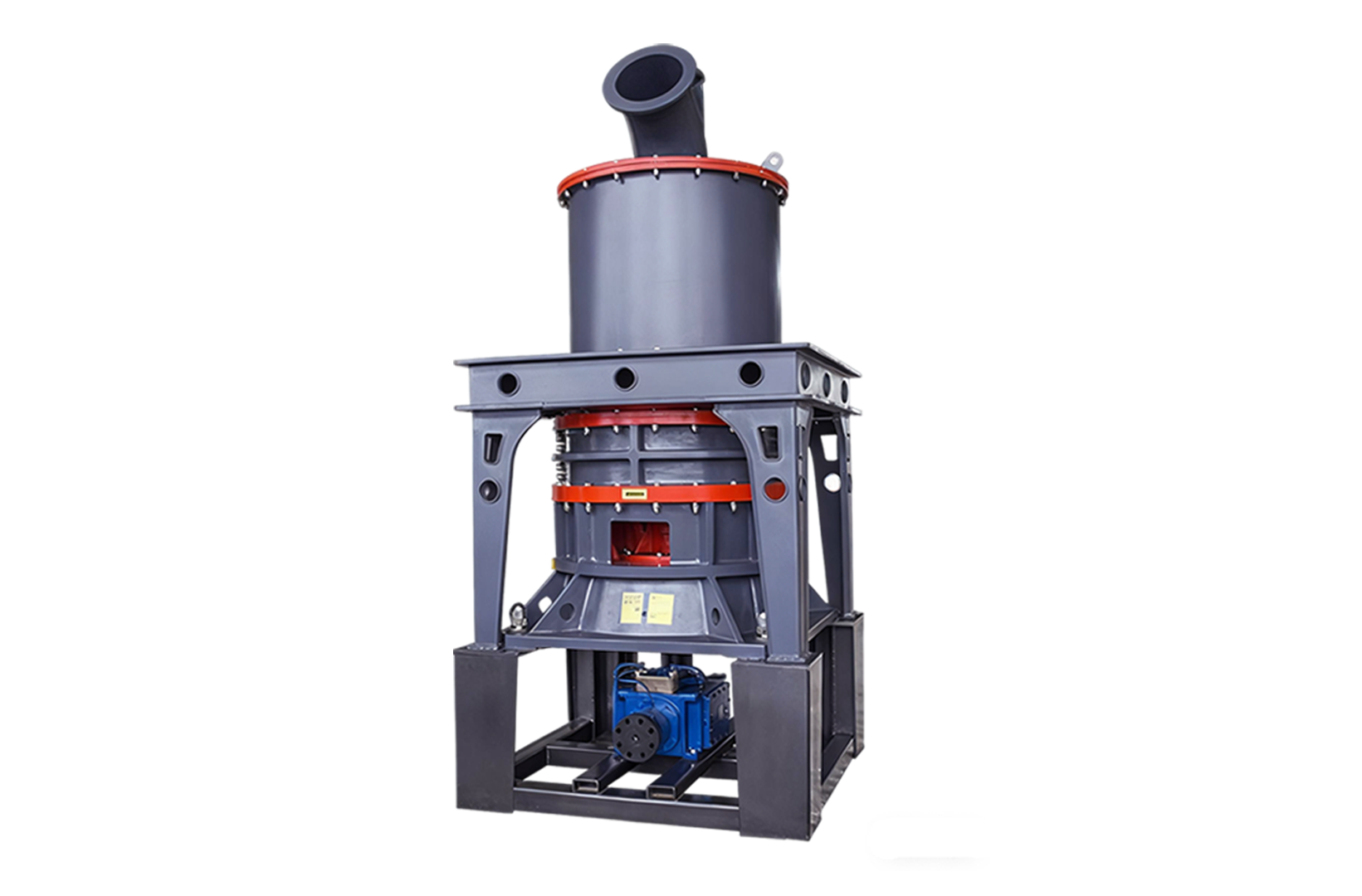
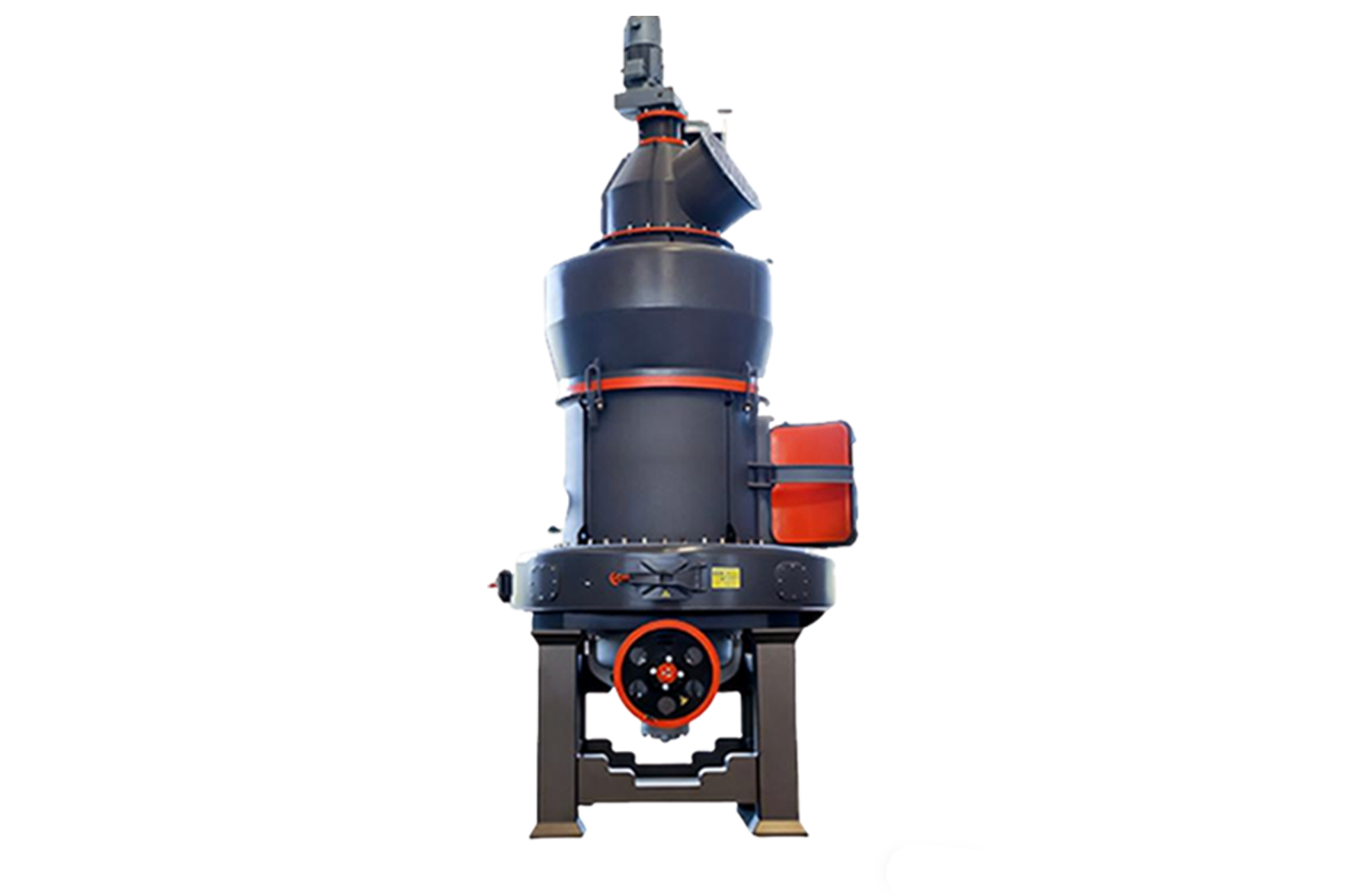
The core working principle of Raymond mill, to put it bluntly, is to use centrifugal force to make the high-speed rotating grinding roller press on the stationary grinding ring for rolling, and at the same time rely on the internal wind network system to blow the crushed material into the classifier for classification. The understanding of this principle directly determines the daily powder output and the quality of the finished powder in your factory. Many factory managers directly apply the factory default settings, resulting in a loss of 15% to 20% of potential capacity. In fact, as long as you keep an eye on two variables-the stability of the feed and the negative pressure air volume-you can force out the limit capacity of this equipment. Let’s break up its mechanical principle and give you a practical operation framework that can be directly used to raise production.
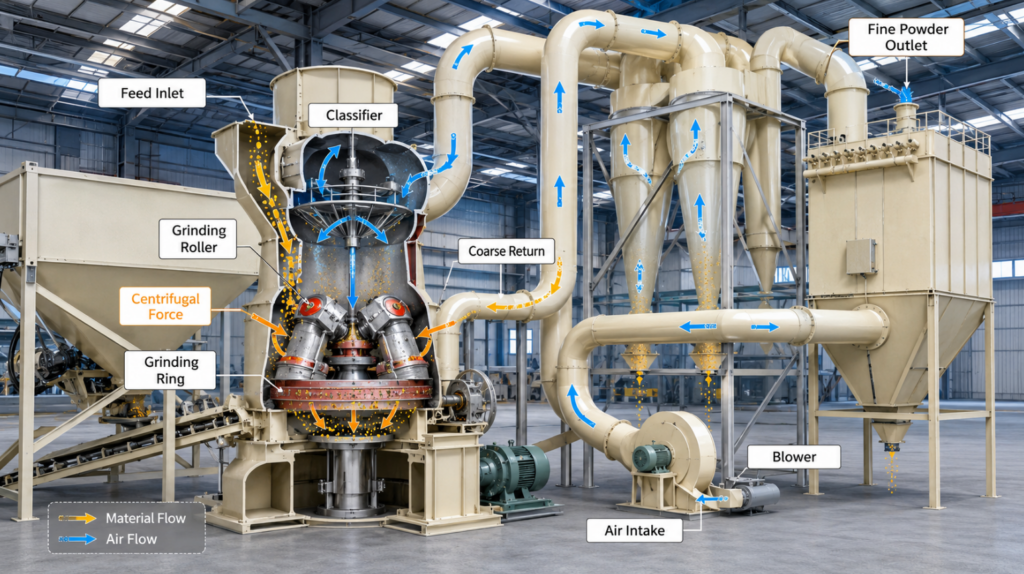
Understanding the physical operation logic in the grinding chamber can help you avoid most of the illegal operations. The whole powder process is essentially a dead cycle of “mechanical rolling” plus “airflow classification.
Spindle high-speed rotation, with a plum blossom frame and hanging on the roller assembly ran together. Centrifugal force throws the grinding rollers out, rubbing them tightly against the stationary grinding ring. At this time, the special shovel blade installed on the chassis will shovel the raw materials (such as limestone, gypsum or barite) and plug them directly into the gap between the grinding roller and the grinding ring. Under this continuous and huge crushing force, the ore raw ore is crushed into fine powder.
The size of the air volume determines the distribution of the final finished powder. After the material is crushed, the blower at the bottom begins to blow into the grinding machine. This updraft will blow the freshly ground powder all the way to the classifier (classifier) at the top of the machine. The blades of the powder separator are constantly rotating, and when they encounter unqualified coarse particles, they are directly returned to the grinding cavity to be rolled again. However, the fine powder that meets the standard smoothly passes through the blades, runs all the way to the cyclone collector along the air flow pipe, and settles down to become the final finished product.
Many mechanics and field operators have a common problem: they have to wait for the machine to stop before they do maintenance. In fact, dynamic optimization is the king of increasing production. We have summarized a set of O.A.E. rules (operation, airflow, equipment), which is a very strict technical framework designed to fill your Raymonds production.
Maintaining a suitable material bed (material buffer layer) can prevent the grinding roller and grinding ring from directly “iron touching iron” dry grinding. The material given by the operator must be in line with the current grinding capacity of the machine. If the feeding is too little, the machine will vibrate crazily and even waste the grinding ring directly. If the feeding is too fierce, a thick layer of material bed will accumulate at the bottom of the machine, which will remove all the impact force of the grinding roller. Not only will the grinding efficiency plummet, but also the air duct will be blocked. After listening to the advice, directly install an automatic weighing feeder in the front section to completely stabilize the load of continuous feeding.
The opening of the blower door directly determines the number of microns of your powder. The whole wind network system must run in the “negative pressure” state, so as to ensure that the dust does not leak out and the material is transported smoothly. You have to keep an eye on the residual air duct-the friction heat of the machine and the evaporation of water from the material will produce excess gas, which must be discharged through the bag of the dust collector. Once the cloth bag is blocked, the inside of the system will be suppressed into “positive pressure”, the pumping of the blower will be finished instantly, and the output of the whole line will lie down directly.
If the blade is ground flat, the material will not enter the grinding area at all. We have measured the data on the spot. As long as the wear rate of the shovel blade reaches 30%, the total output can drop up to 18%, because your grinding roller is running against the empty grinding ring most of the time. Remember, the blade must be checked every 72 hours. In addition, the gap between the blade of the powder separator and the shell must be stuck, otherwise once the coarse particles leak in, the whole batch of fine powder products in your 1 will be completely destroyed.
| Symptom | Mechanical Cause | Immediate Fix |
|---|---|---|
| Grinding output drops significantly | Shovel blade wear reduces material feeding efficiency; worn blade fails to push material into the grinding zone | Inspect and replace the shovel blade when wear reaches the recommended limit |
| Grinding roller runs against an empty grinding ring | Blade surface becomes flat due to excessive wear, preventing proper material entry | Restore blade profile or install a new calibrated blade |
| Powder production decreases by up to 18% | Material circulation inside the grinding chamber becomes unstable due to poor blade performance | Check blade condition every 72 hours and adjust maintenance intervals |
| Coarse particles appear in finished powder | Excessive gap between classifier blade and housing allows unqualified particles to bypass separation | Adjust the classifier blade-to-shell clearance to the specified tolerance |
| Finished powder quality becomes inconsistent | Separator cannot effectively separate fine and coarse particles | Recalibrate the separator gap and verify airflow and classification performance |
| Grinding efficiency becomes unstable | Incorrect blade position or separator clearance disrupts internal material flow | Perform blade alignment checks and fine-tune gap settings |
The factory manual will only teach you how to assemble the machine, and will not tell you the practical traps of wiping out the production capacity. The following are the lessons learned by the old guns on the scene with money.
Don’t think that the faster the material is poured into the hopper, the higher the output will be. Overload feeding will only plug the grinding chamber, cut off the updraft of the blower, and finally directly trigger the overload protection of the main motor, and the whole machine will stop instantly. The correct approach is to stare at the ammeter of the main motor and keep the amperage in the rated operating range specified by the manufacturer.
As long as the moisture content of the raw materials exceeds 6%, the inside of the machine will definitely paste into a ball. The wet powder will stick to the grinding ring, paste the blades of the separator, and even block the conical discharge port of the cyclone collector. The high temperature generated by grinding will turn this water into water vapor, which is mixed with the powder and directly becomes mud. Therefore, in case of materials with high water content, the dryer must be installed before entering the Raymond mill.
What is the maximum feed size for a standard Raymong mill?
Conventional models require feed sizes to be controlled between 15mm and 30mm. If you throw a large stone of more than 30mm into it, it will not only smash the blade, but also cause the entire machine frame to vibrate violently. Before entering the mill, it is best to use a jaw crusher to make a coarse crushing.
How to adjust the rayon grinding powder thickness?
Mainly rely on the frequency converter to adjust the speed of the classifier (classifier). The faster the speed, the larger the particles can not pass, the finer the powder will come out; the slower the speed, the slightly coarser particles can pass through.
Why is my Raymondmill shaking so much?
The violent vibration is basically due to material breakage in the grinding chamber. Without the material as a buffer layer, the heavy grinding roller directly hits the steel grinding ring hard. In this case, quickly increase the amount of feed, or immediately stop the machine to check whether the grinding roller has been worn out.
What is the difference between Raymondo mill and ball mill?
Raymonds mill crushes the material on the ring by centrifugal grinding rollers, which is suitable for processing non-metallic minerals with Mohs hardness below 9.3. The ball mill is to rely on the impact of the steel ball in the drum to smash the material, it can deal with harder, highly abrasive material, and often used in wet (water mill) grinding process.
How often does the grinding roller assembly need to be lubricated?
The high-temperature-resistant industrial butter must be beaten once per shift (8 to 12 hours). The grinding roller bearing works under extremely high temperature and huge radial load. Once the oil is broken, the bearing will lock up immediately. The following shutdown and overhaul can make you lose a lot of money.
Can Raymonds grind flammable materials (such as coal)?
Milled coal powder must do professional explosion-proof modification. Standard models do not have an inert gas system and an explosion-proof valve at all. If you really want to dry pulverized coal, you must use a special coal mill with ATEX explosion-proof certification, otherwise the risk of dust explosion is great.