 Clirik





Search
In order to really do a good job in the maintenance of vertical roller mill (vertical mill), the key is to isolate and accurately measure the wear margin of the three core components: grinding roller, grinding plate liner and hydraulic stretching cylinder. To put it bluntly, the inspection of these components in place or not directly determines whether your plant can calmly carry out a 12-hour planned overhaul or be forced to endure a catastrophic unplanned shutdown of up to 15 days. Most original equipment (OEM) manuals on the market will only perfunctorily tell you to “check the lubrication and tighten the bolts”. But in this article, I will directly tell you how to use specific acoustic characteristics to accurately predict bearing failure a full 3 weeks before thermal runaway occurs. I will also analyze the microcrack patterns that destroyed the new surfacing grinding roller. Let’s break it off. Where are the hidden mechanical stress points that make cement plants and mining enterprises lose millions of production capacity every year.
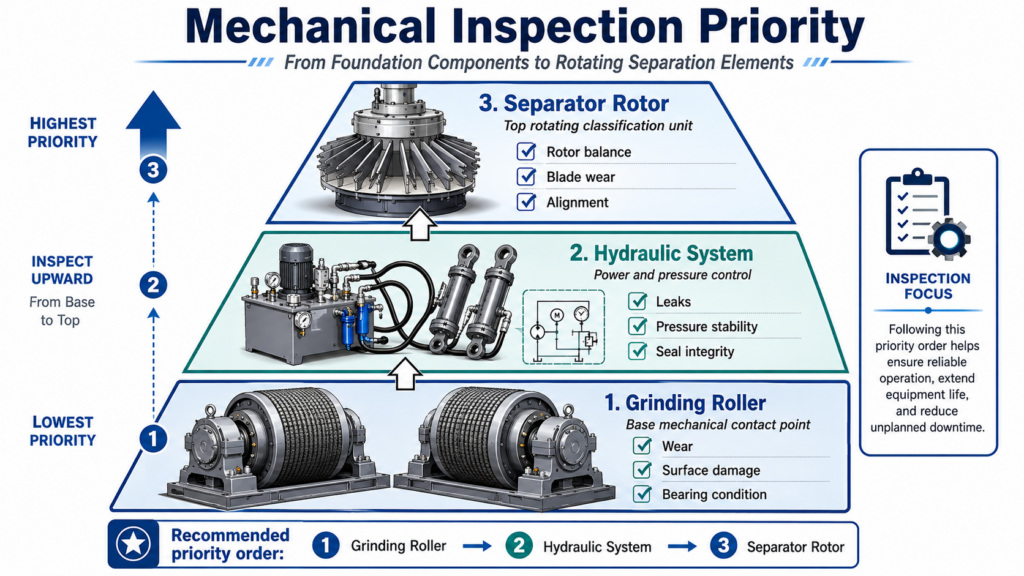
Many plant managers often waste valuable downtime on low-risk components, but watch the critical wear areas deteriorate. The R-H-S (grinding roller-hydraulic-powder separator) critical path framework is to force the maintenance team to focus on the area with the greatest mechanical stress. You must keep 60% of the initial shutdown window on the grinding area, 25% on the hydraulic pressure holding test, and the remaining 15% on the tolerance check of the pneumatic separator. As long as the primary and secondary order is followed, the diagnosis time can be cut in half immediately, and the engineer can be prevented from missing the real culprit that causes the mill to vibrate.
If the preheating procedure is ignored, the spalling of the surfacing layer can account for 40% of the sudden failure in the grinding area. Today’s maintenance teams often rely too much on automatic welding to restore the profile of vertical mill parts, but forget all about the metallurgical stresses generated during processing.
Cold welding on high chromium cast iron can easily produce micro cracks under the surface. Once a material with a high quartz content is encountered, these cracks will directly cause large pieces of metal to flake off. Field engineers always like to look at the surface of the new surfacing grinding roller and take it for granted that there is nothing wrong with the structure. But if you do a local ultrasonic flaw detection, those hidden underneath the stress fracture immediately revealed its original shape. Before welding on the wear-resistant alloy, the grinding track area must be heated to at least 150 ℃, which is the hard truth to prevent the formation of brittle martensite.
Once the sealing air pressure is lower than the pressure in the mill, the extremely abrasive raw material will be forced into the grinding roller bearing. It takes days to replace a spent roller bearing, but it takes a few minutes to adjust the sealed fan. The maintenance worker must keep an eye on one thing: the sealing air pressure must definitely be 2000 to 3000 Pa higher than the internal pressure of the grinding bin, and there must be no ambiguity.
There is a quite famous 5000t/d cement factory, which has not taken the sealing wind pressure 1500 Pa seriously for 3 consecutive shifts. The result? Very fine quartz dust directly through the labyrinth seal, the lubricating oil pollution in a mess. The oil mixed with dust turned into “grinding paste”, which completely dried up the cylindrical roller bearings, resulting in the kiln line being forced to stop for 140 hours, with a direct economic loss of up to 450000 US dollars.
If the nitrogen pressure in the accumulator drops by 5%, the vibration amplitude of the vertical mill will directly soar by 30%. You know, the hydraulic system is not only used to provide grinding pressure, it is the core of the whole machine “shock absorber”.
Once the bladder in the hydraulic accumulator is fatigued and aged, nitrogen will slowly leak into the hydraulic oil circuit. Many technicians only stare at the system pressure gauge at ordinary times, but they just forget to check the nitrogen pre-charge pressure 1 separately when shutting down. The rule is: every 500 hours the equipment runs, it has to take a pressure measuring tool directly to the nitrogen valve of the accumulator to measure it. If the pre-charging pressure falls below the bottom line given by the original factory (generally about 6-8 MPa according to the size of the mill), the damping and buffering capacity of the hydraulic cylinder will be completely exhausted, followed by serious beating of the grinding disc.
If the degree of pollution of hydraulic oil can not even reach NAS level 7, the valve core of the proportional valve must be stuck, and the grinding pressure on several grinding rollers will be uneven. When the pressure is off, the material bed collapses instantly, followed by violent vibration leading to a jump and stop. Don’t try to save trouble. Only by sampling from the oil tank and directly from the hydraulic oil return pipeline can you accurately count how much metal debris has fallen off from the internal wear of the oil cylinder.
As long as the rotor blades of the powder separator are 1 worn, the dynamic balance of the internal airflow is immediately broken, the coarse particles run coarse directly, and the load of the powder grinder is off the charts. The powder selection machine is like the brain of the mill. The fineness index and internal circulation rate of the finished product depend on it.
If the gap between the static guide vane and the rotating powder selection blade exceeds 5mm, the pneumatic seal will be completely destroyed. Once the abrasive particles gnaw the tip of the rotor blade, the powder separator can no longer block the coarse material back to the grinding disc. The maintenance team must honestly take the feeler gauge and measure the gap 1 times along the entire vertical length of the powder separator. As long as the gap crosses the dead line of 5mm, there is no discussion, either surfacing at the tip of the blade or replacing it altogether.
| Gap Size | Aerodynamic Seal Status | Expected Circulation Load Increase | Specific Power Consumption Spike | Maintenance & Operational Impact | Required Action |
| 1 – 3mm | Intact & Optimal | Baseline / Normal | Baseline / Normal | Proper rejection of coarse material; stable internal gas flow dynamics. | Routine monitoring; map clearance gap vertically using feeler gauges. |
| 4 – 5mm | Deteriorating | Moderate Increase | Noticeable Spike | Initial signs of coarse particle bypass; aerodynamic seal weakening. | Monitor closely; schedule repair and prepare replacement parts. |
| > 5mm | Destroyed (Critical Threshold) | Extreme Overload | Severe Spike | Total loss of coarse material rejection; grinding bed overloaded. | Mandatory hardfacing of blade tips or full blade replacement. |
High-frequency acoustic emission (AE) sensors can capture minute spalling of roller bearings a full 20 days earlier than conventional velocity or acceleration vibration probes. The old-fashioned way of maintenance has long been out of date-you have to wait for the machine to shake like a sieve before you think of it.
Conventional vibration sensors are quite slow and have to wait for macroscopic damage to the raceway to catch those low-frequency anomalies. However, AE technology is different. It specializes in “listening” to the high-frequency elastic waves that are accurately released when microcracks just emerge under bearing load. As long as the wireless AE sensor is installed on the rocker arm of the grinding roller, the central control room can stably get the advance amount of 3 week, not only can the spare parts of the vertical mill be ordered calmly, but also the planned shutdown can be clearly arranged.
Putting aside time and deciding what nodes to change parts based on the tonnage processed can make your operating budget amazing. It is recommended to use the following baseline directly to develop your maintenance plan.
Answer: The thickness of the liner must not be lower than the lower limit specified by the original factory. It is usually kept at about 40 to 50mm before surfacing. If you let the profile wear and fall through this pass line, the grinding efficiency will plummet and the power consumption will soar.
Answer: Look for one thing: every 500 hours of operation, the nitrogen pre-charge pressure in the hydraulic accumulator must be measured manually. Once the lack of nitrogen, equipment operation will appear serious mechanical vibration.
Answer: 3 are the main culprits of severe vibration: unstable thickness of the material bed, pressure drop of the hydraulic accumulator, or metal foreign matter mixed into the grinding bin. In fact, as long as the amount of water sprayed is adjusted and the nitrogen in the accumulator is checked, 80% of the vibration problems can be solved.
A: Absolutely not. If you want to replace the labyrinth seal and lip seal, you must pull the entire grinding roller assembly out of the grinding shell. In order to avoid this kind of overhaul and shutdown, the most important thing is to strictly manage the sealing air pressure and strangle the signs of sealing failure in the cradle.
Answer: Too much fine powder is returned. Nine times out of ten, the static guide vane is worn bald or the rotor speed is wrong. To measure the gap between the rotor and the stator, whether there is a pneumatic short circuit (running thick), you can see immediately.
Answer: If grinding cement raw material and slag, the wear resistance of high chromium carbide flux cored wire is top-notch. However, in order to prevent microcracks, the specific alloy ratio must be “tailored” according to the abrasiveness and quartz content of your actual grinding materials “.