 Clirik





Search
In order for the limestone grinding line to really make money, the raw ore moisture must be stuck below 3%, the equipment selection must absolutely match your D97 fineness target, and the heat load must be controlled to prevent the equipment from “blocking”. Over the years, I have run through many mining enterprises. Every year, investors and project leaders burn millions in vain because the equipment does not match the material attributes. Continue to look down, take a seat, and look at the following 7 fatal milling misunderstandings, which one is eating up your production profits, and how to completely solve it.
Any profitable limestone production line actually finds a balance in the 3 dimensions of yield (Capacity), fineness (Fineness) and moisture (Moisture). One of the indicators was moved, and the other two immediately followed.
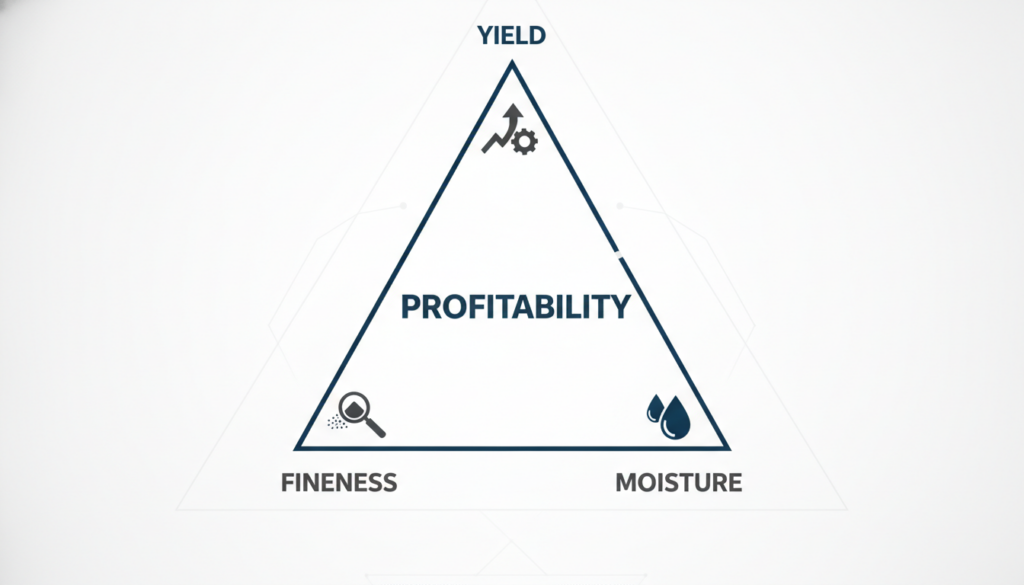
When the moisture is high, the wet powder will stick directly to the internal grinding ring, and the output will fall off the cliff. If the equipment selection machine is not upgraded, it must pursue finer particles (such as D97 < 10μm), and the output will not go up. I usually ask the person in charge of the site to check these 3 core indicators 1 times before troubleshooting mechanical failures. This is the cornerstone of solving the problem.
Once the silica content in the limestone exceeds 2%, ordinary grinding rollers will be scrapped after a few weeks. Many times, the purchasing side simply does not measure the abrasion index (Bond work index) in order to buy ore cheaply. The result is that the grinding rings wear at an astonishingly fast rate. There is no other shortcut to deal with this problem. You must speak with the chemical composition report before purchasing. If high silica ore is really unavoidable, then honestly upgrade the grinding roller to high chromium cast iron.
The traditional pendulum Raymonde mill, once the target fineness exceeds 400 mesh, the mechanical efficiency is basically zero. Some novice investors in order to save the early equipment investment, trying to pull up the speed of the powder selection machine by death, forcing ordinary Raymund to produce 1250-purpose heavy calcium powder. This approach will not only suffocate the host and cause severe vibration, but also waste extremely high electricity bills.
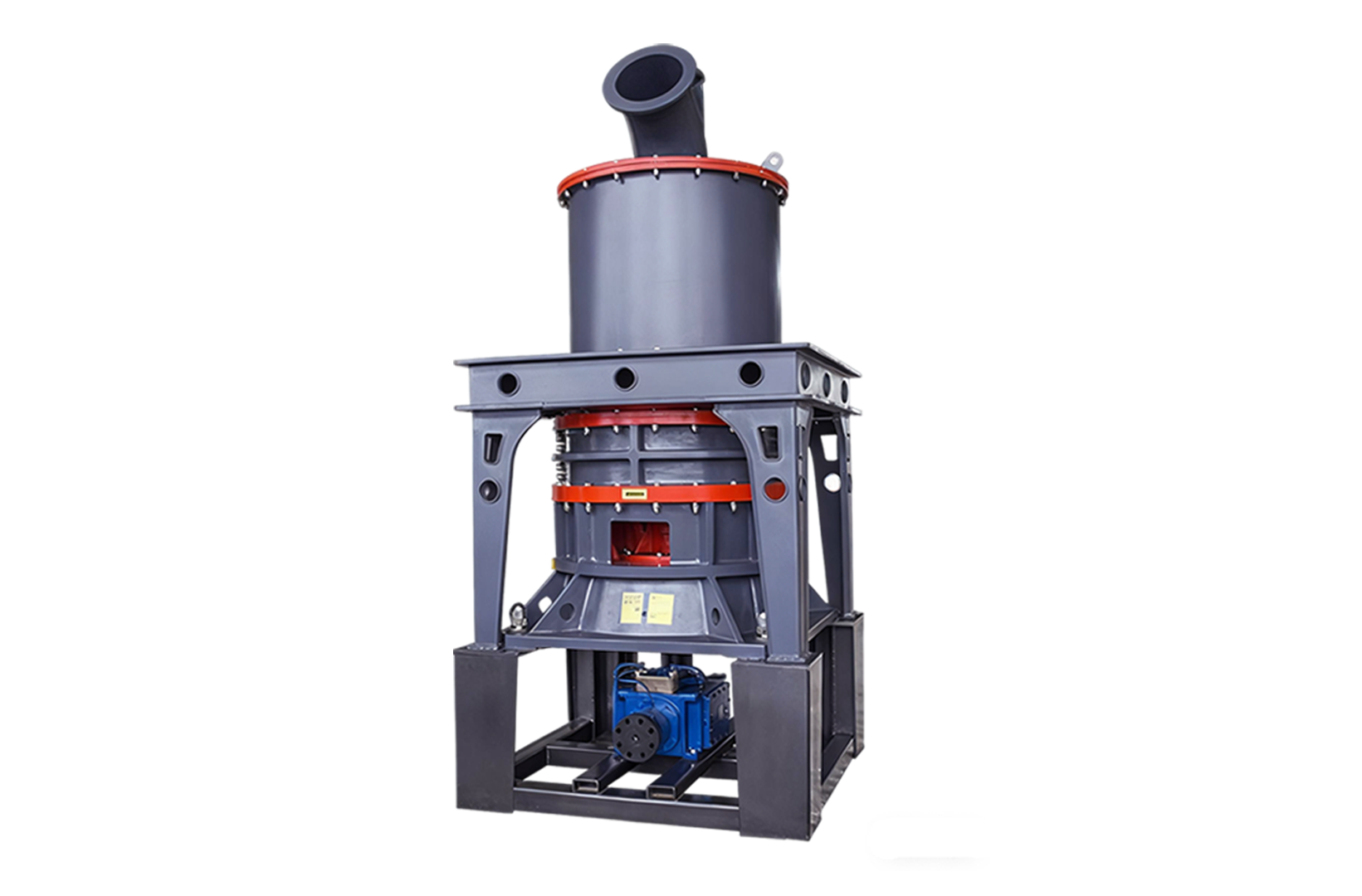
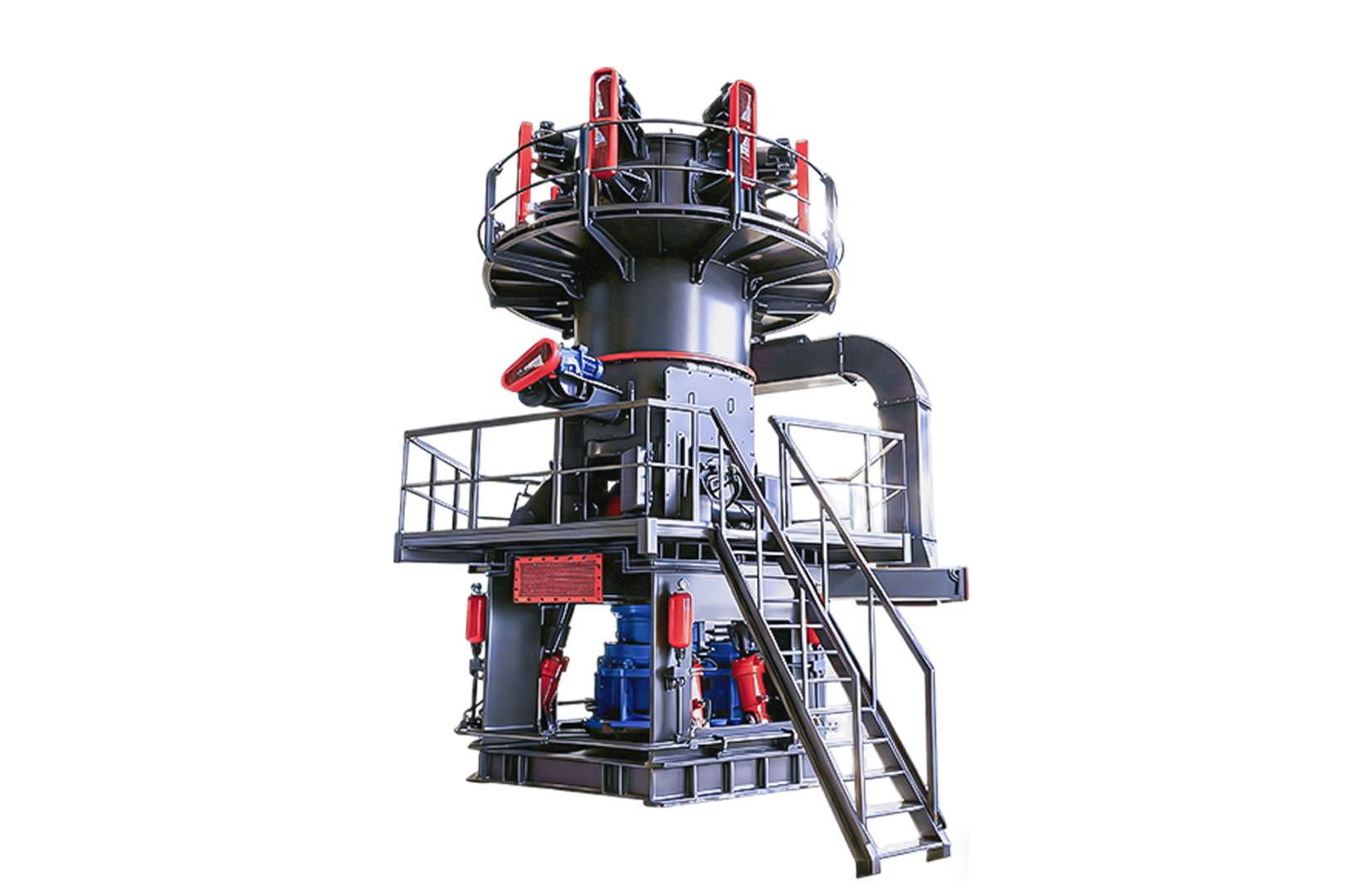
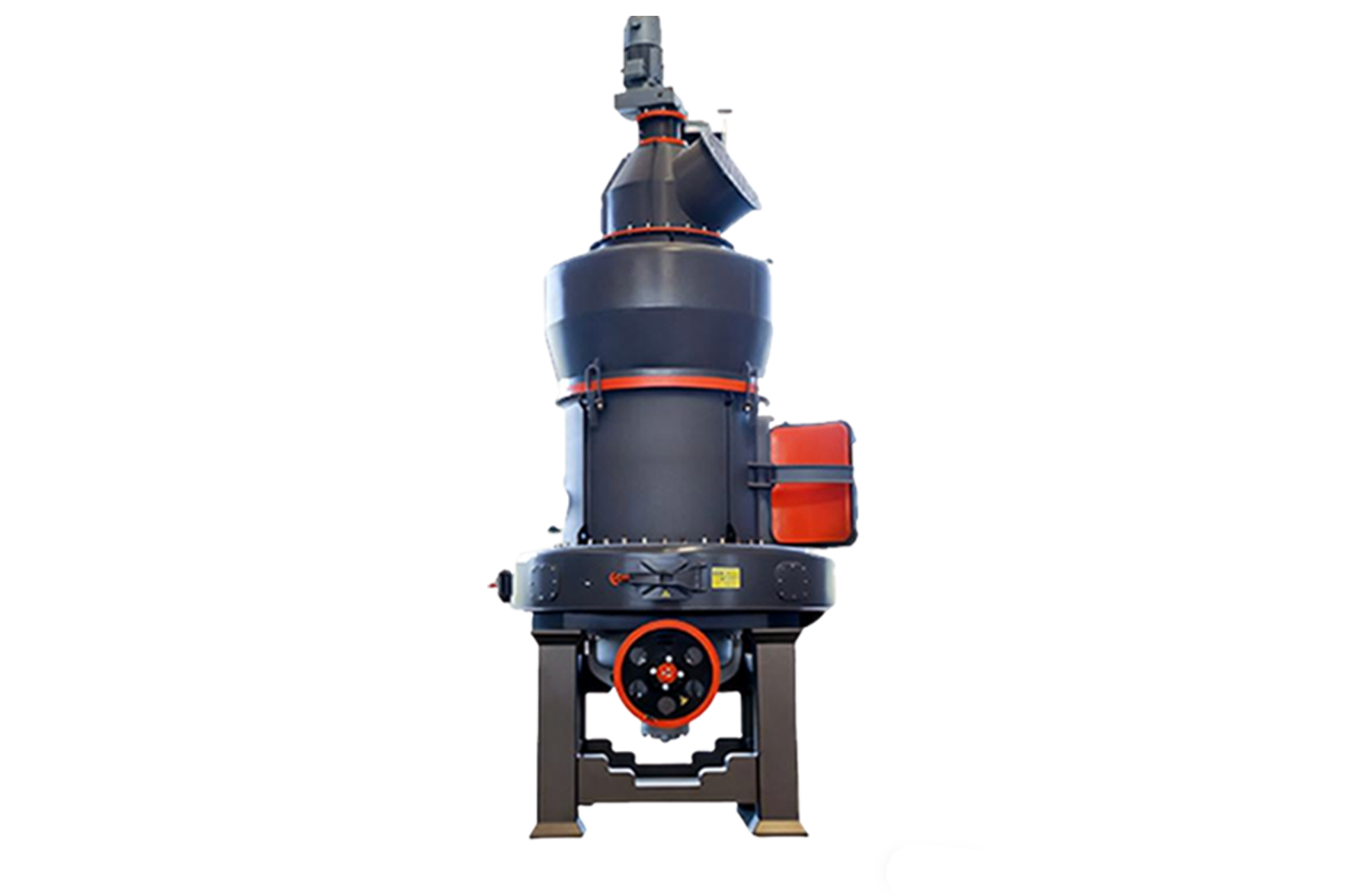
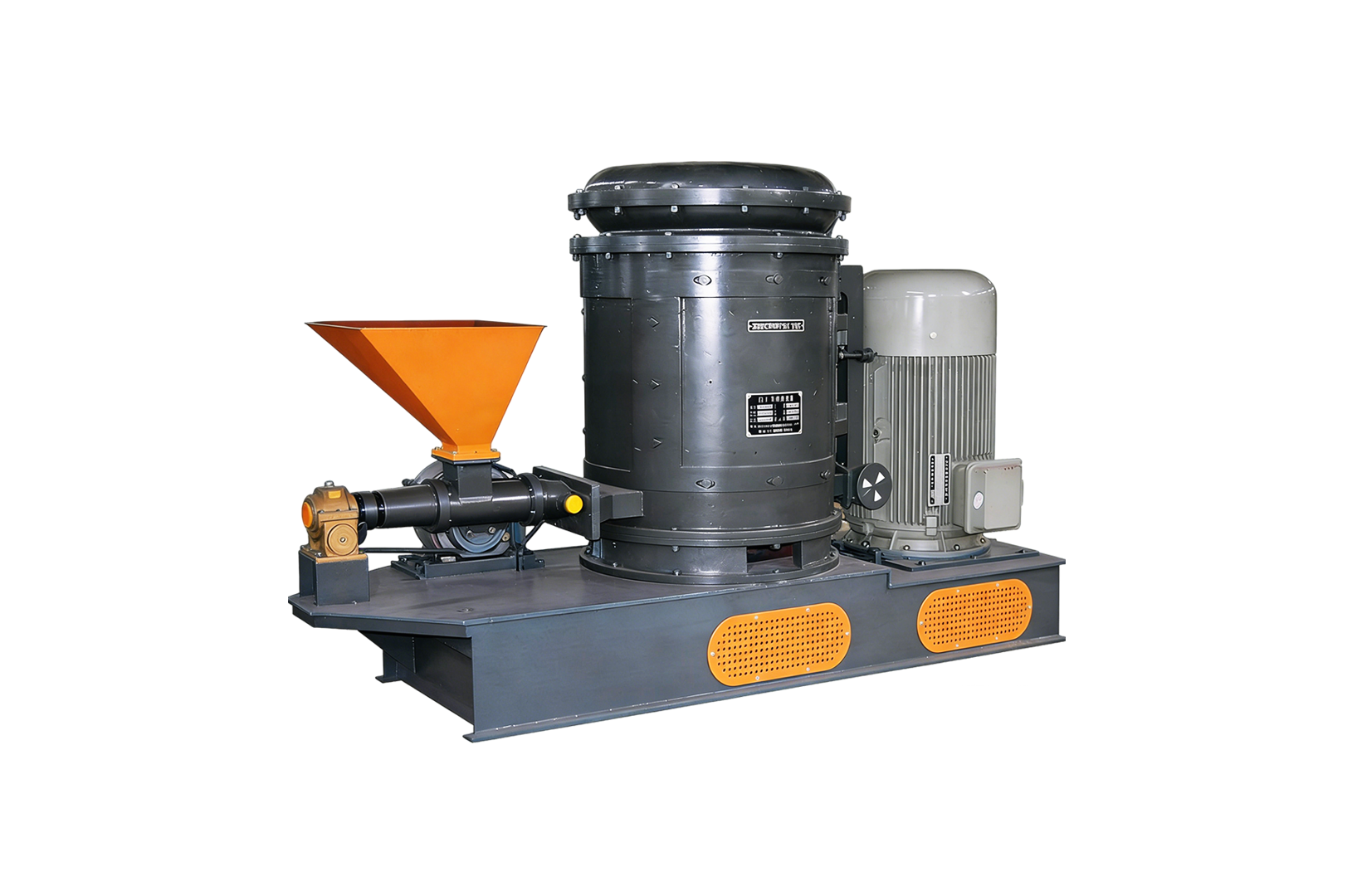
Select limestone mill according to fineness: Raymung mill vs ultra-fine ring roller mill vs vertical mill
Material: Limestone (CaCO3) | Note: Data reflects average industry benchmarks under standard moisture and feed size conditions.
| Mill Type | Maximum Fineness (Mesh) | Ton Power Consumption (kWh/t) | Recommended Application Scenarios |
| Raymond Mill (Pendulum Roller Mill) | 400 Mesh(Approx. 38 μm) | 15 – 25 kWh/t (Moderate) | Basic industrial powder preparation. Power plant desulfurization (FGD), basic building materials, glass manufacturing, and coarse rubber fillers. |
| Ultra-Fine Ring Roller Mill (HGM Series) | 2500 Mesh(Approx. 5 μm) | 35 – 50 kWh/t (Higher, but highly efficient for ultra-fine grinding) | Deep processing of Ground Calcium Carbonate (GCC). High-end paper making, premium plastics, paint, coatings, and cosmetic fillers. |
| Vertical Roller Mill(VRM) | 1250 Mesh (Approx. 10 μm) | 12 – 20 kWh/t(Lowest specific energy consumption) | Massive capacity and large-scale continuous production. Large GCC plants, cement plant raw meal, and large-scale industrial powder operations. |
If your target is heavy calcium carbonate (GCC) below 10 microns, you must go to ultra-fine ring roller mill or vertical mill (VRM). It is a multi-rotor powder selection system specially designed for narrow particle size distribution, which cannot be replaced by ordinary Raymonds.
A sudden plunge in production capacity? Moisture is usually the number one culprit. When limestone with a water content of 5% or even higher enters the grinding chamber, the high temperature generated by the grinding roller will directly evaporate the water. Water vapor is mixed with fine powder 1 and immediately turns into paste in a 1 pan, sealing the grinding ring and blocking the blades of the powder selector.
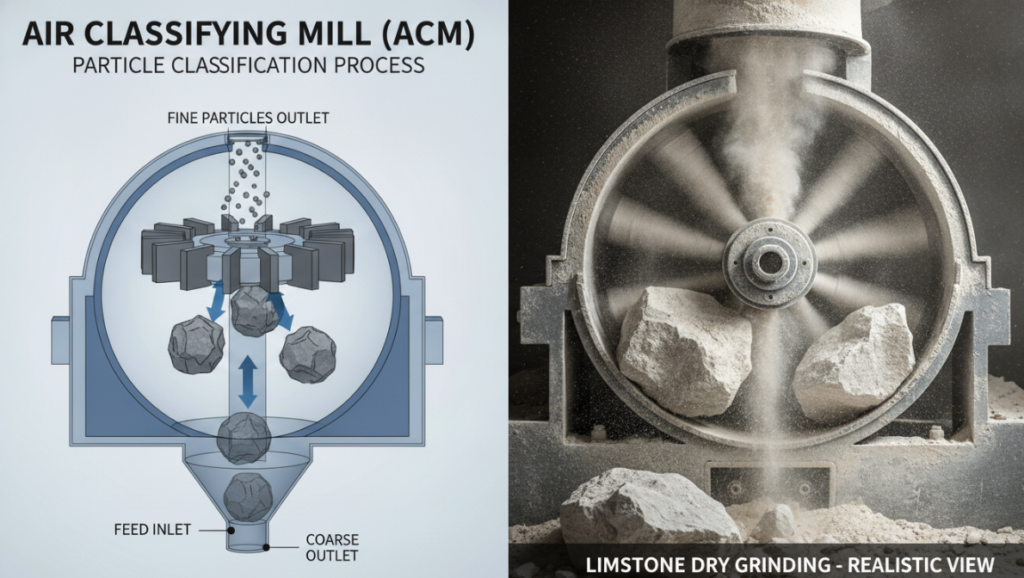
If you are building a plant in a wet area, or if you are dealing with washed limestone, a pre-drying system is a must. Or with a slight change, it is also a very practical way to connect a hot blast stove directly at the bottom of the mill and evaporate the water instantly while grinding.
The feeding amount is obviously fluctuating, and the main fan and the powder separator are also set to a constant speed, so it is strange that the powder quality can be stable. In fact, even in the same shift, the density and hardness of the material are constantly changing. If you don’t dynamically adjust the induced draft fan, the mill will either over-grind the limestone (a pure waste of electricity) or spit out 1 piles of coarse particles for you. By 2026, the current modern production lines are basically using frequency converters (VFD) with acoustic sensors to automatically adjust the air volume according to the real-time load inside the mill.
Once the dust collector holds its breath, the whole production line will have to suffocate. The pneumatic conveying system relies entirely on negative pressure to extract the finished limestone powder from the mill. In the selection of many design drawings, the drawings only look at the average air volume (CFM) and do not take the peak fluctuation into account. The dust bag 1 paste, the positive pressure inside the system soars, the temperature alarm, and the mill must be forced to stop. Listen to me, the air volume of the dust collector must be at least 120 of the theoretical maximum air volume.
Pour 50mm limestone directly into the mill with a calibrated maximum feed of 20mm, and it is strange that the spindle reducer is not discarded. Some enterprises in order to reduce the initial cost, even the front of the jaw broken or hammered to save. It is only a matter of time before large pieces of ore are smashed in, grinding rollers are violently beating on grinding rings, metal fatigue and structural disaster damage. Any limestone grinding system must have a strict pre-crushing process to ensure that the feed size is small and uniform.
If you do not regularly rotate or replace the grinding rollers in complete sets, the grinding machine will have extremely serious vibration, and the quality of the powder will go up and down. Because there is even a slight difference in spring tension or material distribution, the wear rate of the grinding roller cannot be completely consistent. This eccentric load can tear the center bearing directly in the event that one roller is significantly smaller than the other 1 rings. The machine repair team must take calipers to measure the data of all grinding rollers every week, and once they want to change, they have to change the whole set together.
Take a recent limestone project in Texas with a nominal output of 15 tons (TPH) at a time. At that time, the scene was extremely shaken, and the 325-purpose powder could only produce 9 tons per hour.
I went to check the 1 circle and found that the average feed moisture reached 4.5 percent and the fan speed was locked. Later, we added a small hot air generator to the air inlet (directly solving misunderstanding 3), and conveniently replaced the completely blocked dust removal cloth bag (solving misunderstanding 5), and the production capacity of the whole line was instantly restored to the standard line of 15 tons. This is not the end of the calculation. The electricity consumption per ton has actually dropped by 22%, and the electricity bill per moonlight can save the factory thousands of dollars.
It all depends on the fineness of your goal. In the range of 80 to 400 meshes, Raymund is absolutely dominant with very low equipment investment. If the capacity requirements are large (more than 20 tons/hour), the vertical mill (VRM) is the first choice. As for those high-end coatings and plastic fillers that require 800 to 2500 purposes, they must be superfine ring roller mills.
It is mainly composed of power consumption (how many degrees of electricity per ton), replacement frequency of wearing parts (grinding rollers and grinding rings) and labor. Electricity usually accounts for about 60% of the overall operating cost, which means that the equipment power selection must be extremely accurate, otherwise there is no profit at all.
The conventional pendulum mill can handle materials of 15mm to 30mm, depending on the model. Force-fed ore exceeding the size specified by the manufacturer will definitely cause severe vibration and direct damage to the core grinding assembly.
The vibration basically cannot run out of these four reasons: the feed size is too large, the grinding roller is asymmetrically worn, foreign matters such as iron blocks fall into the grinding cavity, or the mill is idling (the material is not fed enough, and the grinding roller directly smashes the grinding ring without material as buffer).
The idea is very clear: press the moisture content of the feed to below 3% to ensure that the pre-crushed feed is uniform and less than 20mm, install an efficient frequency converter for the powder separator, and at the same time ensure that the dust removal system is in the best negative pressure state at all times.