 Clirik





Search
Mastering effective calcium carbonate grinding requires exact synchronization of classifier RPM, system airflow, and grinding pressure to hit your target D97 particle size while keeping energy consumption strictly below 22 kWh/t. Operators in a modern calcium carbonate grinding plant often face sudden drops in throughput or unachieved fineness due to poor internal differential pressure management. We will break down the exact parameter adjustments, troubleshooting steps, and mechanical limits you need to manipulate a calcium carbonate mill effectively.
Here is the deep dive into eliminating the cushion effect, tuning the RPM triangle, and securing optimal particle size distribution (PSD) on your plant floor.
Systematic debugging separates high-performing production lines from those burning excess power. The RPM Triangle Framework (Rate, Pressure, Micro-classification) provides a direct diagnostic path for any calcium carbonate grinding operation.
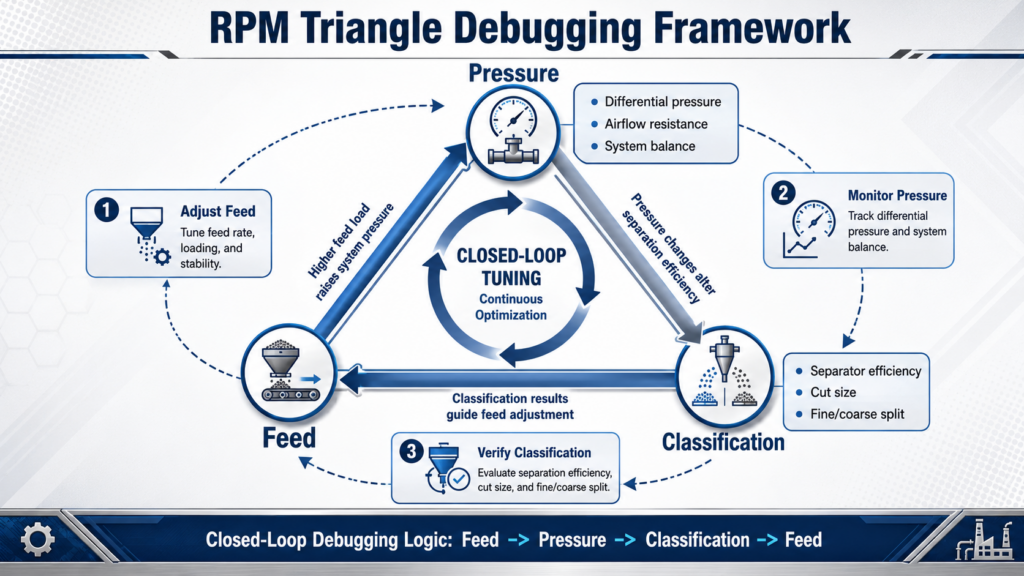
Feeding material blindly based on the main motor’s amp rating guarantees inconsistent grinding. Operators must link the feed rate directly to the mill’s internal differential pressure (dP). When the dP exceeds your baseline by 15%, the mill is choking. Drop the feed belt frequency by 3-5 Hz immediately before adjusting any other parameter. A choked calcium carbonate mill recycles unground coarse particles, wasting mechanical energy entirely.
Hydraulic grinding pressure strictly dictates the generation of ultrafine particles. Mechanical engineers setting up a vertical roller mill (VRM) for calcium carbonate must calibrate the accumulator nitrogen pressure to exactly 60-65% of the operating hydraulic pressure. Setting it higher causes brutal vibrations during large feed size spikes. Lock your grinding pressure parameters strictly within the bounds where the main motor amps remain stable under a continuous 48-hour load.
Fineness depends completely on the drag force inside the classifier cage. Increasing the classifier rotor speed without a proportional increase in the induced draft (ID) fan volume causes product re-agglomeration. Adjust the ID fan damper in 2% increments for every 50 RPM added to the classifier.
The “Cushion Effect” occurs when ultra-fine calcium carbonate powder stays trapped under the rollers, acting as a shock absorber. This specific pitfall tricks inexperienced debuggers into increasing grinding pressure, which instantly skyrockets power consumption without improving fineness.
Your HMI screen tells the whole story. You have hit the cushion effect if your main motor current spikes, vibration sensors alert above 4 mm/s, and your reject return chute is completely empty. The material is circulating as suspended dust, never leaving the grinding zone.
Clear the trapped fines by manipulating airflow, not pressure. First, pause the incoming feed completely for 60 seconds. Second, open the ID fan damper by an aggressive 10% to flush the grinding chamber. Third, reduce the classifier speed by 100 RPM temporarily. You will see an immediate drop in mill vibration and motor amps, proving the cushion has been cleared.
Energy costs dictate the profit margin of your entire plant. Dropping the specific energy consumption from 26 kWh/t to 21 kWh/t requires aggressive thermal and airflow management.
| Parameter | Traditional / Pre-Optimization State | Optimized / Post-Optimization State |
| Production Yield | Restricted / Halted (Reject return chute empty, material trapped) | Restored & Continuous Flow (Trapped fines cleared) |
| Main Motor Current | Spiking / Overloaded | Dropped / Stable Normal Amps |
| Wind Pressure (Airflow) | Standard Pressure (Causing cushion effect) | Aggressive Airflow (+10% ID Fan Damper Opening) |
| Finished Product D97 Fineness | Suspended Dust / Trapped Fines | Controlled Target (Classifier Speed reduced by 100 RPM) |
| Specific Energy Consumption | 26 kWh/t | 21 kWh/t |
| Vibration Level (Additional) | > 4 mm/s (Alert level) | Immediate Drop / Stable |
Leading plants now route the classifier inverter data and main motor current into a predictive PLC loop. The system reads a micro-spike in the bucket elevator load and preemptively drops the mill feed rate 2 seconds before the surge hits the grinding table. You bypass the traditional human reaction time lag completely, ensuring the grinding bed depth never deviates past 30mm.
Heat hardens calcium carbonate during the grinding phase, degrading product whiteness. Keep the mill exit temperature strictly between 75°C and 85°C. When ambient temperatures rise in summer, increase the fresh air intake valve by 15% and lower the return air damper to dump the excess heat. Running a cold mill prevents mechanical fatigue on the roller bearings and stops moisture-induced blinding on the filter bags.
Hitting a D97 of 10 microns requires more than just maxing out the separator speed. Narrowing your PSD curve directly increases the market value of your final product.
The stationary guide vanes below the classifier rotor control the upward swirl of the powder-air mixture. Mechanical engineers must physically enter the mill during downtime and set these vanes to a rigid 15 to 18-degree angle. A wider angle destroys the cyclonic lift, dropping coarse particles straight back onto the grinding track and ruining your PSD narrowness.
Liquid grinding aids reduce the surface energy of calcium carbonate particles, preventing electrostatic agglomeration at high fineness levels. Inject triethanolamine (TEA) based grinding aids directly onto the feed belt at a strict ratio of 250 to 300 grams per ton. Over-dosing turns the powder bed into a slick paste, instantly causing roller slippage and catastrophic mill vibration.
Q1: What is the optimal bed depth for a vertical calcium carbonate mill?
Keep the grinding bed depth strictly between 25mm and 35mm. A shallower bed causes metal-to-metal contact and extreme vibration, while a deeper bed triggers the cushion effect and lowers grinding efficiency.
Q2: Why is my calcium carbonate grinding plant experiencing sudden high vibration?
Sudden vibration spikes usually result from foreign tramp metal entering the table or an abrupt loss of feed. Check your metal detector reject gate and verify that the weigh feeder belt has not lost tension.
Q3: How does moisture content affect calcium carbonate grinding?
Raw calcium carbonate moisture must remain below 1%. High moisture creates a sticky mud-ring on the grinding track, blinding the classifier cage and severely restricting the induced airflow.
Q4: What causes the main motor current to fluctuate wildly during operation?
Inconsistent feed size or a malfunctioning hydraulic accumulator nitrogen bladder causes current swings. Verify your jaw crusher output size is uniform and check the hydraulic station for pressure leaks.
Q5: How can I decrease the specific energy consumption in my grinding plant?
Maximize your system airflow while maintaining the lowest possible classifier RPM that still achieves your target D97 fineness. Stop over-grinding by strictly controlling the cut-point of your separator.
Q6: What is the correct air-to-material ratio for grinding 400-mesh calcium carbonate?
Maintain an air-to-material ratio of approximately 2.5 to 3.0 cubic meters of air per kilogram of calcium carbonate. This specific ratio ensures rapid particle removal without overburdening the bag filter’s pressure drop limits.