 كليريك






بحث
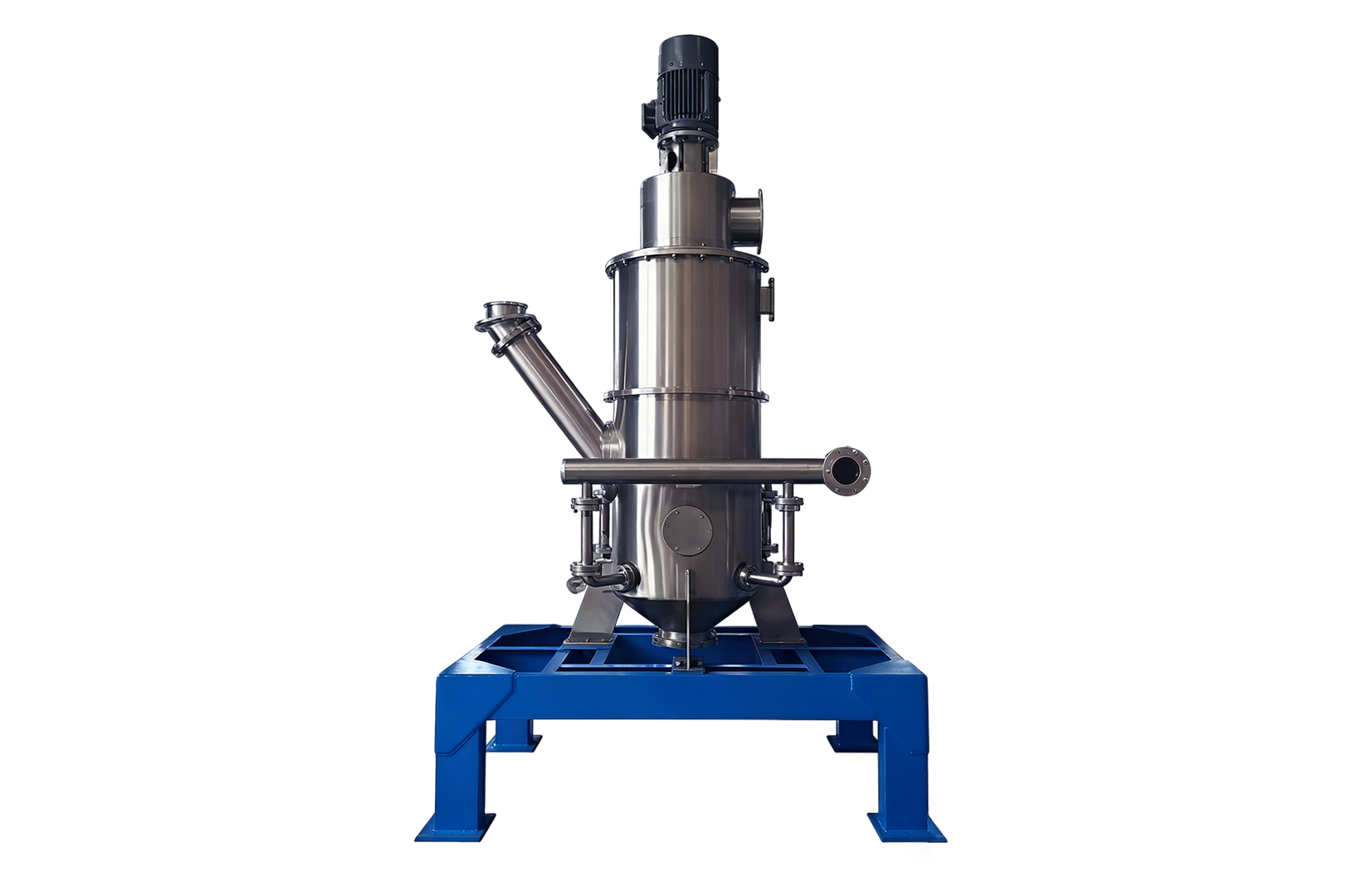
A jet mill uses high-speed jets generated from compressed air, nitrogen, or another process gas to make particles collide, impact, and shear against one another. It generally does not use mechanical grinding media. The terms “fluidized bed” and “opposed jet” further describe the powder state in the grinding chamber and the direction of the jets. Understanding these two points helps distinguish this type from other jet mills.
The equipment forms a fluidized powder bed inside the grinding chamber. Multiple nozzle jets accelerate the particles, which collide with one another in the area where the jets converge. Grinding mainly relies on interactions among the particles rather than continued contact between the material and mechanical grinding media. The name fluidized bed opposed jet mill refers to this type of structure.
Grinding intensity is not determined by nozzle pressure alone. Jet velocity; nozzle pressure and number; powder concentration; particle density; feed rate; and grinding-chamber geometry can all affect collision frequency, residence time, and grinding intensity. These factors show which operating conditions work together, but they cannot be used on their own to calculate a model’s finished particle size or throughput.
The absence of mechanical grinding media does not mean that the whole machine has no moving parts or wear. A fluidized-bed jet mill generally includes a dynamic classifier. Particle erosion may still affect nozzles, liners, the classifier wheel, seals, filters, pipe bends, and collection components. The exact wear parts and configuration depend on the model and cannot be inferred from the equipment category alone.
After collision, the dynamic classifier keeps coarser particles in circulation and sends them back to the grinding zone. Fine particles that meet the classification condition leave with the gas and enter a cyclone or filter for collection. The finished product is therefore not determined by the jets in the grinding chamber alone; collision, classification, and recycle work together.
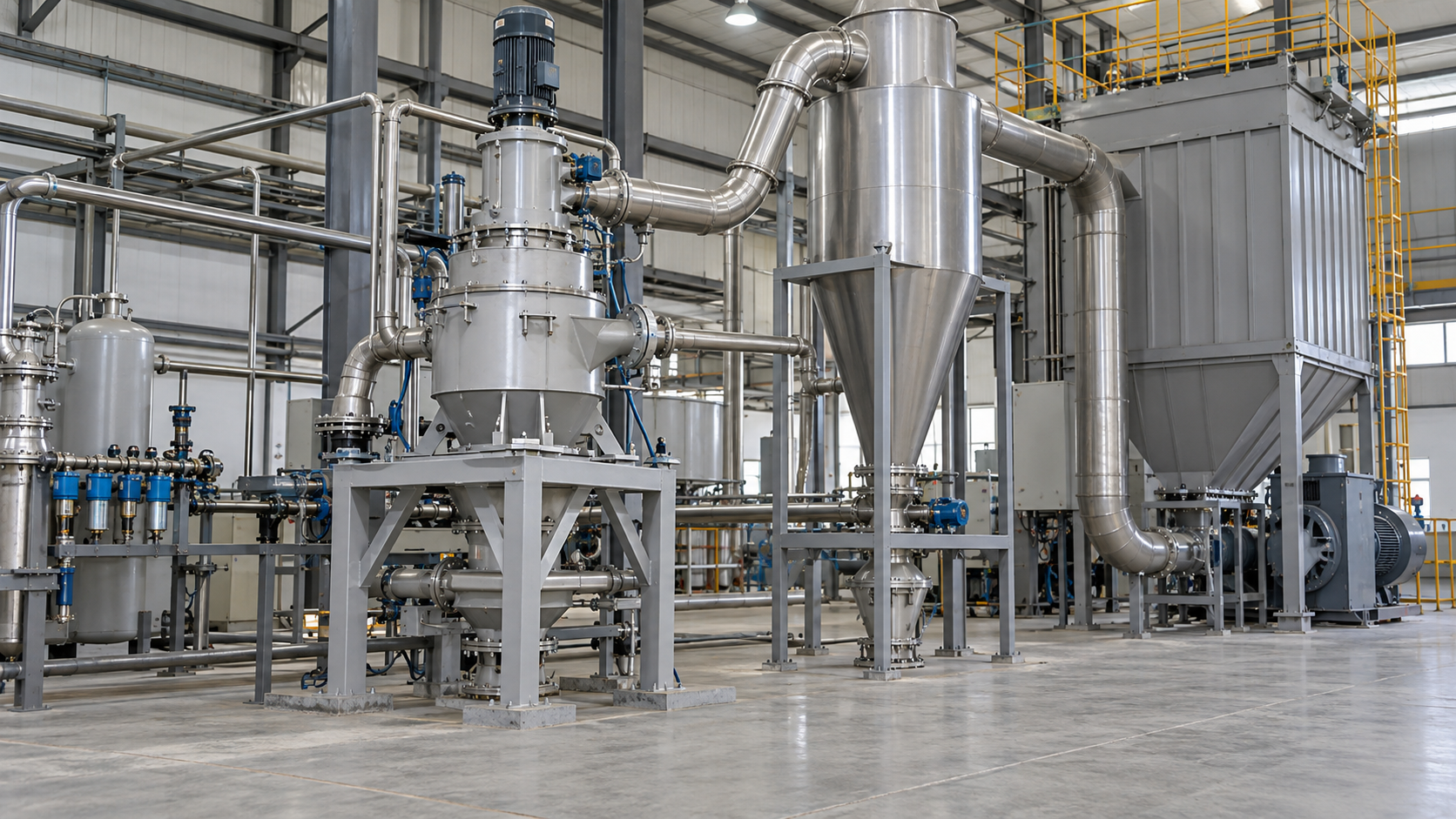
Centrifugal force from the classifier wheel and gas drag work together to control the top cut. Wheel speed, gas flow, and particle properties affect the top-cut size and coarse-particle recycle. Too little airflow may destabilize fluidization, allow coarse particles to short-circuit, or reduce collection efficiency. Too much can raise compressor energy use, increase the filter load, and carry product out with the gas. A single setting should not be treated as a universal answer independent of the material.
This equipment generally operates in a closed-loop pneumatic system. In a typical dry process, compressed gas is filtered and pressure-regulated, and may also be dried or cooled. Gas quality, pressure, flow, dew point, filter condition, and collection efficiency all affect product quality. When a narrower particle-size distribution or an adjustable top cut is required, a fluidized-bed jet mill with a dynamic classifier can be included in the comparison. This is a screening direction, not a performance guarantee for every material.
A spiral jet mill typically uses a ring of nozzles to create a spiral flow field and uses static classification. A fluidized-bed opposed-jet mill is distinguished by its powder bed, opposing jets, and dynamic classification. Both use gas jets, but the powder moves differently inside the chamber and the classification structures differ. An air classifier mill, by contrast, typically uses mechanical impact components for the main grinding and then controls particle size with a classifier. Sharing the word “classification” does not mean these machines use the same grinding method.
In the product classification, CLJM-L corresponds to the name Fluidized Bed Air Jet Mill. This confirms its equipment category, but its nozzle count, chamber dimensions, throughput, fineness, or performance guarantee for a particular material cannot be inferred from the name. Fine-size ranges for other manufacturers’ specific models apply only to those models and the stated material conditions; they are not universal figures for this equipment category.
Specific particle-size or throughput figures should be tied to the feed material and condition, gas type, pressure and flow, classifier settings, continuous running time, and test method. Laboratory equipment can be used to assess sample feasibility, but its throughput cannot be directly extrapolated to continuous production capacity. Targets can be stated as measurable values such as d50/d97, top-cut size, or particle-size-distribution width; “ultrafine” alone is not enough to compare equipment or test results. Results from laser diffraction, sieving, and image analysis are not directly interchangeable, and sampling, dispersion, and instrument conditions can also affect the reading.
Jet mills are commonly used for dry, brittle, hard, or heat-sensitive materials. Materials with high moisture, strong adhesion, or high ductility may clog, agglomerate, or be difficult to fluidize stably. Suitability should be judged against the feed condition and sample tests. If the material cannot be fed or fluidized steadily, drying, pre-grinding, or other pretreatment may also need to be evaluated.