 كليريك






بحث
Raymond mill working principle relies on a suspended pendulum mechanism where grinding rollers swing outward due to centrifugal force, crushing materials against a stationary steel ring. When configured as a raymond coal mill, the system simultaneously acts as a dryer, grinder, and classifier by utilizing heated updraft airflow to sweep pulverized coal particles into a separator. Most technical manuals stop at this basic mechanical description. Engineers tasked with maximizing a plant’s thermal efficiency need to look past the basic rotation speeds. The true secret to pushing coal mill throughput beyond baseline ratings lies in manipulating the fluid dynamics of the internal air-sweep and controlling the heat mass balance.
Centrifugal pressure dictates the primary crushing force, not the static weight of the rollers. As the central shaft rotates driven by the transmission gear, the plum blossom frame carries the grinding rollers. These rollers pivot on horizontal axes, swinging radially outward to press against the grinding ring. A standard 5R Raymond mill operating at 100 RPM generates tons of radial pressure per roller. You must ensure the spring tension or hydraulic preload (if retrofitted) matches the specific gravity of the coal feed.
Internal airflow governs the particle size distribution (PSD) more than the actual mechanical crushing. A shovel plate scoops the raw coal up and throws it between the roller and the ring. Simultaneously, the main blower forces pressurized air into the base of the mill. This updraft lifts the crushed particles. Fine particles rise to the classifier, while heavier particles fall back to the grinding zone. Adjusting the blower damper controls the ascending velocity. Setting this velocity too low causes over-grinding and excessive power consumption, while setting it too high forces coarse coal particles past the classifier, reducing combustion efficiency in the kiln or boiler.
Coal grinding demands a distinct operational framework compared to processing inert materials like limestone. Factory directors can diagnose production bottlenecks by applying the 3T Optimization Matrix: Throughput, Temperature, and Tolerance.
Mill capacity drops exponentially when processing coal with an HGI below 50. The Raymond mill operates at peak efficiency when the HGI is between 60 and 80. Feeding harder coal requires slowing down the feed rate and reducing the classifier speed to maintain the required fineness. Plant operators must mandate daily HGI tests from the stockpile. Ignoring the HGI variance leads to bed instability, where the coal layer between the roller and ring becomes too thin, causing direct metal-to-metal contact and severe vibration.
A raymond coal mill requires specific inlet temperatures to dry raw coal containing up to 15% moisture. The inlet hot air temperature typically ranges from 200°C to 300°C. The outlet temperature must be strictly maintained between 70°C and 85°C. Dropping below 70°C leaves moisture in the pulverized coal, causing blockages in the pneumatic conveying lines. Exceeding 90°C risks igniting the highly reactive volatile matter inherent in bituminous or sub-bituminous coals.
Wear part degradation drastically alters the internal aerodynamic profile of the mill. As the rollers and the ring wear down, the grinding gap widens. This widening reduces the effective crushing pressure and alters the airflow trajectory. Maintenance teams should flip the grinding ring after it reaches 50% wear to extend its lifecycle.
| الأعراض | Probable Cause | Corrective Action |
| High Vibration | Bed instability and direct metal-to-metal contact caused by ignoring HGI (Hardgrove Grindability Index) variance. | Mandate daily HGI tests from the stockpile. Slow down the feed rate and reduce the classifier speed when feeding harder coal. |
| Coarse Fineness | Wear part degradation (rollers and ring wear down) widening the grinding gap, which reduces effective crushing pressure. | Flip the grinding ring after it reaches 50% wear to extend its lifecycle and restore the internal aerodynamic profile. |
| Output Drop | Processing hard coal with an HGI below 50, causing mill capacity to drop exponentially. | Monitor coal stockpile to maintain an optimal HGI between 60 and 80 for peak efficiency. |
Spontaneous combustion remains the most severe threat to any Raymond coal mill system. Operating a coal mill without strict oxygen monitoring invites disaster. Plant engineers often focus entirely on mechanical output and neglect the inerting systems. The oxygen content within the mill circuit must be kept below 12% by volume. Introducing inert gases (like nitrogen or recycled flue gas) is a non-negotiable safety requirement when grinding high-volatile coals.
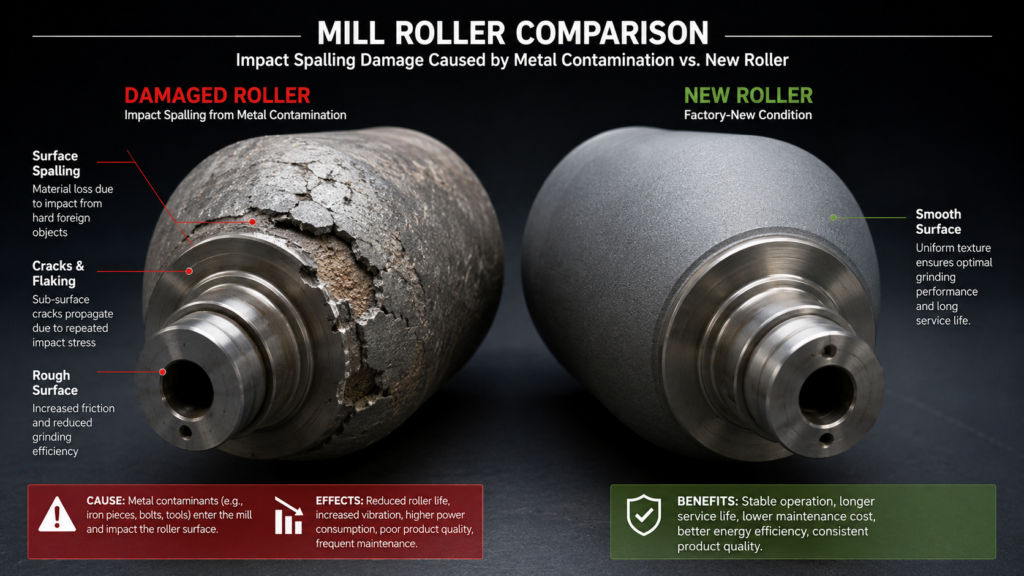
Mill vibration is rarely a bearing failure; it is usually a material bed issue or tramp iron. Magnetic separators installed on the feed belt often fail to catch non-magnetic manganese steel fragments from upstream crushers. When these fragments enter the Raymond mill, they disrupt the pendulum geometry, causing massive localized impacts. Install dual-stage metal detectors and strict feed screening protocols to eliminate unnecessary mill trips.
Replacing a static turbine classifier with a variable-frequency dynamic classifier yields immediate PSD improvements. We tracked a 4R3216 coal mill processing sub-bituminous coal (HGI 65) aiming for 200 mesh (75 microns) with 85% passing. Under the original static classifier, the mill maxed out at 4.2 tons per hour. The fineness curve showed excessive ultra-fines (below 10 microns) which wasted energy.
After installing a dynamic rotor separator and optimizing the bypass valve, the active classification rejected coarse particles much faster. The mill output climbed to 4.9 tons per hour—a 16.6% increase. Power consumption per ton of pulverized coal dropped by 12%. The data proves that mechanical crushing capability is rarely the bottleneck; classification efficiency dictates the actual yield.
High surface moisture causes raw coal to stick to the shovel plates and internal walls, reducing the feed rate. The mill requires adequate hot updraft air to evaporate this moisture instantly; otherwise, the capacity drops and the classifier gets clogged with damp coal dust.
There is no physical “gap” setting like in a roller press. The rollers are pushed outward by centrifugal force against the ring. A material bed of pulverized coal naturally forms between them, usually 5mm to 15mm thick, preventing direct metal friction.
Vibration occurs when the internal material bed collapses. This happens due to starving the mill (insufficient feed), tramp metal entering the chamber, or feeding coal with extremely poor grindability (low HGI) that refuses to form a stable grinding layer.
Higher classifier rotational speeds create a stronger centrifugal force at the top of the mill. This force knocks larger coal particles back down into the grinding chamber, allowing only the finest dust to pass through. Higher speeds mean finer coal, but lower total production output.
An air-swept coal mill heavily relies on large volumes of preheated air to dry and lift the material, often configured as a tube mill or a specialized vertical mill. A Raymond mill relies purely on the pendulum roller mechanism for crushing, using lower-velocity air primarily for separation rather than intense drying.
Explosions are prevented by controlling three factors: eliminating ignition sources (sparking from tramp metal), monitoring outlet temperatures strictly below 85°C, and maintaining oxygen levels below 12% by introducing inert flue gases into the air circuit.
Raymond mills perform best with coal having an HGI of 60 or above. Processing coal with an HGI below 50 drastically accelerates the wear on the rollers and rings and significantly reduces the hourly output.