 كليريك






بحث
Maximum output in calcium carbonate grinding requires achieving a precise equilibrium between differential pressure, classifier RPM, and feed rate to eliminate internal over-grinding. Plant managers can extract 15% to 22% more tonnage from their existing equipment without CapEx investments by synchronizing airflow sweep velocity and dynamic feed loads. Most production lines lose hours of peak capacity daily due to static parameter settings. The exact calibration steps, operational frameworks, and field-tested data required to eliminate these bottlenecks are detailed below.
The V.A.M. Capacity Pyramid (Ventilation, Automation, Media) is a systematic diagnostic framework designed for zero-CapEx capacity growth. Equipment engineers waste weeks adjusting random variables when faced with declining output in a calcium carbonate grinding plant. Diagnosing performance issues through the V.A.M. hierarchy isolates the root cause immediately, preventing unnecessary downtime.
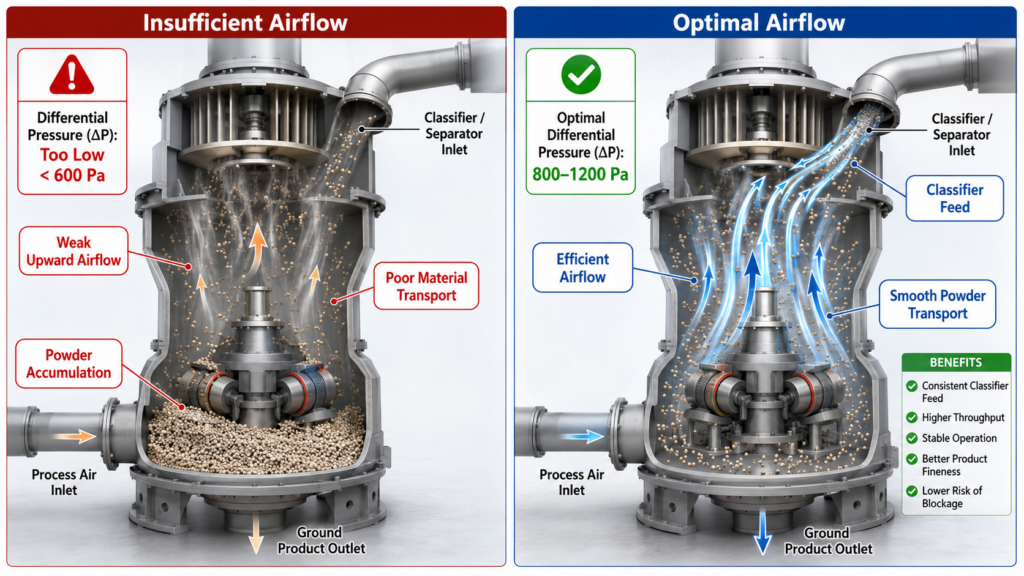
Proper airflow sweep completely prevents the cushioning effect in the grinding zone. A poorly ventilated calcium carbonate mill traps fine particles inside the chamber, forcing the rollers to waste kinetic energy re-grinding already finished powder. Operators must monitor the differential pressure (dP) across the mill. A rising dP indicates material accumulation. Increasing the draft fan damper opening by 2-5% increases the sweep velocity, lifting finished particles directly to the classifier and freeing up space for fresh feed.
Static feed rates guarantee underperformance. Manual operators set the feed rate based on safe, average values to avoid mill blockages, deliberately sacrificing up to 10% of peak capacity. Implementing a dynamic PID control loop tied directly to the mill’s main motor current ensures the feed weighing scale reacts to internal load changes in milliseconds. When the motor current drops below the optimal setpoint, the PLC instantly increases the feed rate, keeping the calcium carbonate grinding continuous and the mill operating at 99% of its physical limit.
Chemical Grinding Aids (CGAs) neutralize particle surface charge to eliminate micro-agglomeration. As calcium carbonate reaches ultra-fine levels (e.g., D97 = 10 microns or below), static electricity causes powder to clump together, mimicking large particles. The classifier rejects these clumps, sending them back to the grinding table. Dosing liquid amine-based or glycol-based CGAs at a rate of 150-300 grams per ton alters the fracture mechanics of the limestone. Tests confirm this exact chemical intervention reduces internal recirculation by 12%, directly translating to higher discharge rates.
Operators rely on outdated heuristics passed down through generations of plant staff. These habits actively destroy production yields and inflate energy consumption per ton.
Speeding up the classifier without adjusting the draft fan creates devastating internal circulation dead zones. When a customer demands a finer D97 particle size, the standard operator response is to aggressively increase the separator RPM. High RPMs generate immense centrifugal force, throwing borderline-sized particles back into the grinding ring. The mill becomes choked with rejected material. Achieving higher fineness while maintaining output requires a simultaneous micro-adjustment: increasing separator RPM by 50 while boosting draft fan suction by 2-3% to maintain the necessary drag force.
Inconsistent raw material sizing destroys the grinding bed stability. Feeding large 40mm limestone boulders alongside fine 5mm gravel causes the roller assembly to vibrate violently. To protect the machinery, the hydraulic system drops the grinding pressure. Lower grinding pressure equals lower output. Pre-screening raw materials to a consistent 10-15mm uniform feed size allows engineers to maximize hydraulic cylinder pressure safely, accelerating the crushing phase inside the chamber.
Hard data proves that targeted parameter calibration outpaces physical hardware upgrades. A prominent calcium carbonate grinding plant operating a mid-sized vertical roller mill reported a capacity stagnation at 12 tons per hour (tph) when producing D97=15μm powder. The CapEx proposal suggested purchasing a $400,000 secondary ball mill.
The engineering team rejected the CapEx and applied the V.A.M. framework. They identified severe internal agglomeration causing a 45% recirculation rate. By introducing a specific glycol-based CGA and recalibrating the PID loop to respond to differential pressure rather than just motor current, the recirculation rate dropped to 28%.
| Operating Parameter | Before Optimization (Baseline) | After Optimization (V.A.M. Applied) | Delta / Impact |
| Raw Material Feed Size | 5mm – 40mm (Mixed/Inconsistent) | 10mm – 15mm (Pre-screened uniform) | Eliminated bed vibration |
| Feed Rate (TPH) | 12.0 TPH | 14.2 TPH | + 18.3% |
| Main Motor Current | 185 A (Highly fluctuating) | 172 A (Stable) | Lower energy consumption per ton |
| Separator RPM | 650 RPM | 700 RPM | + 50 RPM (w/ +2.5% draft fan suction) |
| Differential Pressure | 6,800 Pa (Choked / High resistance) | 5,400 Pa (Stable / Smooth flow) | PID recalibrated for DP response |
| Internal Recirculation | 45% (Severe micro-agglomeration) | 28% (Optimized fracture mechanics) | – 17% (Due to 200g/t CGA dosing) |
| Final Output TPH | 12.0 TPH | 14.2 TPH | + 18.3% Output Reclaimed |
The final output stabilized at 14.2 tph. This adjustment generated an 18.3% increase in total yield, equivalent to an additional 17,600 tons annually, using the exact same calcium carbonate mill.
How do you increase the grinding efficiency of calcium carbonate?
Optimize the differential pressure to ensure finished particles exit the grinding zone instantly. Eliminate feed size variations and dose chemical grinding aids to prevent ultra-fine particles from agglomerating and recirculating.
What is the optimal differential pressure for a calcium carbonate mill?
The optimal range depends on the specific machine size, but it typically rests between 4,000 Pa and 6,500 Pa for vertical mills. Sudden pressure spikes indicate a choked mill, requiring an immediate feed reduction and draft fan increase.
Does feed moisture affect grinding capacity?
Feed moisture above 1.5% drastically reduces capacity. Wet calcium carbonate turns into a thick paste inside the chamber, blinding the classifier blades and dampening the crushing impact of the rollers. Pre-drying raw materials is mandatory for peak output.
How do you control the D97 particle size without losing output?
Balance the classifier rotor speed with the upward airflow velocity. Instead of relying solely on higher rotor speeds to cut larger particles, maintaining a high-velocity, clean airflow ensures only the correct sized particles are lifted, preventing the mill from choking on rejected material.
Can grinding aids reduce power consumption per ton?
Yes. Grinding aids weaken the structural integrity of calcium carbonate particles by reducing surface tension. The rollers require less mechanical energy to shatter the particles, dropping the main motor’s amp draw and lowering the kW/h cost per ton by up to 10%.